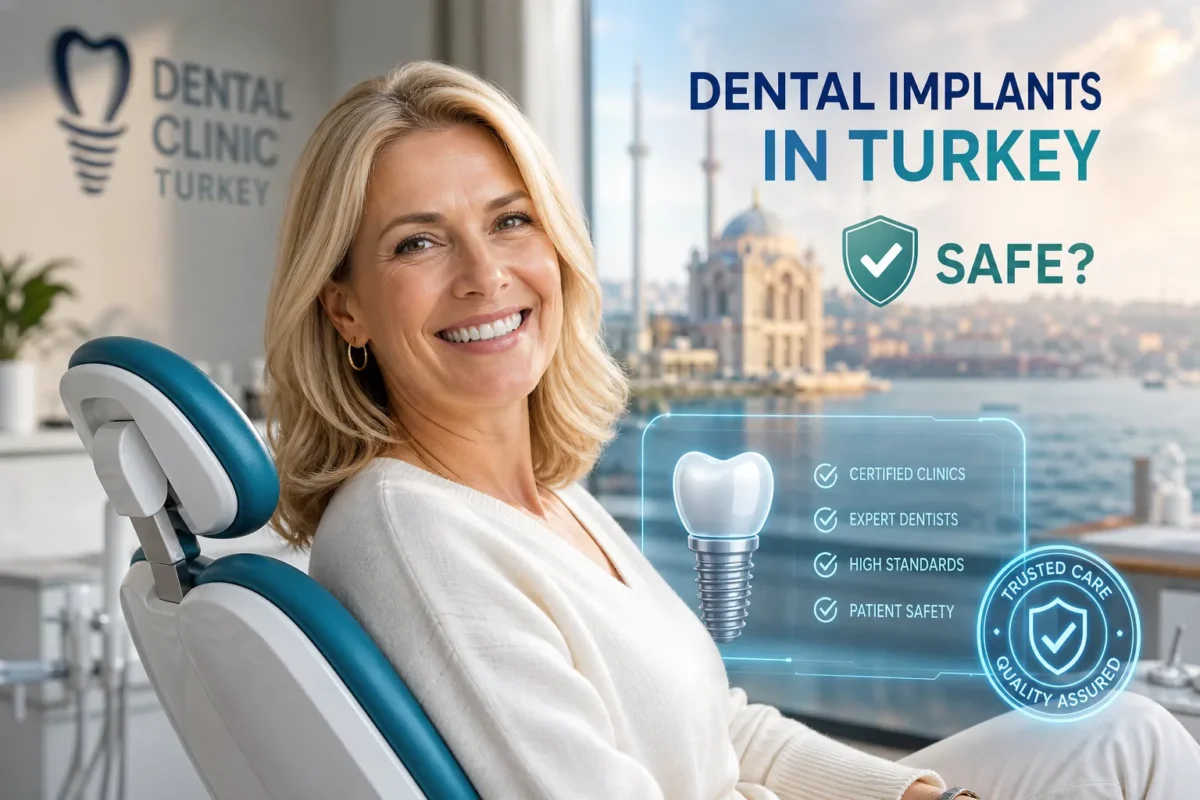
Dental implants in Turkey can be safe for UK patients when treatment is provided by a properly authorised clinic using documented implant systems, complete diagnostics and a clear aftercare plan. Safety cannot be judged by destination or price alone; surgeon credentials, imaging, sterilisation, case selection and support after returning home all matter.
Is Turkey a safe place to get dental implants? It is a question worth asking carefully, and the honest answer is: yes, if you choose the right clinic. A single dental implant in Turkey costs between £300 and £650 fully fitted, including the abutment and crown. The same treatment at a UK private practice starts at £2,400 and frequently runs higher. That gap is why a significant number of British patients fly to Istanbul every year, and it is exactly why the question deserves a thorough, evidence-based answer rather than a blanket reassurance.
The answer depends entirely on which clinic you walk into, which implant brand goes into your jaw, and who is performing the surgery. Turkey has world-class facilities that produce outcomes comparable to the best UK private practices in published outcome studies. It also has high-volume operations that cut corners on implant brands, skip diagnostic imaging, and leave patients with complications they cannot easily resolve back home. Both exist, and they are not always easy to tell apart from a website.
This guide gives you a clear framework to make that judgement. It draws on peer-reviewed outcome data, certification standards, implant brand specifications, and the practical realities of aftercare once you are back in the UK. Where relevant, it uses Dt. Çağrı Altuntaş Dental Clinic in Nişantaşı, Istanbul, as a concrete reference point for what a credible operation actually looks like. The goal is to help you make this decision with clear eyes, not to sell you a trip.
Is Turkey a safe place to get dental implants? What the clinical data says
Most people assume Turkey produces worse results because prices are lower. The peer-reviewed evidence does not support that assumption, at least not at credentialled clinics.
A systematic review covering 4,487 implants placed in Turkey found a mean survival rate of 97.48% over a follow-up period of roughly 43 months. Failures broke down as follows: lack of osseointegration accounted for 44.4% of failures, infection for 38.9%, implant fractures for 5.8%, and peri-implantitis for 1.76%. Those numbers sit comfortably within the ranges published by premium UK private practices, not outside them.
Published five-year survival rates at properly credentialled Turkish clinics fall between 92% and 98%, the same band as UK private treatment. The research is clear on what drives outcomes: surgeon experience, implant brand quality, and post-operative follow-up protocol. Geography does not appear as a significant variable. A skilled surgeon using a Nobel Biocare implant in Istanbul produces statistically similar results to the same surgeon using the same implant in London.
The complications that dominate news coverage are almost always traceable to high-volume, low-cost operations that use unbranded implant systems, skip bone grafting assessments, and process patients at a pace that precludes proper diagnostic workup. Those clinics exist. The risk is real. But conflating them with Turkey’s entire dental sector is like avoiding all UK dentists because of one struck-off practitioner. The issue is clinic selection, not country of origin.
Evidence and survival rates: what peer-reviewed studies show
The 97.48% mean survival rate cited above comes from peer-reviewed research on Turkish implant placement specifically. Long-term follow-up data from Straumann and Nobel Biocare, the most widely studied premium systems, shows 10-year success rates of 95, 98% regardless of country of placement. These figures are drawn from published clinical studies, not manufacturer marketing materials. When evaluating any clinic’s claims, ask which implant system they use and whether peer-reviewed outcome data exists for that specific brand.
The certifications that separate safe clinics from the rest
Credentials are not decoration. For international patients, they are the only independent verification that a clinic meets enforceable standards, because you cannot walk through the door in advance and inspect the sterilisation room yourself.
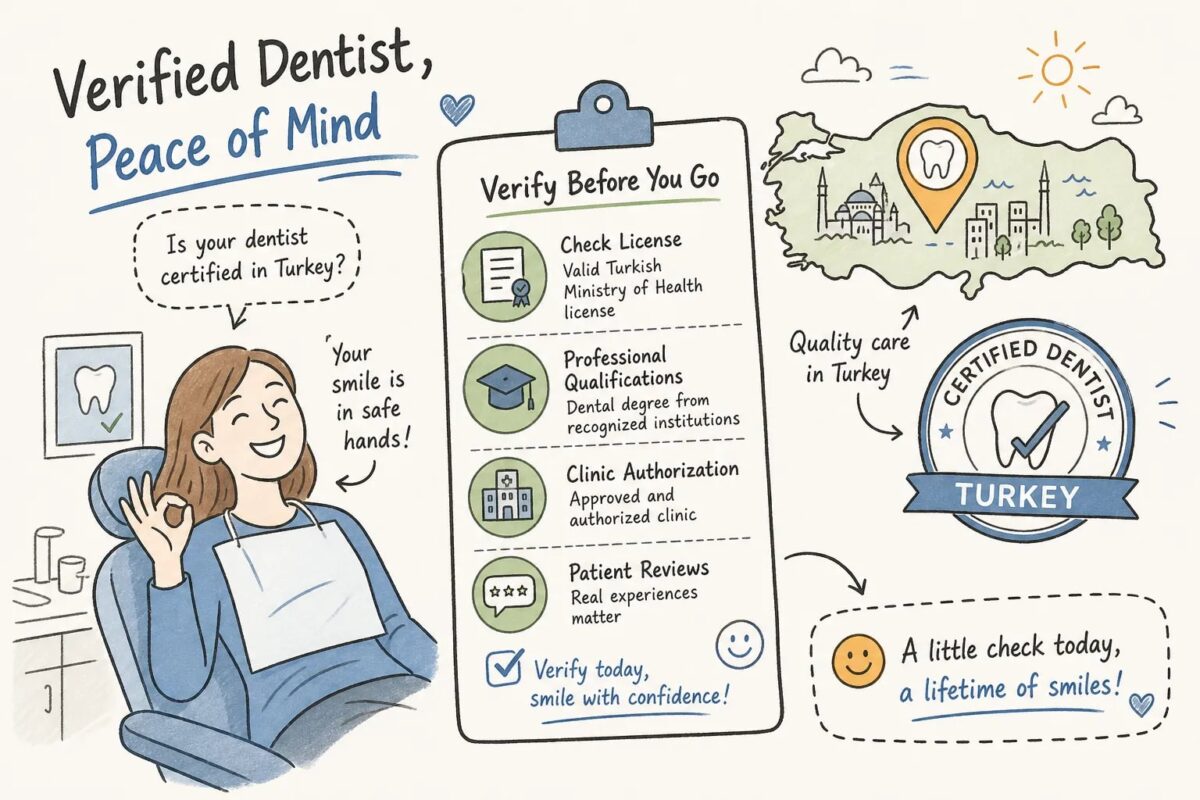
Health Turkey is an official certification programme run under the Turkish Ministry of Health for clinics serving international patients. A certified clinic has passed audits covering sterilisation protocols, facility hygiene, patient rights procedures, staff qualification records, and documented complication management pathways. It is the baseline minimum you should require before booking any treatment in Turkey. If a clinic cannot point you to its Health Turkey status on the official Ministry platform, that is a clear signal to look elsewhere.
Only licensed, government-approved institutions appear on that platform. If a clinic is not listed, it is not legally permitted to treat international patients, that alone should end the conversation.
Joint Commission International (JCI) accreditation is the global gold standard for healthcare quality and patient safety. It covers clinical governance, infection control, and patient safety goals across the entire facility. ISO 9001 (quality management systems) and ISO 15189 (medical laboratory competence) provide additional technical validation that JCI does not fully cover on its own. A clinic holding JCI accreditation alongside Health Turkey certification has passed two independent international audits, a combination that carries real weight when you are making a decision from a distance.
Every dental clinic operating legally in Turkey must hold national registration with the Turkish Ministry of Health. This is not optional. Always verify the clinic appears on the ministry’s registered provider list before engaging. It does not guarantee excellence, but its absence guarantees a red flag. The same principle applies to local dental chamber registration and a verified licence from the Turkish Dental Association.
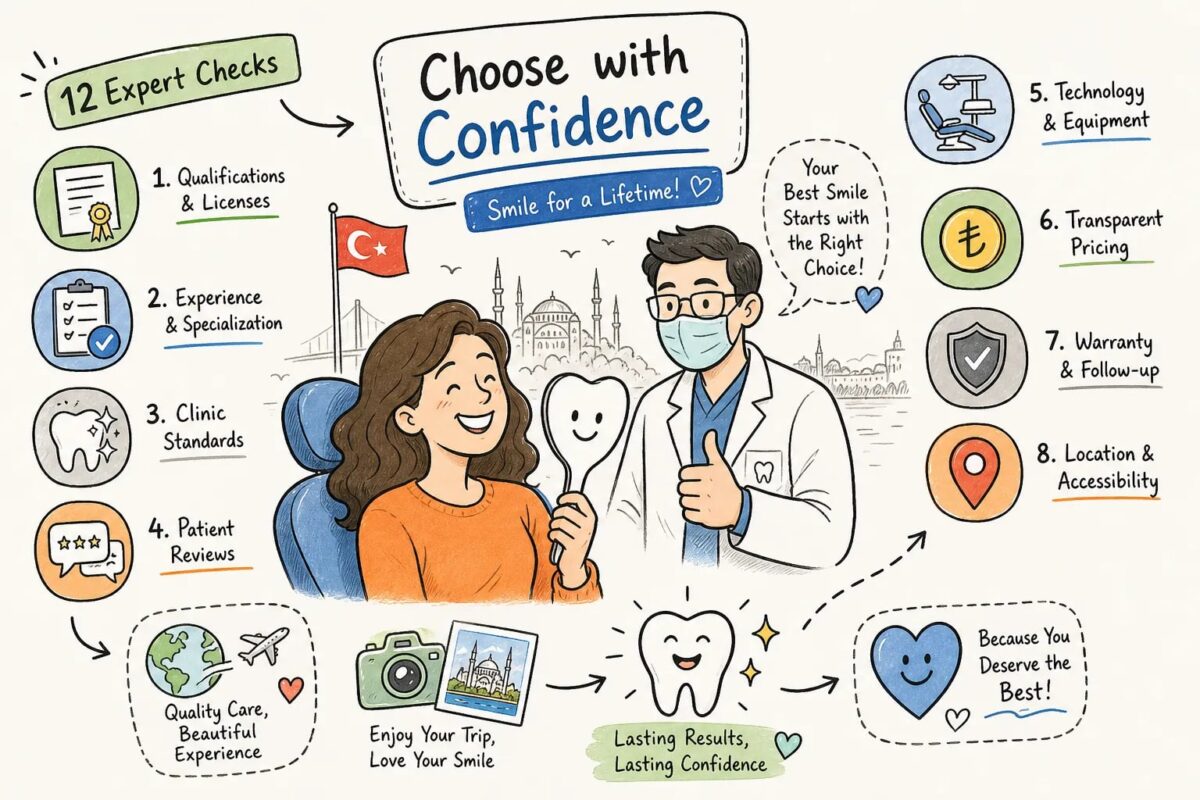
Dental tourism Turkey: a clinic selection checklist
- Confirmed Health Turkey certification, verifiable on the Ministry of Health platform
- JCI accreditation or equivalent international quality standard
- Turkish Ministry of Health registration and Turkish Dental Association licence
- Named surgeon with documented specialist qualifications
- CBCT (3D cone beam) scanning as standard diagnostic procedure
- Written treatment plan specifying implant brand, model, diameter, and length
- Documented aftercare protocol for international patients
- Globally available implant brand with compatible components in the UK
Implant brands matter as much as the surgeon
You can have an excellent surgeon place a poorly manufactured implant and face complications within three years. Brand selection is not a minor detail. It is a clinical decision with decade-long consequences.
The major international brands used at credible Turkish clinics include Straumann (Switzerland), Nobel Biocare (Switzerland/Sweden), Dentsply Sirona (USA/Germany), Zimmer Biomet (USA), Osstem/Hiossen (South Korea/USA), and MegaGen (South Korea). All carry CE marking and FDA approval. The Turkish brand DTI holds both CE certification and FDA approval as well. Premium systems from Straumann and Nobel Biocare show 10-year success rates of 95, 98% in published research, regardless of the country of placement. These are not inflated marketing figures; they come from peer-reviewed long-term follow-up studies.
There is a practical problem that most patients never consider until it affects them directly: the parts problem. Many lower-tier Turkish implant brands do not export their components, including the small screws and abutment drivers needed for repairs or crown replacements. If your UK dentist cannot source compatible parts, your only option is to fly back to Turkey for every adjustment. Always ask the clinic to confirm the implant brand and verify it is available globally before you agree to treatment. If you do not get a clear, documented answer, that is a dealbreaker, not a negotiating point.
Request the full implant system reference in writing before you commit: brand name, model, diameter, and length. A reputable clinic will provide this without hesitation as part of your treatment plan documentation. A clinic that hedges, delays, or gives vague answers about which system they plan to use is telling you something important about how they operate.
How to read a surgeon’s credentials before you book
Most patients spend more time researching hotels than they do vetting the person about to place a titanium post into their jawbone. That imbalance is worth correcting before you book flights.
A general dentist in Turkey can legally place implants. A specialist with a Master’s degree or postgraduate diploma in oral surgery and implantology has completed additional years of surgical training on top of their dental qualification. Those are not equivalent skill sets, particularly for complex cases involving bone grafting, sinus lifts, or multiple simultaneous implant placements. For anything beyond a straightforward single implant in a patient with adequate bone volume, specialist training is not a nice-to-have. It is the relevant qualification.
As a concrete benchmark: Dr. Çağrı Altuntaş of Dt. Çağrı Altuntaş Dental Clinic in Nişantaşı, Istanbul, holds a Master’s degree in Oral Surgery and Implantology from Saint Camillus International University of Health Sciences in Italy, completed through formal European postgraduate study rather than a short-course certificate. He has over 15 years of clinical experience, and the clinic operates under Health Turkey certification with 3D CBCT scanning and intraoral digital planning as standard. That combination of verified overseas academic training, domestic Health Turkey approval, and a long clinical record is the credential profile you are looking for when evaluating any clinic abroad.
Cross-reference any surgeon’s claimed qualifications with the issuing university directly where possible. Check whether the clinic is registered with the Turkish Dental Association. Look for consistent before-and-after case documentation across a range of implant cases, including complex ones, not just the five best-looking results selected for a homepage gallery.
What a legitimate consultation looks like before you commit
The consultation process itself tells you a great deal about how a clinic operates. Many patient-advice organisations recommend against paying any deposit before a thorough clinical assessment has been completed and a written treatment plan provided, if a clinic pushes for payment upfront without that process, treat it as a warning sign.
A proper implant assessment includes full dental X-rays or a CBCT scan (cone beam computed tomography) to evaluate bone volume, bone density, and the position of nerves and sinuses. Clinics using intraoral scanners and 3D digital planning are working to a higher diagnostic standard than those relying on traditional impressions and basic X-rays. These tools reduce surgical uncertainty, improve the accuracy of the final prosthetic fit, and generate documentation you can share with a UK clinician later.
There are specific questions worth asking directly: Which implant brand will you use, and what is the full component reference? What does your sterilisation protocol involve? What is your documented approach to managing complications for international patients after they return home? Will you provide a written aftercare plan I can share with my UK dentist? A clinic that gives you clear, detailed answers is not hiding anything. One that deflects, rushes, or steers you toward immediate booking before those questions are answered is showing you exactly how it operates.
The real cost breakdown for UK patients
The savings are genuine. But the honest total cost is slightly different from the headline figures advertised on clinic websites, and it is worth working through the numbers properly before you decide.
A single titanium implant with abutment and crown in Istanbul costs roughly £300, £650, compared to £2,400 or more at a UK private clinic. Full-mouth restoration using All-on-4 or All-on-6 systems for both arches runs approximately £2,800, £12,000 in Turkey depending on prosthetic material, against £25,000, £40,000 in the UK. Even at the premium end of Turkish pricing with top-tier brands, the savings on full-mouth work run to five figures.
Return flights from major UK airports to Istanbul typically cost £100, £250. Most reputable clinics include hotel accommodation and airport transfers within a treatment package, adding roughly £200, £400 in bundled value. Factor in £150, £300 per visit if you need a UK dentist for routine follow-up, and add a realistic contingency for potential complications. Even with all of that accounted for, patients treating multiple implants or undergoing full-mouth restoration are typically saving £10,000 or more versus equivalent UK private treatment.
The one cost patients consistently underestimate is peri-implantitis treatment back in the UK. Non-surgical therapy at a London specialist starts at around £550, £600. Regenerative surgery, which involves bone grafting for advanced cases, starts at £850 and rises with the materials required. Complex cases with significant bone loss can exceed £4,000 per implant. If a complication develops after you return home and the Turkish clinic is unreachable or the implant brand is incompatible with UK equipment, that bill lands entirely with you. This is not an argument against going to Turkey. It is an argument for choosing a clinic that gives you thorough documentation, a recognised implant brand, and a clear aftercare protocol before you fly.
What to prepare before and after your treatment
Preparation on both ends of the trip is where most complications are either prevented or managed effectively. Arriving without the right documentation puts your UK dentist at a significant disadvantage if anything goes wrong.
Before you fly home from Istanbul, obtain the following in writing: a copy of your full treatment records, the implant brand and component reference numbers, baseline post-operative X-rays, written aftercare instructions, the clinic’s direct contact details, and a documented protocol for what to do if you experience symptoms after returning to the UK. Do not leave without these. A clinic that resists providing them is a clinic that may not be reachable when you need them.
Book a post-treatment review with a UK dentist or implant specialist before you travel to Turkey. Brief them on your treatment plan so they are prepared to monitor your healing and manage any issues that arise. Share your implant component reference with them so they can verify parts availability in the UK in advance. Do this before you travel, not after you return, it takes fifteen minutes and eliminates the most common logistical problem UK dental tourists encounter: a UK dentist who cannot identify the implant system and has to start diagnostic work from scratch.
What to do if dental implant complications arise back in the UK
Complications happen even with excellent surgery and recognised implant brands. Knowing the clinical and legal pathway in advance reduces both the anxiety and the financial damage when they do.
Fever, facial swelling, pus discharge, a loose implant, difficulty swallowing, or persistent severe pain are all signs that require same-day dental or medical attention. Do not wait to see if symptoms settle. Early-stage peri-implantitis responds well to non-surgical treatment; advanced peri-implantitis may require surgical implant removal and bone reconstruction, which is significantly more expensive and involved.
UK dentists can manage most implant complications if you arrive with complete documentation and a recognised implant brand. Without those, they face additional diagnostic work, new X-rays, brand identification, which adds cost and delays treatment. In the worst cases, incompatible implant components force the entire restoration to be removed and redone. The NHS provides a useful checklist for patients who have received dental treatment abroad, and the General Dental Council publishes guidance titled ‘Going Abroad for Your Dental Care’ which outlines what to expect from UK practitioners managing overseas complications.
On the legal side, all UK dental clinics must register with the Care Quality Commission. The CQC regulates only providers operating within England and has no jurisdiction over treatment performed in Turkey. If a Turkish clinic caused harm through negligence and you want to pursue a claim, you will generally need to do so through Turkish civil courts or via a specialist medical travel solicitor in the UK. Travel insurance may cover emergency dental treatment abroad, but it rarely covers elective follow-up care for planned dental tourism. Check your policy before you travel, not after. Document everything throughout your treatment, from the initial consultation through to your final post-operative check.
Making the decision: is Turkey a safe place to get dental implants?
Turkey is a safe place to get dental implants if you walk into the right clinic. The peer-reviewed data supports that conclusion for credentialled facilities with experienced surgeons, recognised implant brands, and proper diagnostic protocols. The risk is not the country. It is the clinic, the implant brand, and the aftercare plan.
The standard you are looking for is a surgeon with verifiable specialist training, a Health Turkey-certified facility with documented sterilisation and complication management protocols, CE-marked implants from a globally supported brand, CBCT diagnostic imaging as part of the consultation, and a written aftercare protocol you can share with your UK dentist. Dt. Çağrı Altuntaş Dental Clinic in Nişantaşı meets that standard, as do a number of other serious providers across Istanbul and beyond.
Your job as a patient is to verify it before you commit, not assume it because the website looks professional or the price is low. Use the framework in this guide. Ask the hard questions before any deposit changes hands. Get the documentation before you board the return flight. Then make the decision with full information, not just the headline price.
Frequently asked questions
Is Turkey a safe place to get dental implants for UK patients?
Yes, provided you choose a Health Turkey-certified clinic with a qualified implant specialist and a globally recognised implant brand. The peer-reviewed survival rates at credentialled Turkish clinics are comparable to UK private treatment. The risk lies in clinic selection, not in the country itself.
What certifications should a Turkish dental clinic have?
At minimum, Health Turkey certification from the Turkish Ministry of Health, Turkish Dental Association registration, and Ministry of Health registration. JCI accreditation provides an additional layer of internationally recognised quality assurance.
What implant brands are safe to use in Turkey?
Straumann, Nobel Biocare, Dentsply Sirona, Zimmer Biomet, Osstem/Hiossen, MegaGen, and DTI all carry CE marking and FDA approval. Ask for the full component reference in writing before committing to treatment.
What happens if I have a dental implant complication after returning to the UK?
Seek same-day dental attention for symptoms such as swelling, fever, pus, or a loose implant. UK dentists can manage most complications with proper documentation and a recognised implant brand. Consult the GDC’s guidance ‘Going Abroad for Your Dental Care’ for further information on your options.
How much do dental implants in Turkey cost compared to the UK?
A single implant with abutment and crown costs approximately £300, £650 in Istanbul versus £2,400 or more at a UK private clinic. Full-mouth restoration runs £2,800, £12,000 in Turkey compared to £25,000, £40,000 in the UK. Always factor in travel, accommodation, follow-up visits, and a contingency for complications when calculating the true cost.