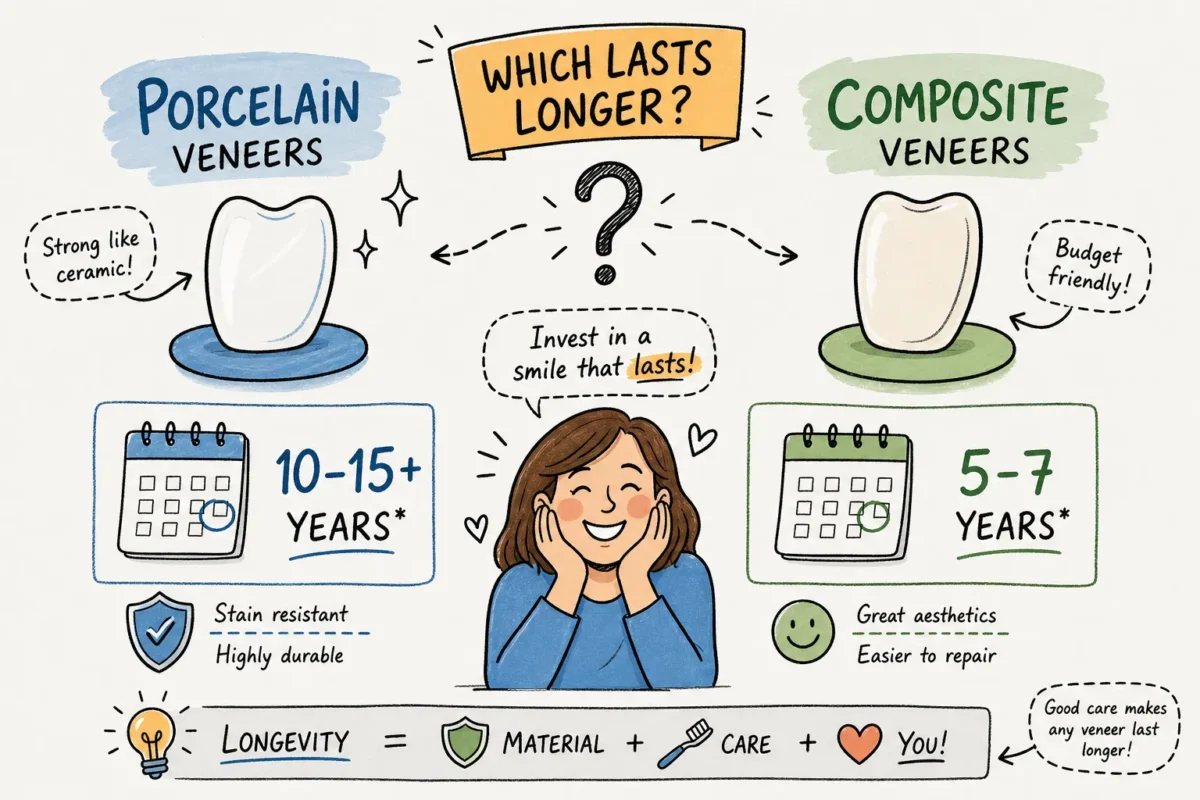
Porcelain veneers usually provide greater colour stability and longer clinical service than direct composite, while composite is easier to repair and may be more conservative for small corrections. Zirconia can offer additional masking and strength in selected situations. The longest-lasting option is the one matched to enamel, bite, tooth position and maintenance—not simply the strongest material.
Which type of veneer lasts the longest is the question every patient should ask before sitting in the dental chair, yet many patients prioritise aesthetics over longevity when they first come in for a consultation. The smarter question is which veneer will still be intact in fifteen years. Those are not always the same answer, and the difference between them can cost thousands of pounds in replacements over a lifetime.
The three materials worth comparing are porcelain, composite, and zirconia. They age differently, fail for different reasons, and suit different patients. A composite veneer that chips in year eight is not necessarily a failure of your dentist’s skill; in many cases, it is a predictable outcome of the material’s biology. Understanding that before you sit in the chair changes everything about how you choose.
At Dr. Çağrı Altuntaş Dental Clinic in Istanbul, international patients are guided to consider longevity alongside aesthetics from the very first consultation, because the material decision made at the outset is what separates a ten-year result from a twenty-year one. This article covers the clinical lifespan data for each material, the factors that accelerate failure, and the aftercare habits that genuinely protect your investment.
Why the material you choose now shapes the next two decades
The difference between a veneer lasting 7 years and 20 years
Veneer longevity is not random. Survival rates at five, ten, and twenty years differ dramatically by material, and those differences compound over a lifetime of dental spend. A composite veneer at year ten has roughly a 66% survival rate. A well-bonded porcelain veneer at the same point sits above 90%. That gap is not marginal, it means many composite patients will require at least one replacement within fifteen years, while a porcelain patient may not need to return at all within that same window.
The financial implication matters, but so does the clinical one. Each replacement cycle involves preparation work, temporary veneers, and a period of adjustment. Choosing the longer-lasting material from the start means fewer interventions, less time in the chair, and less cumulative stress on the underlying tooth structure. For anyone weighing up which type of veneer lasts the longest, this compounding effect is worth factoring into the initial decision.
Why “reversible” and “long-lasting” are often in conflict
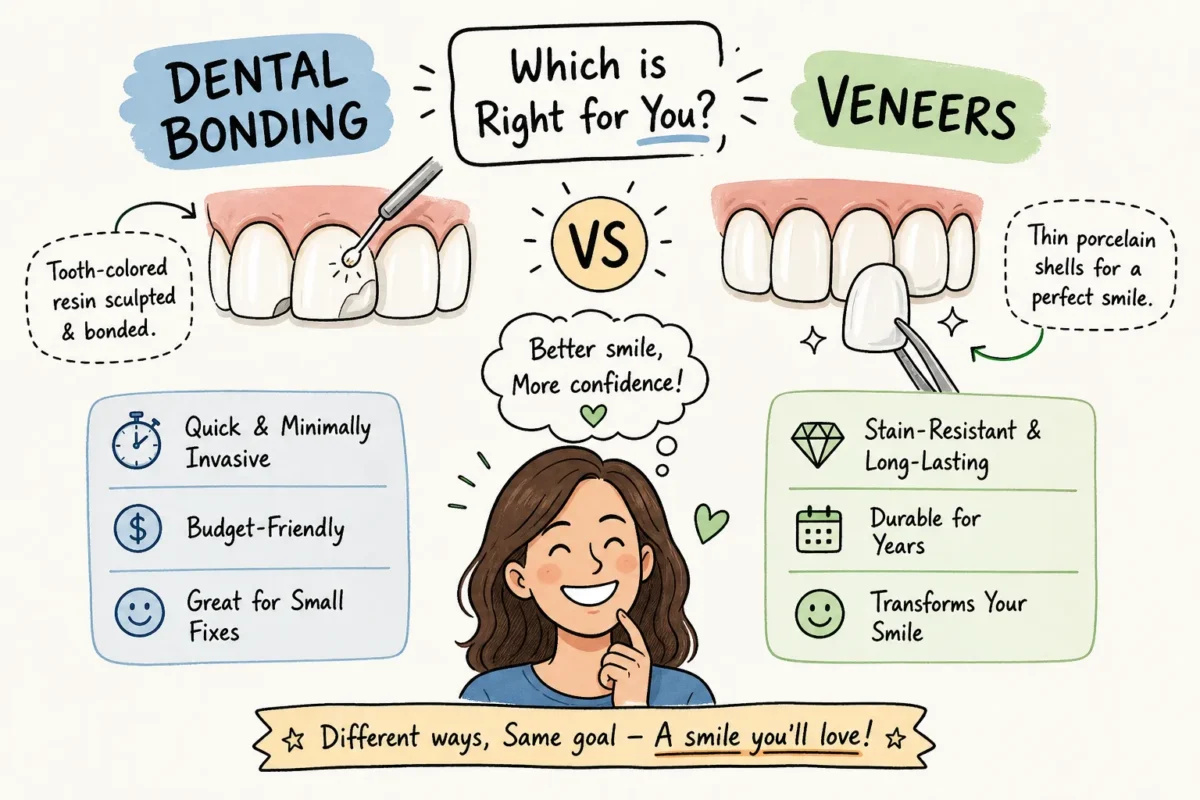
Patients often choose composite because it requires less tooth reduction and feels like a safer, more conservative option. This reasoning is sound up to a point, but repairability and durability are different properties, and it is worth keeping them separate. Composite can be repaired chairside if it chips; porcelain cannot. But porcelain is far less likely to chip in the first place. The central trade-off running through this entire comparison is this: composite offers flexibility and reversibility, while porcelain offers longevity and stability. Neither is universally superior. The right choice depends on your teeth, your habits, and your timeline.
Porcelain veneer lifespan: what the clinical data actually shows
Survival rates at 5, 10, and 20 years
The peer-reviewed evidence on porcelain is extensive and consistently strong. Porcelain veneers achieve 95, 100% survival at five years, 90, 96% at ten years, and 73, 91% at twenty years. Feldspathic porcelain bonded entirely to enamel showed approximately 96% survival at twenty-one years in landmark clinical studies. These are not manufacturer claims; they are findings from independent clinical trials with real patients followed over real decades.
More about our porcelain veneer techniques is available on our porcelain veneers page.
Failure tends to cluster in two windows: the first five years, when bonding and adjustment issues surface, and after fifteen years, when material fatigue begins. The five-to-fifteen-year window is the most stable period for well-placed porcelain. For most patients, that middle decade passes with no intervention at all.
Feldspathic porcelain vs lithium disilicate: which holds up better
Two porcelain types dominate clinical use, and they perform differently. Lithium disilicate showed 97% survival at five years and 94% at ten years, making it the stronger performer in durability studies. Feldspathic porcelain is more translucent and mimics natural enamel’s light behaviour more convincingly, but it is slightly more fragile under high bite loads. At Dr. Çağrı Altuntaş Dental Clinic, material selection is based on each patient’s bite load and aesthetic demands rather than defaulting to one type across all cases.
Technical information on lithium disilicate (e.max) can be found in our E-Max veneer guide.
For patients who prioritise the most natural-looking result and have a relaxed bite, feldspathic is often the better aesthetic choice. For patients with stronger bite forces or any history of grinding, lithium disilicate provides an extra margin of structural safety.
Why bonding to enamel is the single biggest longevity variable
The surface a veneer bonds to matters as much as the veneer material itself. Bonding to prepared enamel produces survival rates close to 96% at twenty-one years. Bonding to exposed dentin increases the risk of intervention by a hazard ratio of 10.6. That is not a small difference; it is the distinction between a veneer that lasts and one that debonds within years.
Preparation design is therefore a longevity decision, not just an aesthetic one. Large pre-existing composite restorations reduce the enamel surface available for bonding, which directly increases debonding risk. When evaluating clinics, asking about their approach to enamel preservation and bonding protocol is more revealing than asking about the brand of ceramic they use.
Composite veneer longevity: the honest numbers
What a 10-year survival rate of 66% actually means
Composite veneers average five to ten years in clinical practice, with a ten-year survival rate of approximately 66% and an annual failure rate of 3.9, 4.1%. Ceramic veneers show 89% survival over the same period. In practical terms, if you have ten composite veneers placed today, roughly three to four of them will need replacement or significant repair within a decade. Over fifteen years, most patients will have replaced their composite veneers at least once, and many will have done so twice.
This is not a reason to dismiss composite entirely, but it is a reason to go in with accurate expectations rather than optimistic ones. The lower upfront cost of composite veneers looks different once you account for the lifetime replacement cost.
Where composite genuinely makes sense
Composite is not the wrong choice in every scenario. It is well-suited to younger patients whose bite or jaw is still developing, because the conservative preparation preserves more tooth structure for future treatment options. It also works as a trial period, patients who want to see the shape and size of a new smile before committing to porcelain can use composite as a diagnostic step, then transition to porcelain once they are confident in the result. For cases where minimal tooth preparation is a clinical priority, composite provides a reasonable medium-term solution. The key is matching the material to the patient’s actual situation, not choosing it by default because it sounds less invasive.
The one real advantage: repairability
Unlike porcelain, composite can be repaired chairside. A chipped composite veneer can be bonded with resin at a cost of £95, £400 per tooth in the UK (figures vary by region and case complexity). A chipped porcelain veneer must be replaced entirely, typically at £500, £1,200 per tooth. For patients who grind their teeth, play contact sports, or have habits that put veneers at risk, this repairability has genuine practical value. A sport-related chip that would write off a porcelain veneer is a straightforward fifteen-minute fix in composite.
Zirconia veneers: when strength outranks everything else
Clinical strength and why zirconia rarely fractures
Zirconia is the toughest material used in modern dentistry. Its flexural strength significantly exceeds both porcelain and composite, making it the preferred material for patients with heavy bites, bruxism managed with a nightguard, or posterior teeth bearing high occlusal loads. In implant-supported restorations, zirconia is already the clinical default for this reason. Long-term veneer-specific survival studies for zirconia are less extensive than the porcelain data, but short-to-medium term clinical performance is strong, with minimal fracture reported across case series.
For patients who have been told their bite is aggressive, or who have cracked previous restorations, zirconia deserves serious consideration. The structural margin it provides over ceramic is substantial, and for the right patient, that margin is the difference between a restoration that survives and one that does not.
The aesthetic trade-off most patients don’t expect
Zirconia is more opaque than feldspathic porcelain. It does not transmit light the way natural enamel does, which means it can appear visibly different from adjacent natural teeth when used for veneers rather than full crowns. For patients who prioritise natural translucency and have mostly healthy adjacent teeth, this is a genuine limitation. For patients who want maximum structural durability above all other considerations, it is a worthwhile trade-off. The discussion about which way to go belongs in a pre-treatment consultation, informed by a look at the actual teeth, not a general preference stated before the dentist has assessed your bite.
No-prep veneers and Lumineers: do ultra-thin options hold up?
Survival data that contradicts conventional wisdom
The assumption that removing less tooth structure means weaker results turns out to be wrong in well-executed cases. No-prep and minimally invasive porcelain veneers outperformed traditional preparation in one comparative study: 100% survival at nine years for no-prep, versus 96.7% for conventional preparation. Custom ultra-thin veneers at 0.3, 0.5 mm achieved 91% success over ten years. The data suggests that minimal preparation, when carefully matched to the patient’s anatomy, does not compromise longevity and may reduce the post-operative sensitivity that drives early failure.
The critical qualifier is precision of execution. No-prep veneers placed without careful bite analysis, or on patients with insufficient enamel for bonding, do not achieve these results. The technique is not universally applicable; it is a tool for specific clinical presentations.
Why Lumineers specifically produce inconsistent outcomes
Lumineers are a branded product with standardised fabrication, which limits the degree of customisation available for individual anatomy and bite mechanics. The manufacturer claims a twenty-year lifespan. Real-world clinician reports range from five to seven years at the lower end to eleven years with careful maintenance. The variability reflects the tension between standardised production and the highly individual nature of each patient’s bite, tooth shape, and enamel surface. A custom-crafted ultra-thin porcelain veneer made by a specialist to fit your specific anatomy consistently outperforms off-the-shelf branded options in durability, because it accounts for the variables that a standardised product cannot.
The factors that cut veneer lifespan short
Bruxism: the single biggest threat to any veneer
Untreated teeth grinding produces failure rates up to eight times higher than in patients who wear nightguards. This is the largest quantified risk factor across all material types. Bruxism generates micro-fractures that accumulate over months and years, eventually producing visible chips or full fractures, particularly in feldspathic porcelain and composite. The fracture risk is concentrated in the upper front teeth, with central incisors showing an odds ratio of 13.56 for fracture and lateral incisors at 10.43, reflecting how directly they absorb grinding forces.
For bruxers, a nightguard is not an optional extra; research consistently shows it has a substantial protective effect on veneer survival. Clinically, the difference between managed and unmanaged bruxism can mean years of additional veneer life. If you grind your teeth and your dentist has not discussed a nightguard as part of your treatment plan, that gap is worth addressing before any veneers are placed.
Bonding protocol, enamel loss, and dentin exposure
Clinical failure linked to bonding is almost always preventable. Veneers placed over more than 50% exposed dentin carry a hazard ratio of 10.6 for requiring intervention, whether recementation, endodontic treatment, or replacement. As this figure indicates, the bonding substrate is one of the most consequential variables in long-term outcomes. Large pre-existing composite restorations reduce the enamel surface available for bonding and directly increase debonding risk. Your dentist’s technique at the cementation stage also matters, contamination from saliva or sulcular fluid is a protocol issue, entirely preventable, not a shortcoming of the material itself. Meticulous bonding technique, supported by published evidence, can reduce debonding to under 2% at ten years.
Diet, habits, and the daily choices that add up
Biting into hard foods such as ice, crusty bread, or whole nuts generates impact forces that compound micro-damage over time. Using teeth to open packaging or bite nails adds stress the veneer was not designed to absorb. Acidic drinks erode the cement margin around veneers, particularly composite. Smokers face additional risk through gingival inflammation, which causes bleeding that compromises the bond at the margin. These factors are within the patient’s control, and their cumulative effect on veneer survival rate is measurable. None of them individually will destroy a veneer, but together over years they consistently separate the patients who reach twenty-year outcomes from those who return at eight.
Aftercare habits that genuinely extend veneer life
Daily maintenance that actually makes a difference
The basics remain the most effective: a soft-bristle brush, non-abrasive toothpaste, and daily interdental cleaning protect both the veneer surface and the margin where it meets the gum line. Some evidence suggests that alcohol-based mouthwashes can degrade composite resin over time, so these are worth avoiding or using sparingly if you have composite veneers. For porcelain, the veneer surface itself resists staining well, but the cement margin at the gum line can discolour after five years without consistent hygiene. Keeping that margin clean is the highest-return daily habit available to porcelain veneer patients.
What to ask your dentist at each check-up
Routine check-ups are an underused tool for veneer longevity. At each visit, ask your dentist to assess margin integrity, surface wear, and any early signs of debonding. These are visible clinically before they become symptomatic, which means early detection is genuinely possible. An annual bite assessment is worthwhile for anyone who has had veneers placed, particularly if grinding is a risk factor. A veneer that is beginning to loosen caught at a six-month check-up is a straightforward fix; the same veneer discovered after a year of progressive debonding is a more complex and costly problem.
Repair vs replacement: knowing the cost of waiting
A minor chip in composite caught early costs £95, £400 to repair. Left for months, it can extend into the underlying tooth structure, requiring a full replacement at £150, £500, or in severe cases, a crown at £1,500, £2,500. Porcelain cannot be repaired at all; prompt replacement at £500, £1,200 is the only clinical option. Across both materials, acting within days of noticing damage keeps both costs and clinical complexity low. Waiting to see if it gets worse is almost never the right call.
What to look for in a clinic if longevity is your priority
Digital planning and why it changes outcomes
A clinic that uses intraoral scanning and 3D smile planning can assess bite load, contact points, and veneer thickness before any preparation begins. This precision reduces the risk of early failure from misaligned occlusion or insufficient material thickness, both causes of premature fracture that skilled pre-treatment planning can eliminate. At Dr. Çağrı Altuntaş Dental Clinic in Istanbul, digital smile design is integrated into every veneer treatment as standard. For international patients, this pre-treatment precision supports a smoother process from the outset, which matters particularly when travelling from the UK.
Why a specialist’s training matters more than the clinic’s location
A cosmetic dentist with postgraduate training in restorative dentistry understands material selection, bonding protocols, and bite mechanics at a depth that general dentistry training does not fully cover. This expertise directly affects survival rates: the same ceramic material placed by two different clinicians with different levels of restorative training will produce measurably different long-term outcomes. Dr. Çağrı Altuntaş has postgraduate specialist training and extensive clinical experience in cosmetic and restorative dentistry, with credentials that are verifiable on request and directly relevant to the longevity outcomes discussed throughout this article.
How international patients approach this decision
British patients travelling abroad for veneers should look for Health Turkey certification or equivalent international accreditation, English-language consultation, and a documented digital treatment plan they can take home. Information is also available in German for some treatments; see our porcelain veneers (German) page. Significant cost differences compared to UK prices are possible when the clinic uses high-grade ceramic and has the clinical depth to support it, but patients should request itemised treatment plans and verify accreditation independently before committing. The relevant question is not whether a clinic abroad is as good as one at home; it is whether the specific dentist’s training, the material grade, and the bonding protocol meet the standards that the clinical data shows produce twenty-year outcomes.
Which type of veneer lasts the longest: the bottom line
If your primary concern is which type of veneer lasts the longest, porcelain, specifically lithium disilicate or high-grade feldspathic ceramic bonded to enamel, is the answer the clinical evidence consistently supports. Survival rates sit above 90% at ten years, and documented cases extend past twenty years. Composite veneer longevity is more limited, averaging five to ten years in practice, though it remains a reasonable short-to-medium term option where repairability matters or where a conservative approach is clinically indicated. Zirconia wins on structural strength for patients with heavy bites or bruxism but involves an aesthetic trade-off in translucency. No-prep porcelain, when custom-made and expertly placed, performs as well as traditional preparation and sometimes better.
Material choice alone does not determine the outcome. Bonding protocol, bite assessment, and daily maintenance determine whether a veneer reaches its potential lifespan or falls short years before it should. Before committing to any treatment, ask your dentist specifically about the material grade they are using, the percentage of enamel that will remain available for bonding, and how they assess and manage bruxism risk. These questions separate the clinicians who are thinking about your twenty-year outcome from those who are thinking about your appointment.
If you are considering veneers and want to understand your options with clinical precision, Dr. Çağrı Altuntaş Dental Clinic offers a smile analysis and personalised treatment consultation. For patients travelling from the UK, the combination of Health Turkey certification, digital planning technology, and Dr. Altuntaş’s specialist postgraduate training means the conversation starts at a level of detail that genuinely serves long-term outcomes. Get in touch to book your consultation and receive a treatment plan built around longevity, not just aesthetics.
Frequently Asked Questions
Which veneer material usually lasts the longest?
Well-bonded ceramic veneers generally have stronger long-term survival data than direct composite, but individual longevity varies with bite, enamel and care.
Can composite veneers be repaired?
Yes. Local chips and wear can often be repaired directly, which is one of composite’s practical advantages.
Do porcelain veneers stain?
Glazed ceramic is highly stain resistant, although surface damage, exposed margins and natural teeth can change appearance over time.
Is zirconia always stronger than E.max?
Zirconia has high fracture resistance, but strength alone does not determine suitability. Optical demands, bonding and restoration thickness also matter.
Does grinding shorten veneer lifespan?
Yes. Bruxism can increase chipping, debonding and wear risk for every veneer material. Bite management and a protective night guard may be recommended.
When should a veneer be repaired instead of replaced?
Small composite defects are often repairable. Ceramic repair depends on defect size, margin integrity, bonding and whether the underlying tooth is healthy.