Most people searching for invisible braces or clear braces have a cosmetic goal. They want whiter, more even teeth. They want a smile that looks different. The problem is that clear aligners are an orthodontic tool, designed to move teeth, not to change what those teeth look like. That distinction shapes everything: the timeline, the cost, and whether the treatment will actually deliver the result you are picturing.
Before committing to 12 months of wearing trays and spending upwards of £3,000, it is worth being clear about what you are actually trying to fix. Some people genuinely need their teeth moved. Others would be better served by veneers, a gum correction, or a digital smile design consultation that maps the whole picture before any treatment begins. The seven things below will help you work out which category you fall into.
1. Clear aligners fix alignment, not every smile problem
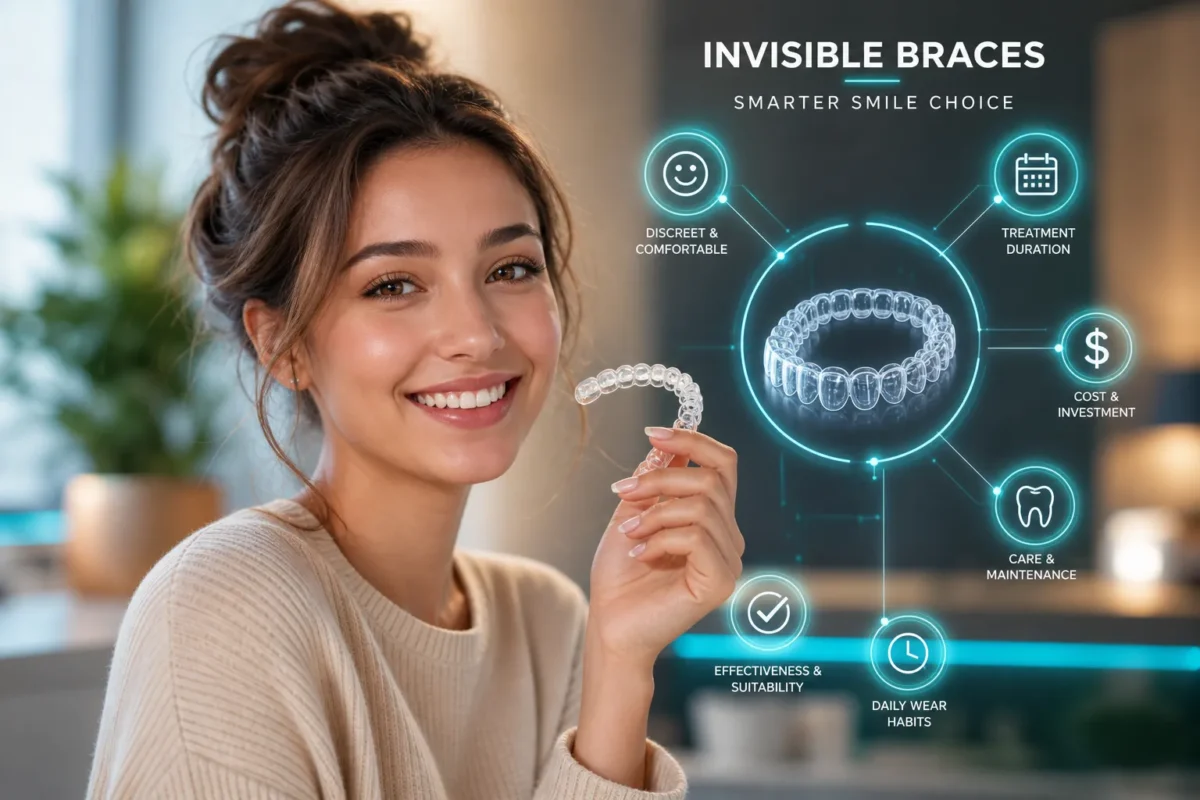
Invisible aligners are removable orthodontic trays worn for 22 hours a day. They work by applying gentle, progressive pressure through a series of custom-fitted trays, each moving teeth slightly further than the last. They are well-suited to mild and moderate crowding up to around 6 mm, gaps between teeth, minor rotations, and certain bite issues where the jaw itself is not the underlying cause. For these cases, the evidence base is solid and the outcomes are predictable.
Where aligner therapy hits a hard limit is with severe rotations, significant bite corrections with skeletal causes, large gaps requiring extraction closure, and complex molar movements. In these situations, fixed braces apply stronger and more continuous force, giving the clinician far greater mechanical control. No amount of brand-switching changes this. It is a physics problem, not a product problem.
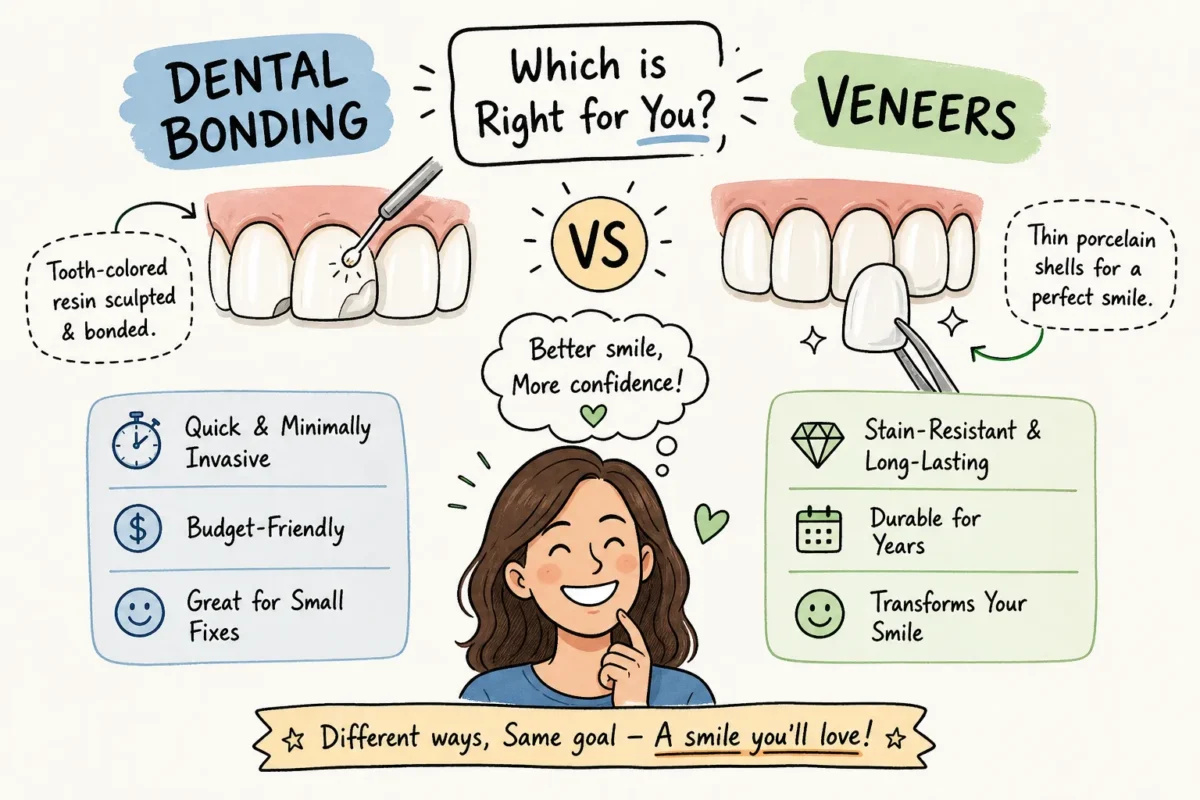
The cases most patients do not realise aligners will not solve are the cosmetic ones. Discolouration, chips, cracks, short teeth, uneven tooth shape, and gum line asymmetry are concerns that orthodontics simply cannot address. If these are the issues driving your search, choosing invisible braces will move your teeth whilst leaving the cosmetic problem completely untouched. That is where the conversation shifts, and where a lot of people waste significant time and money by not asking the right question at the start.
2. When veneers do the job better, and faster
Porcelain veneers are thin ceramic shells bonded to the front surface of teeth. They correct deep discolouration that whitening cannot shift, reshape chipped or worn teeth, close minor gaps, and create a uniform, natural-looking smile without any tooth movement at all. For patients whose primary concern is the colour, shape, or texture of their teeth rather than how they are aligned, veneers typically resolve the issue in two to four appointments rather than 12 to 18 months of aligner therapy.
The timeline difference is significant. A full veneer treatment from consultation to final placement is generally completed within two to four weeks. Clear aligner therapy for a comparable aesthetic outcome, assuming alignment is genuinely the issue, takes 9 to 18 months depending on case complexity. If your underlying teeth are acceptably aligned, choosing aligners first adds cost and the better part of a year before your smile looks meaningfully different.
There are situations where alignment should come before veneers. Severely crowded teeth or significant bite issues can place excessive force on veneers and shorten their lifespan considerably. A qualified cosmetic dentist will identify this during assessment. The point is not that veneers always win, but that the choice depends on a proper diagnosis, not a default assumption that braces are always the first step in any smile improvement.
3. What digital smile design actually is and why it changes your decision
Digital smile design is a process where a clinician uses intraoral scanning, high-resolution photography, and 3D planning software to map out what your final smile will look like before any treatment begins. You see the expected outcome modelled on your own face, your own lip line, your own proportions. This matters because it forces clarity: you and the clinician agree on the goal before committing to a treatment path, and the technology reveals whether that goal is achievable with aligners, veneers, or a combination of both.
For patients with both alignment concerns and cosmetic concerns, digital smile design often reveals that a combined approach, or sometimes veneers alone, achieves the visual outcome more efficiently than months of orthodontics. A patient who believes they need 14 months of clear orthodontics to fix mild crowding, may discover during a 3D smile analysis that four to six veneers would achieve the same visual result in three weeks. Many UK high-street consultations simply do not offer this level of digital planning, whether due to time constraints or a lack of the relevant technology.
At Dt. Çağrı Altuntaş Dental Clinic in Istanbul, Dr Altuntaş offers a free smile analysis using advanced intraoral scanning technology. Patients receive a clear picture of which option, removable aligners, porcelain veneers, or a full smile design programme, is the right route before spending a single pound on treatment. For patients who have spent months assuming they need invisible braces, this conversation often changes everything.
4. What invisible braces realistically cost in the UK in 2026
UK clear aligner costs in 2026 range from around £1,500 for minor front-tooth adjustments using short-course programmes, up to £6,000 or more for comprehensive full-arch treatment. The realistic average for a standard adult cosmetic case sits between £2,800 and £4,500, with the median Invisalign cost across UK practices sitting at approximately £3,244. London clinics charge at the upper end of that range; regional providers are generally cheaper, though not dramatically so.
What is often excluded from the quoted price is worth knowing upfront. The headline figure frequently omits initial records such as X-rays and digital scans, refinement sets if your teeth do not track as planned, and retainers after treatment ends. Retainers are not optional: without them, teeth shift back within months. Budget for at least £150 to £300 for retainers as an illustrative estimate, though prices vary by clinic and type, and factor this into the true cost of invisible braces treatment from the outset.
The comparison to alternatives abroad is worth understanding before you commit. Porcelain veneers at a high-quality clinic in Istanbul cost a fraction of UK prices, often less than a single arch of UK-priced aligner treatment. A single porcelain veneer in Turkey averages around £200 to £300, compared to £900 to £1,200 in the UK, a difference of roughly £700 to £900 per tooth. For patients whose concern is cosmetic rather than structural, this comparison is directly relevant to the decision.
5. The NHS funding reality for clear orthodontics
The NHS does not fund clear aligner treatment for adults. This is not a grey area or a matter of finding the right dentist. Invisible braces are generally not funded by the NHS for adults and are typically considered elective rather than clinically necessary, adult orthodontics falls outside NHS provision regardless of how significant the misalignment is. If you are an adult researching NHS-funded removable braces, that route does not exist.
Children and young people under 18 may qualify for NHS orthodontic treatment if their case meets the Index of Orthodontic Treatment Need threshold, specifically a Dental Health Component grade of 4 or 5. Even then, NHS orthodontics means traditional fixed metal braces. The NHS Band 3 charge for orthodontic treatment in England from April 2026 is £332.10 for those who do not qualify for free treatment. Clear braces, removable aligners, and cosmetic orthodontic options are simply not part of that provision.
The practical implication for every adult reading this is that you are self-funding. That makes genuine treatment comparisons between providers, brands, and countries a legitimate and sensible part of the decision-making process. Understanding the cost gap between UK private dentistry and internationally certified clinics in countries like Turkey is not a shortcut. For many patients, it is the most financially rational thing they can do.
6. How long invisible braces treatment actually takes
Mild front-tooth crowding or minor gaps treated with a limited programme typically resolve in three to six months using 7 to 14 aligners changed weekly. Full-arch moderate crowding or bite correction with a comprehensive programme runs 9 to 18 months on average, with 20 to 50 or more aligners. Most UK adults completing a standard cosmetic case finish somewhere between 9 and 12 months, with regular check-ups every 6 to 8 weeks throughout.
Poor wear compliance is the most common cause of extended treatment and the most avoidable. Aligners must be worn for 22 hours per day. Missing hours accumulates quickly and throws off the planned staging, which is the sequence of movements designed to bring your teeth into their final positions. Refinement rounds, additional aligner sets issued when teeth do not move exactly as expected, are common and typically add several weeks to a few months to the overall timeline. Factor these in from the start rather than treating the initial estimate as a guarantee.
Night-time aligners, worn for around 10 hours during sleep, are marketed as a more convenient alternative. Treatment time is substantially longer than standard 22-hour protocols for equivalent cases, and they are suitable only for very mild corrections. They are not a like-for-like alternative to full aligner therapy and should not be chosen primarily for convenience if the case genuinely requires full treatment. The trade-off between comfort and outcome is real.
7. How to find out which option is actually right for your teeth
Many patients arrive at a clear aligner consultation having already decided they want invisible braces. The appointment then confirms that decision rather than questioning it. A genuine smile assessment starts from the patient’s goal, maps the clinical reality of the teeth, and then works backwards to the most efficient treatment path. That sequence makes a significant difference to both the outcome and the total cost.
A credible assessment should include digital scans or clinical-quality photographs, an examination of alignment and bite, an evaluation of tooth colour, shape, and gum line, and a frank conversation about timelines and alternatives. As a matter of good clinical practice, a dentist should present at least two treatment paths and explain the reasoning behind their recommendation. If the only option offered is the product the clinic happens to sell most of, seek a second opinion. A dentist who offers only aligners will see every case as an aligner case.
The questions worth asking in any consultation are straightforward:
- Is my concern structural (the position of my teeth) or cosmetic (the appearance of my teeth)?
- Would veneers or smile design achieve the same visual result in less time?
- What does the outcome actually look like on my face, not on a generic diagram?
For UK patients weighing up removable aligners against veneers or a full smile makeover, a free professional assessment is the logical first step. Dr Altuntaş reviews each case individually using digital smile design technology to show patients exactly what each route would achieve, whether that is clear orthodontics, porcelain veneers, or a combined programme. Many patients who book expecting to confirm a braces plan leave with a different, faster, and more cost-effective solution they had not previously considered.
The honest conclusion
Clear aligners are a genuinely effective treatment for the right cases. The right case means measurable alignment problems: crowding, gaps, bite issues with dental rather than skeletal causes. They are not the right answer for discolouration, chips, gum asymmetry, or worn teeth. Choosing them for cosmetic dissatisfaction rather than genuine misalignment is an expensive mistake that takes over a year to recognise.
Before committing to invisible braces, and the 12 months and several thousand pounds that come with them, establish clearly what you are actually trying to fix. Veneers address cosmetic concerns in roughly two to four weeks. Digital smile design shows you the outcome before treatment starts. And an honest assessment from a clinician who is not simply selling you what they already planned to prescribe is the only reliable way to know which path is right for your specific teeth and your specific goal.
That conversation, the one that starts from your goal rather than a product catalogue, is where the real decision gets made. If you have not had it yet, that is where to start.