If you’re searching for a Health Turkey certified dentist, you already know the core problem: every dental clinic targeting American patients looks legitimate online. The website is polished, the before-and-after photos are impressive, and the badge wall features logos that sound authoritative. Buried somewhere in the footer or the “About Us” page, there’s a line that reads “internationally certified” or “approved by the Ministry of Health.” You have no way to tell, from the website alone, whether any of that is real.
The good clinics and the questionable ones are presented with equal confidence. The credential claims look identical. And most Americans don’t know which Turkish government agency actually issues these approvals, let alone how to verify one.
This guide fixes that. By the time you finish reading, you’ll know exactly which documents prove a clinic is legally authorized to treat international patients, how to verify a dentist’s license with the Turkish Dental Association, where to find the official government directory, and what to do when something doesn’t add up. Worth noting upfront: even in Istanbul’s upscale Nişantaşı district, where clinics like Dt. Çağrı Altuntaş Dental Clinic operate under formal government authorization, the verification steps in this guide still apply. The credential has to be checked, not assumed.
What Health Turkey certification actually means
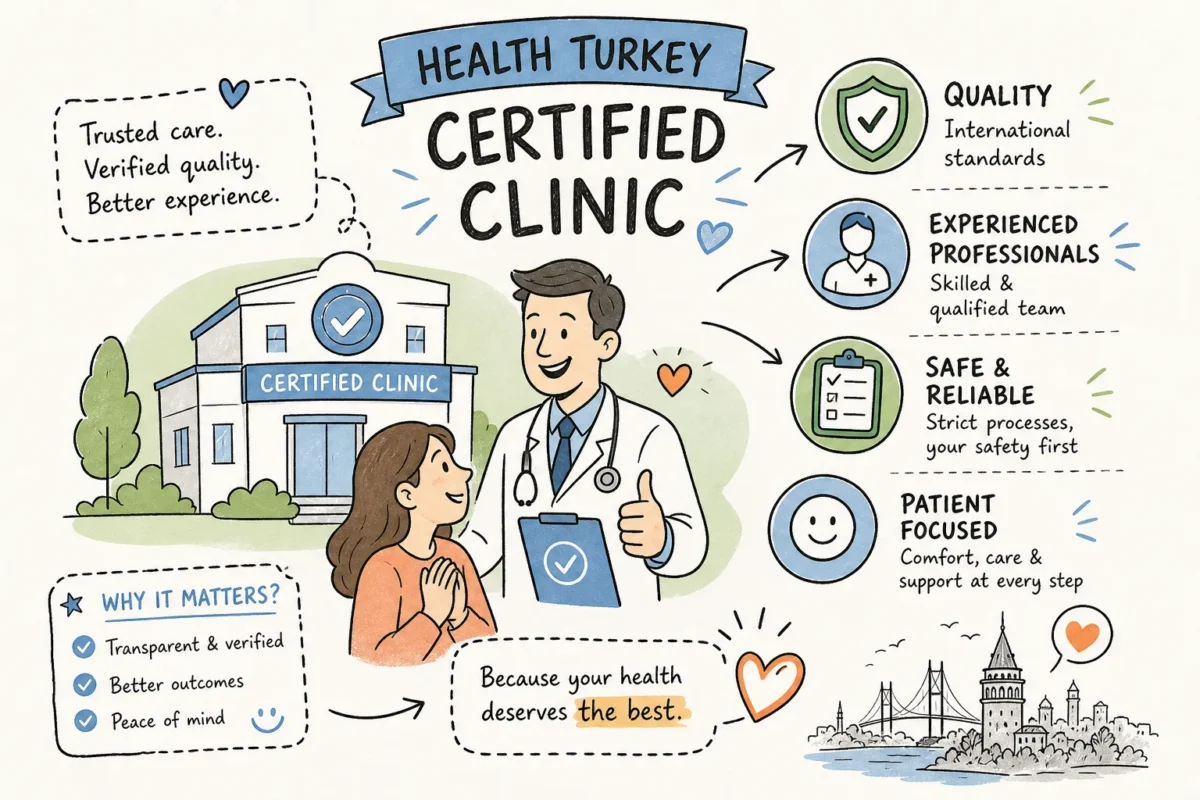
Most people assume “Health Turkey certified” is a marketing label a clinic applies to itself. It isn’t. The certification refers to Turkey’s International Health Tourism Authorization, a government-issued permit from the Turkish Ministry of Health that legally allows a clinic to treat and actively market to international patients. Without this authorization, a clinic is not legally qualified to solicit foreign patients, regardless of the quality of its work.
The government body behind the certification
The authorization is administered by the Turkish Ministry of Health’s Health Tourism Department. Clinics apply through an official platform called EKIP, submit required documentation to the Provincial Health Directorate, undergo document review, and pass an on-site inspection before the certificate is issued. This is not a self-registration system. A government inspector visits the facility.
What a clinic must prove to earn authorization
To receive authorization, a clinic must hold a valid operating license, meet the Ministry’s infrastructure requirements for international patient services, employ at least one foreign-language-speaking staff member, and maintain a communication channel for international patients. The clinic must also pass the on-site inspection. Applications with uncorrected deficiencies are rejected within 30 business days.
Why this matters more than a generic “internationally certified” claim
A clinic can display ISO logos, print “internationally certified” on every page, and still be operating without the government authorization specifically required for foreign patient care. The Health Tourism Authorization is a distinct, verifiable credential, it’s the one that actually matters for you as an American patient, and it’s the one that needs to be confirmed directly, not taken on faith.
How to verify a Health Turkey certified dentist using the official directory
The single most direct verification step is looking up a clinic on the official Health Türkiye portal, the Turkish government’s central platform for international health services, maintained by the Ministry of Health. Most American patients don’t know this directory exists. It should be your first check, not an afterthought.
Where to find the official provider list
Go to the official Health Türkiye website, navigate to the provider list or certified healthcare providers section, and search by the clinic’s name, city, or treatment category. For dental care, filter by the dental or oral health category and confirm the clinic appears as an authorized provider. The provider lists published there represent official Ministry of Health authorization status.
What a legitimate listing should show
A real Health Türkiye listing will show the clinic’s exact legal name, city, and treatment authorization category. These details should match what the clinic tells you precisely. If the names are even slightly different, clarify before booking. Some clinics operate under a parent company name that differs from the brand name on their website, which can create confusion during verification.
Why you should verify right before booking, not during research
Authorization status can change. A clinic listed when you first researched it six months ago may have had its authorization lapse or come under review. Verify the listing on the live official directory immediately before you commit to booking. And do not accept a screenshot from the clinic as proof. Check the directory yourself, in real time.
Ministry of Health documents that prove a clinic is legally operating
The Health Türkiye directory is your first check. The physical documents behind it are your second. A legitimate clinic should be able to produce three key documents without hesitation.
The operating license and compliance certificate (Uygunluk Belgesi)
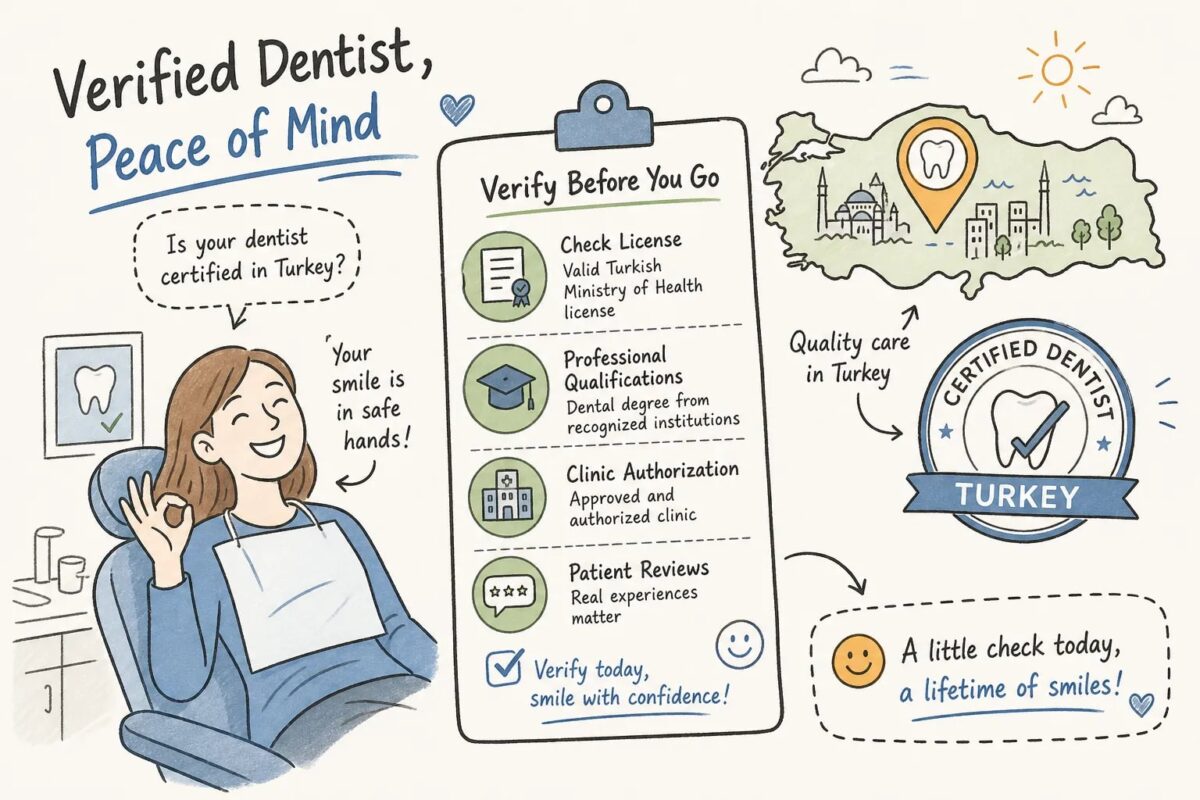
Every legally operating dental clinic in Turkey holds a facility license issued by the Ministry of Health or the relevant Provincial Health Directorate. Alongside this, private oral and dental clinics are issued a Uygunluk Belgesi, a Conformity or Compliance Certificate, confirming the facility passed inspection. These are the baseline documents that prove a clinic is legally allowed to operate in Turkey at all. Without them, nothing else matters.
The International Health Tourism Authorization Certificate explained
This is the document that specifically qualifies a clinic to serve American patients. It’s a separate certificate from the operating license, issued after the Ministry of Health confirms the clinic meets the additional infrastructure and staffing requirements for international patient care. Ask to see this certificate by name. A clinic operating in the dental tourism space without this document is doing so outside its legal authorization.
Documents a Health Turkey certified dentist’s clinic must show
There’s no need to make this uncomfortable. A straightforward message works: “Could you share a copy of your Ministry of Health facility license and your International Health Tourism Authorization Certificate? We’d like to confirm these before booking.” A clinic that responds promptly and sends the actual documents is telling you something positive. One that deflects, says “we’re certified, trust us,” or sends a marketing brochure instead of the real paperwork is telling you something else entirely.
Verifying your dentist’s license through the Turkish Dental Association
The clinic’s authorization covers the facility. The dentist’s license is a completely separate check, and it matters just as much. Every practicing dentist in Turkey must be registered with the Turkish Dental Association, known by its Turkish acronym TDB.
What TDB registration means for a practicing dentist
TDB registration confirms that a dentist is a licensed, practicing member of the national dental profession. It’s the baseline credential for any Turkish dentist. Without it, a person is not legally qualified to practice dentistry in Turkey. The TDB also tracks chamber membership, diploma status, and any disciplinary history associated with a registration.
How to request and cross-check a dentist’s credentials
Ask the clinic for the dentist’s full legal name exactly as it appears on official records, plus their TDB registration number. Then contact TDB directly to confirm. The Turkish Dental Association can be reached at [email protected] or +90 312 435 93 94. Since TDB’s member registry is primarily an internal system rather than a public search tool, direct confirmation from TDB is more reliable than searching a public-facing database. For extra certainty, the local dental chamber in the clinic’s city can also confirm a dentist’s standing independently.
Why specialty claims need a closer look
General TDB registration confirms a dentist is licensed. It doesn’t confirm specialty credentials. If a dentist is being presented as an oral surgeon, implantologist, or cosmetic dentistry specialist, that claim requires documented postgraduate training, not just years of practice in that area. Ask for the specific postgraduate degree or residency documentation and verify the institution independently. A dentist with a master’s degree in oral surgery from a recognized European or Turkish university is demonstrably different from a general dentist who has performed a high volume of implants.
International accreditations decoded: ISO, JCI, and TEMOS
Most clinic websites display five or six certification logos without explaining what any of them actually measure. Here’s a direct breakdown so you know what you’re looking at.
What ISO certification covers (and what it doesn’t)
ISO 9001 is a quality management system standard. It means the clinic has documented processes for consistency, complaint handling, corrective actions, and continuous improvement. That’s useful. What ISO 9001 does not certify is clinical skill or patient safety in the clinical sense. It covers how the system is organized, not whether the dentist is exceptional. ISO 27001 covers data security. ISO 10002 covers customer complaint handling. These are worth noting, but none of them tell you whether the clinical work will be done well.
Why JCI is the accreditation worth looking for
Joint Commission International accreditation is the strongest signal of broad patient safety standards. JCI covers patient identification protocols, infection prevention and control, medication safety, staff qualifications, emergency readiness, and documented treatment processes. It requires an in-depth external audit and ongoing compliance. For a dental clinic to hold JCI accreditation, it has demonstrated clinical and operational standards that go well beyond organized paperwork. It’s the accreditation that carries the most weight from a patient safety perspective.
TEMOS and other medical tourism standards: what they signal
TEMOS is an accreditation designed specifically for medical tourism contexts. It focuses on patient safety, communication quality, and care processes for international patients. If a clinic holds TEMOS accreditation, it has been evaluated on the standards most relevant to a foreign patient’s experience. This is a meaningful credential in the dental tourism space, and it pairs well with the government-issued Health Tourism Authorization. Treat JCI and TEMOS as stronger signals. Treat ISO alone as useful context, but not sufficient on its own.
What legal protections you have if something goes wrong
This is the section most people skip when they’re excited about booking. It’s also the section that matters most if a complication occurs after you’ve returned home. International patients treated at Ministry of Health licensed clinics in Turkey have the same core patient rights as Turkish nationals, including the right to information, informed consent, access to medical records, and the right to file a formal complaint. Turkish law explicitly prohibits nationality-based discrimination in patient rights.
The ALO 184 hotline and how to use it from abroad
The Turkish Ministry of Health operates a hotline at ALO 184, which is listed as offering English-language support for international patients. If you experience a problem after treatment at a licensed facility, this hotline is a direct channel to the Ministry. Your first step is always to document everything: get copies of your records, X-rays, consent forms, and any written treatment plans before you leave the clinic, regardless of how the treatment went.
Embassy support and legal resources available in Istanbul
The U.S. Embassy and consulates in Turkey can help you navigate the local system if a serious problem arises. The Istanbul Bar Association provides access to legal advice and translation support for foreign nationals. Foreign patients have the same right to pursue legal action through Turkish courts as Turkish citizens.
The complication insurance requirement: what to ask your clinic
According to clinic communications, since April 2025, clinics serving international patients are required to carry complication insurance for surgical procedures. This would create a formal remediation mechanism for post-surgical problems. Verify this directly with your clinic before your appointment. Ask explicitly whether they carry complication insurance for surgical procedures and request written confirmation. This information comes from clinic sources rather than published government regulations, so direct confirmation is essential before you rely on it as a protection.
Red flags that signal a clinic to avoid
Most red flags aren’t dramatic. They’re quiet. And they usually appear during the verification process, not after it.
Credential evasion: what it looks like and why it matters
A clinic that can’t or won’t provide a TDB registration number is a serious warning sign. A clinic that doesn’t appear in the Health Türkiye directory, or appears under a name that doesn’t match what they’ve told you, warrants clarification before you proceed. These aren’t bureaucratic technicalities. They’re the basic documentation that any legitimately operating clinic should have ready access to. Defensiveness around standard credential questions is itself diagnostic.
Pricing, pressure tactics, and documentation red flags
Watch for clinics that give vague price ranges with pressure to pay deposits before you’ve received any formal documentation. A legitimate clinic will provide a written treatment plan with itemized costs, material specifications, and the treating dentist’s name before asking for any financial commitment. Before-and-after photos presented without any patient consent details, or “celebrity patient” claims with no verifiable source, are also worth noting. Strong marketing without verifiable substance is a pattern worth taking seriously.
What a properly certified clinic actually looks like in practice
After working through all of these checks, it’s worth anchoring what a complete, credentialed clinic looks like when all the boxes are checked.
The credential stack that signals a trustworthy provider
A fully vetted dental clinic serving international patients holds a Ministry of Health operating license, a valid International Health Tourism Authorization Certificate, and a dentist registered with TDB with documented specialty credentials. Ideally, the clinic also holds an international accreditation such as JCI or TEMOS. Every document should be available without prompting, and every credential should hold up to independent verification. That’s the complete picture.
Dt. Çağrı Altuntaş Dental Clinic as a real-world benchmark
Dt. Çağrı Altuntaş Dental Clinic in Istanbul’s Nişantaşı district is an example of what this credential stack looks like in practice. The clinic holds Health Turkey certification for international patient services. Dr. Altuntaş holds TDB registration and completed postgraduate training in oral surgery and implantology at Saint Camillus University in Italy, documented specialty credentials that go beyond general practice claims. The clinic uses digital smile design and intraoral scanning technology, maintains a dedicated international patient support team, and operates under Health Turkey-certified international standards. This is what passing each of the checks in this guide actually looks like when applied to a real clinic.
Your five-step pre-booking verification checklist
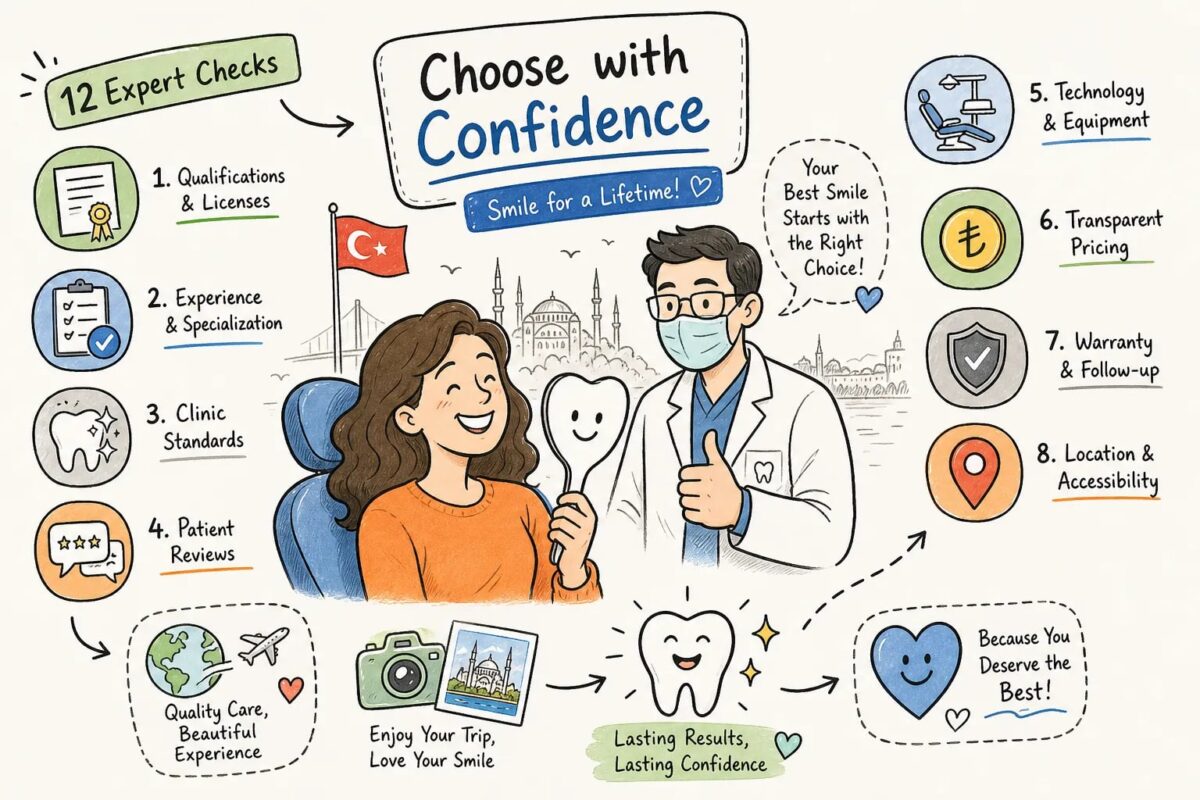
Before you commit to any clinic, run through these five checks in order:
- Confirm the clinic appears in the official Health Türkiye provider directory under its exact legal name and dental treatment category.
- Request and review the International Health Tourism Authorization Certificate and Ministry of Health facility license directly from the clinic.
- Verify the treating dentist’s TDB registration by contacting TDB directly with the dentist’s full legal name and registration number.
- Confirm specialty credentials with documented postgraduate training for any specialty claimed, and verify the institution independently.
- Ask about complication insurance for surgical procedures and get written confirmation before signing any consent or paying a deposit.
Five checks. Each one takes a few minutes. Together, they give you a reliable picture of whether a clinic is what it says it is.
Verification is simpler than it looks
Once you know where to look, confirming that you’ve found a legitimate Health Turkey certified dentist is not complicated. The Health Türkiye directory is publicly accessible. TDB can be contacted directly by email or phone. The Ministry of Health documents should be available from any clinic that actually has them. The system exists. You just have to use it.
Before you book, confirm your Health Turkey certified dentist using the five checks above. The clinics worth trusting are the ones that make this process easy, they don’t hesitate when you ask for a TDB number, they send documents without being pushed, and they treat credential verification as a normal step, because for them it is.
Do the five checks. Trust what you find. Choose accordingly. The information is there; the only question is whether you use it before you book rather than after you’ve returned home.
Frequently Asked Questions
What does Health Turkey authorisation confirm?
It indicates that a provider is authorised within Turkey’s international health-tourism framework; it does not replace checking the treating dentist and treatment plan.
Where should I verify a clinic’s status?
Use the current official HealthTürkiye or Ministry of Health directory and match the legal clinic name and address rather than relying on a website badge.
Does certification guarantee a perfect outcome?
No. Certification is an important legal and operational signal, but outcomes also depend on diagnosis, clinician skill, materials, case selection and maintenance.
Should I ask for the dentist’s registration details?
Yes. Verify who will perform each stage and request professional registration and relevant education details.
What if a clinic avoids sending documents?
Credential evasion, mismatched business names and pressure to pay before documentation are reasons to pause and investigate further.