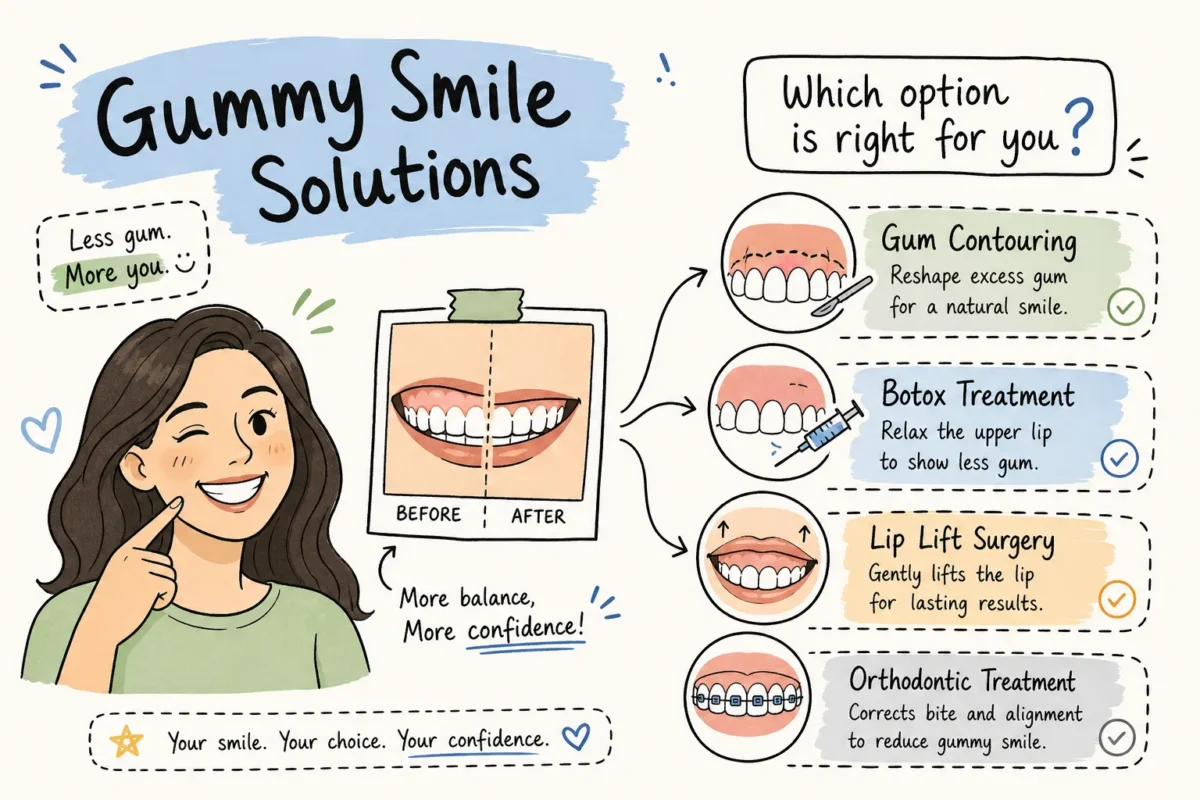
The best gummy-smile treatment depends on its cause. Excess gum tissue may respond to contouring or crown lengthening; a hyperactive upper lip may require a different approach; skeletal causes can need specialist surgical assessment. Aesthetic treatment should follow examination of lip movement, tooth proportions, gum health and bone position.
If you’re wondering what is the best treatment for a gummy smile, you’re not alone, and you’re asking exactly the right question. Showing a few extra millimetres of gum when you smile is one of the most common cosmetic dental concerns people will ever face, yet it remains one of the most misunderstood. The internet is full of before-and-after photos, quick-fix promises, and conflicting advice that leaves people either over-treating a mild case or ignoring a structural problem that genuinely needs surgical correction. The reality is simpler and more reassuring: every gummy smile has a specific cause, and every cause has a matched treatment that works well when applied correctly.
Many people assume they need surgery when a single injection would produce excellent results. Others spend years repeating temporary fixes when the underlying anatomy demands something more permanent. This guide cuts through both extremes. By the end, you’ll be able to identify the most likely cause of your excessive gum display, compare the realistic pros, cons, permanence and costs of each treatment route, and walk into any consultation with the right questions ready. What’s worth knowing upfront is that the best clinics in this space, including the team at Dt. Çağrı Altuntaş Dental Clinic in Istanbul, never recommend a treatment before establishing the cause. The same visible gummy smile can have five completely different origins, and the treatment that works brilliantly for one will fail completely for another.
What a gummy smile actually is (and why cause matters more than appearance)
The clinical term for what most people call a gummy smile is excessive gingival display (EGD). It is defined as showing more than 3 to 4 mm of gum tissue above the upper front teeth when smiling naturally. Roughly 10% of young adults are affected, with women experiencing it at twice the rate of men. Knowing this matters, because it means you are dealing with a well-documented condition with a clear evidence base behind its treatments.
The six causes behind excessive gum display
A hyperactive upper lip is the single most significant driver of excessive gingival display, according to research published in clinical periodontology literature. In this case, the muscles responsible for raising the upper lip contract too forcefully, lifting it higher than the aesthetic norm when smiling. Vertical maxillary excess (VME) is a skeletal cause: the upper jaw has grown downward or forward, pushing gum tissue into the smile line regardless of what the lips are doing.
Gingival hypertrophy refers to genuinely enlarged gum tissue, which can arise from genetics, hormonal changes during puberty or pregnancy, poor oral hygiene, or as a side effect of certain medications. The three most commonly implicated drug classes in clinical practice are calcium channel blockers, cyclosporine, and anticonvulsants. Altered passive eruption occurs when the gums fail to recede normally as teeth emerge, leaving teeth that appear short and stubby with a disproportionately large band of gum above them. Short or worn teeth and tooth misalignment round out the six main causes, both of which shift the gum-to-tooth ratio without any problem in the gum tissue itself. If you’re more concerned about shrinking or receding gums rather than excess tissue, see Gum Recession Treatment in Nişantaşı for related management information.
Why your cause determines your treatment
This is the central principle that most online content misses entirely: no single gummy smile treatment works for every patient. Attempting to correct vertical maxillary excess with Botox will produce a modest, temporary reduction at best. Treating altered passive eruption with lip repositioning surgery addresses the wrong anatomy entirely. The treatment ladder runs from temporary and non-invasive through to permanent and surgical, and where you sit on it depends on diagnosis, not on how many millimetres of gum you’re showing.
What is the best treatment for a gummy smile? Start with your severity
Severity classifications in clinical practice are not universally standardised, but most specialists work with three informal bands. A mild case involves 3 to 4 mm of visible gum; moderate runs from 4 to 6 mm; and severe is anything above 6 mm. These ranges guide initial treatment conversations but are not diagnostic in isolation. A display of over 8 mm is frequently the threshold at which a hyperactive upper lip is the dominant cause, making it a particularly useful rough reference point.
A simple way to get a rough measurement at home
Take a front-facing photo with your phone showing your most natural, relaxed smile. Measure the gap between your gum line and the edge of your upper lip, then compare it to the visible height of your front teeth for proportional context. This is a starting point for conversation, not a diagnosis. The measurement you get at home will not account for bone structure, lip thickness, or tooth length, all of which a professional smile analysis will assess accurately. Use it to frame your first consultation question, not to self-prescribe a treatment.
Botox for a gummy smile: the fast, reversible route
Botulinum toxin A works by limiting the upward movement of the upper lip when smiling. Small, precise doses are injected into the levator labii superioris alaeque nasi muscle on each side of the face, typically at the Yonsei point or along the nasolabial fold. The procedure takes a matter of minutes, requires no anaesthetic, and produces no downtime. Full effect becomes visible within 10 to 14 days.
What the clinical evidence shows
Clinical studies report an average reduction of 2.48 to 3.27 mm of visible gum tissue, with a 70 to 71% reduction in gingival display for mild to moderate cases. Botox is most effective for gummy smiles up to 4 to 5 mm in display. Results last 3 to 6 months, requiring approximately three maintenance sessions per year. The treatment is considered off-label by regulatory bodies but carries a strong safety record and is widely used in specialist dental and aesthetic practice.
The most commonly reported side effect is temporary asymmetry, which resolves as the product wears off. Starting doses are typically conservative, around 2 units per side, with a review at two weeks before any adjustment. The maximum recommended total dose for gummy smile correction sits at 10 units, so this is genuinely a minimal intervention.
Who it suits and who it doesn’t
Botox is the logical starting point for mild to moderate cases where a hyperactive lip is the confirmed cause. It allows you to test the visual outcome of a reduced gum display before committing to anything permanent, which is a significant advantage for patients who aren’t sure how much correction they want. It is not appropriate for severe skeletal issues such as VME, nor for significant gingival hypertrophy. If your gum display is driven by bone position or excess tissue rather than muscle activity, read on.
Gum contouring and gingivectomy: reshaping the gum line for good
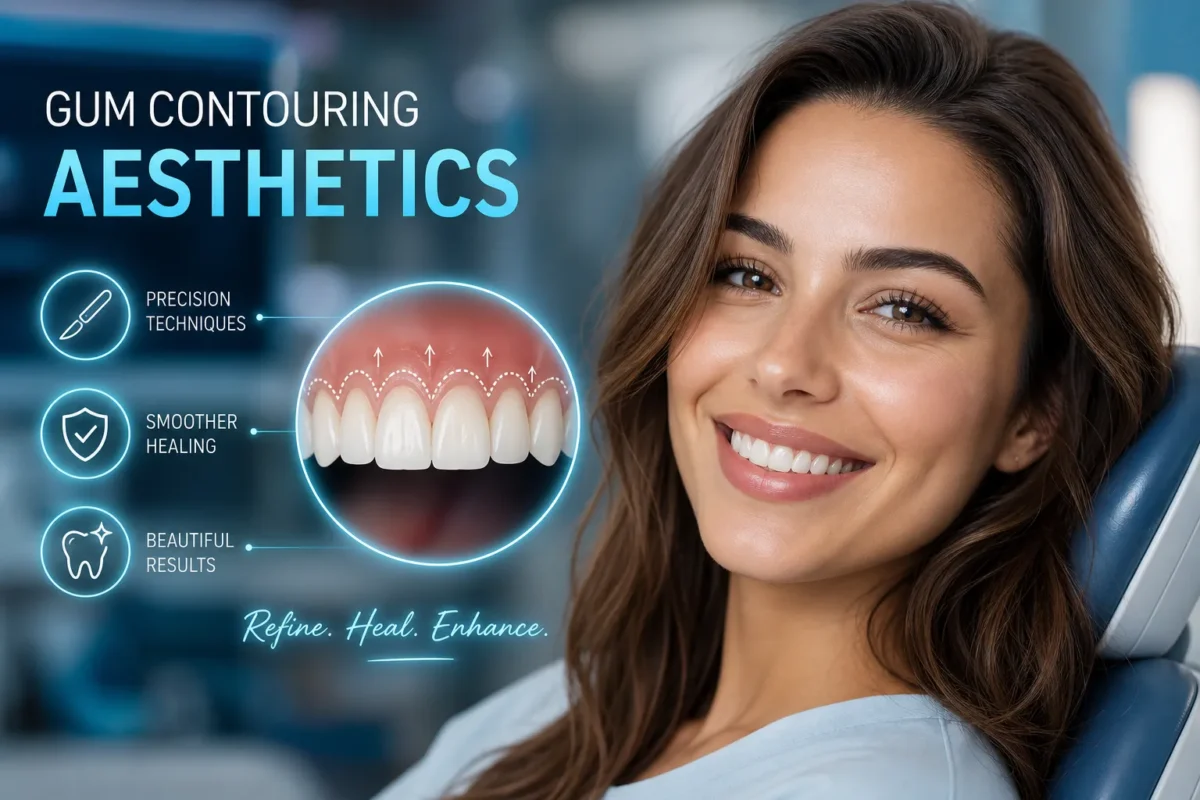
When the cause is altered passive eruption or gingival hypertrophy, the gum tissue itself needs to be addressed. Gum contouring, or gingivectomy, is a single-session procedure performed under local anaesthetic that removes excess gum tissue and reshapes the gum line to restore natural tooth proportions.
Laser versus scalpel: how the procedure works
The procedure begins with local anaesthetic to ensure the area is completely numb. The dentist then removes excess gum tissue using either a laser or a scalpel, and in many cases also removes a small amount of bone at the tooth root to prevent the gum from regrowing to its original position over time. The laser method seals the wound during the procedure, which means no stitches, minimal bleeding, and faster initial healing. The scalpel approach is equally effective but may involve suturing and a slightly more involved recovery. Both are typically completed in one appointment.
Recovery, risks and post-op care in plain terms
Most patients return to normal activity within one to two days. Soreness and swelling typically fade within 7 to 10 days, and full gum tissue healing takes up to three weeks. The main risks are gum tissue relapse if insufficient bone was removed, temporary tooth sensitivity as newly exposed tooth surfaces adjust, and infection if oral hygiene is poor post-procedure.
Post-operative care is straightforward: stick to soft, cool foods for the first week; avoid brushing the surgical site for the first few days; rinse with warm saltwater or an antibacterial mouthwash; and avoid smoking and alcohol for at least one week. Both significantly slow healing and raise infection risk. If antibiotics are prescribed, complete the full course.
Permanence and success rates
Gingivectomy results are permanent in the vast majority of cases, with most patients achieving a 50 to 70% reduction in visible gum tissue. Unlike Botox, gum tissue does not regenerate to its original position once correctly removed. Revision is possible if healing produces an uneven result, but this is uncommon when the procedure includes adequate bone contouring. For patients whose gummy smile is caused by genuine tissue excess or altered passive eruption, this is frequently the most complete single-treatment solution available.
Crown lengthening: when the bone needs addressing too
Crown lengthening goes a step further than soft-tissue gum contouring. It involves reshaping both the gum tissue and the underlying alveolar bone to expose more of the natural tooth crown. This becomes necessary when teeth appear unusually short due to altered passive eruption with bone involvement, or when soft-tissue removal alone would leave insufficient bone support around the tooth root. The procedure is performed under local anaesthetic, usually in one or two sessions, and is considered minor surgery rather than a major operation.
Recovery timeline and cost expectations
Because bone is involved, recovery is more involved than soft-tissue-only gum contouring. Initial healing takes 2 to 3 weeks, with complete bone remodelling continuing beyond that. Two to three follow-up appointments are standard, and revision is possible if bone or gum healing is incomplete. In the UK, crown lengthening typically costs between £800 and £1,800, reflecting both the surgical complexity and the specialist expertise required. The outcome, when correctly indicated, is permanent correction of tooth proportions with a stable, healthy gum margin.
Lip repositioning and jaw surgery: treating the structural root cause
For patients whose gummy smile stems from anatomy that cannot be resolved conservatively, two more involved surgical options exist. This category also includes patients where orthodontic treatment, braces or clear aligners, forms part of a broader multi-disciplinary plan, particularly when tooth misalignment is contributing to the overall presentation. All surgical and orthodontic routes are best pursued after a full multi-disciplinary assessment.
Lip repositioning surgery: permanent muscle restriction
Lip repositioning surgery limits how high the upper lip can rise by surgically reducing the depth of the mucosal tissue connection between the lip and the gum. It is a permanent solution for hyperactive lip cases where the patient wants to avoid ongoing Botox maintenance. Recovery is longer than Botox but substantially shorter than jaw surgery. The clinical literature is candid about one limitation: relapse rates sit between 8% and 25%, with recurrence most commonly occurring within the first 6 to 12 months post-procedure. Technique modifications, including specific suturing approaches and muscle management, can reduce this risk significantly. For most patients with hyperactive lips, Botox remains a first-line choice due to its lower complication profile, with lip repositioning reserved for those who prefer a permanent solution and accept the associated relapse risk.
Orthognathic surgery: correcting the jaw position
Vertical maxillary excess is the skeletal cause that no injectable or soft-tissue procedure can permanently resolve. Orthognathic surgery repositions the entire upper jaw upward via a Le Fort I osteotomy under general anaesthetic. Most patients return to work or school within 2 to 3 weeks, resume a normal diet by 6 to 8 weeks, and reach complete bone healing by 3 to 6 months, with final aesthetic settling taking up to 12 months. Published outcome data report a success rate of approximately 93.9% for this procedure, with a complication rate of around 9% for traditional techniques and no severe complications associated with modified approaches.
In the UK, private costs typically run from £8,000 to £15,000, with multiple follow-up appointments over 6 to 12 months included. This is a significant commitment, but for genuine skeletal cases it is the only treatment that addresses the root cause with a permanent result.
How to know if you’re a surgical candidate
A few practical indicators point towards a surgical consultation being the right next step. If your gummy smile measures over 5 to 6 mm, if your upper jaw appears to protrude when viewed from the side, if your bite has never felt comfortable or aligned properly, or if non-surgical treatments have produced inadequate results, you are likely in this category. No irreversible procedure should be pursued without a full assessment from a specialist who evaluates your skeletal structure, lip anatomy, tooth proportions and gum tissue together.
What is the best treatment for a gummy smile? Comparing all four routes
Each treatment maps to a specific cause and severity band, which is why comparing them purely by cost or recovery time misses the point. That said, having a practical reference is genuinely useful when approaching a consultation.
| Treatment | Best suited for | Typical UK cost | Duration of results | Recovery |
|---|---|---|---|---|
| Botox | Mild to moderate; hyperactive lip | £200, £330 per session | 3, 6 months | None |
| Gum contouring / gingivectomy | Altered passive eruption; gingival hypertrophy | £500, £1,200 | Permanent | 7, 10 days minor soreness |
| Crown lengthening | Bone-level altered passive eruption | £800, £1,800 | Permanent | 2, 3 weeks initial healing |
| Orthognathic surgery | Skeletal VME | £8,000, £15,000 | Permanent | Up to 12 months full recovery |
What the clinical evidence actually says about choosing
There is no single randomised controlled trial comparing all gummy smile treatments head-to-head in one study. The clinical literature instead recommends aetiology-specific selection: match the treatment to the confirmed cause, and outcomes are consistently strong. Patient satisfaction across all modalities is reported as high when this matching principle is followed. This reinforces the central message of this guide, diagnosis first, treatment second. A practitioner who leads with treatment options before establishing cause is working backwards.
When a combination approach makes sense
For moderate to severe cases, combination therapy is common and often produces the most harmonious result. Gingivectomy to address gum tissue excess combined with Botox to manage residual lip movement is a frequently used pairing. Crown lengthening followed by porcelain veneers restores both gum position and tooth proportions simultaneously. For patients considering non-surgical adjuncts to improve shade and surface appearance, the Best Teeth Whitening Treatments guide explains contemporary options. Patients searching for a single treatment should be aware that two complementary procedures can achieve results that neither would produce alone, particularly when multiple causes are contributing to the overall presentation.
What a proper gummy smile consultation should look like
The quality of your consultation determines the quality of your outcome, regardless of which treatment you ultimately choose. A specialist in gum aesthetics should do considerably more than look at your smile and quote you a procedure.
The role of digital smile design in gum aesthetics
Digital smile design and 3D intraoral scanning have transformed how gummy smile consultations work. Instead of verbal descriptions of possible outcomes, a specialist clinic can digitally map gum tissue depth, tooth proportions, lip movement and facial symmetry to produce a projected result before any treatment begins. Research into digital smile design-guided procedures reports strong agreement between digital previews and actual post-treatment outcomes, with high patient satisfaction scores following DSD-guided crown lengthening.
This is precisely the approach at Dt. Çağrı Altuntaş Dental Clinic in Istanbul’s Nişantaşı district, where gum aesthetics, referred to internally as “pink aesthetics”, is planned around digital analysis rather than clinical estimation. Dt. Çağrı Altuntaş’s background in oral surgery and implantology from Saint Camillus University in Italy, combined with more than 15 years of cosmetic dentistry practice, means that the structural and aesthetic dimensions of gum correction are assessed together from the first appointment. For international patients, this level of pre-treatment planning removes significant uncertainty from the process.
The five questions worth asking at your first appointment
Arriving at a specialist consultation with specific questions separates an informed patient from a passive one. These five are worth preparing in advance.
- What is the primary cause of my gum display, and how was that determined?
- Am I a candidate for a reversible treatment first before committing to anything permanent?
- What does a natural-looking result look like for my specific face shape and tooth proportions?
- What is the full cost, including follow-ups, revision procedures, and any complementary treatments?
- Can you show me digital before-and-after projections based on my own anatomy?
A practitioner who answers these questions clearly and specifically is working in your interest. One who deflects the cause question or presents only one treatment option without explaining why it suits your anatomy is worth a second opinion.
What natural, harmonious gummy smile results actually look like
A successful gummy smile correction should reveal no more than 1 to 2 mm of gum at rest in a natural smile, maintain tooth proportions that suit the patient’s jaw width and facial structure, and leave the lip line looking relaxed rather than artificially restricted. Overcorrection is a real risk when treatment is applied without proper aesthetic planning: a lip that barely moves, elongated teeth that look unnatural, or a gum line that appears perfectly flat rather than gently curved are all signs that the aesthetic component of the treatment was not considered carefully enough.
The before-and-after cases at Dt. Çağrı Altuntaş Dental Clinic reflect a consistent focus on results that look like a better version of the patient’s own smile rather than a standardised cosmetic outcome. That distinction matters enormously, and it is something digital smile design makes genuinely achievable rather than aspirational.
The decision framework: what is the best treatment for a gummy smile for your case?
A gummy smile is not a single condition with a single fix. The best treatment depends on one thing: an accurate diagnosis of the cause. For most people with mild to moderate gum display, Botox offers a low-risk, fast way to test how their smile looks with less gum visible before committing to anything permanent. For those with structural or tissue causes, gum contouring, crown lengthening, lip repositioning or jaw surgery each offer lasting solutions when correctly matched to the patient’s anatomy.
The most important step is getting an assessment from a specialist who treats the cause rather than just the symptom. Whether you explore treatment locally or consider a dedicated gum aesthetics clinic abroad, start with a free smile analysis and ask to see digital treatment planning before any procedure is discussed. At Dt. Çağrı Altuntaş Dental Clinic, that initial analysis is offered without obligation, with same-day appointments available and multilingual support for international patients.
Frequently asked questions about gummy smile treatment
What is the best treatment for a gummy smile in mild cases?
For mild gummy smiles of 3 to 4 mm caused by a hyperactive upper lip, Botox (botulinum toxin A) is typically the first-line recommendation. It is non-invasive, takes minutes to administer, and allows you to evaluate the aesthetic outcome before considering anything permanent. If altered passive eruption is the confirmed cause, even in mild cases, gum contouring may be more appropriate and deliver a permanent result in a single session.
How long does gummy smile treatment last?
This depends entirely on the treatment. Botox results last 3 to 6 months and require ongoing maintenance. Gum contouring, crown lengthening, lip repositioning and orthognathic surgery all produce permanent changes to gum tissue, bone or jaw position that do not reverse, though lip repositioning carries a relapse rate of 8 to 25% within the first year.
Is gummy smile treatment available on the NHS?
In most cases, no. Gummy smile correction is considered a cosmetic procedure and is not routinely funded by the NHS. Orthognathic surgery may be available on the NHS where there is a functional indication, such as a significant bite problem, rather than a purely aesthetic one. A referral from your NHS dentist to a specialist maxillofacial unit would be the starting point for that assessment.
Can a gummy smile come back after treatment?
Botox results are temporary by design. For surgical and tissue-based treatments, relapse is uncommon when the procedure is correctly performed, particularly where adequate bone contouring accompanies soft-tissue removal. Lip repositioning has the highest documented relapse rate among the permanent options, at 8 to 25%. Orthognathic surgery and well-executed gingivectomy with bone contouring have strong long-term stability records.
Your smile should look like you, just with better proportions.
Additional Questions
Can digital smile design help plan gummy-smile treatment?
Yes. Photographs, video and digital measurements can show how tooth, gum and lip proportions interact and support communication about realistic changes.
Is gum contouring the same as crown lengthening?
No. Contouring reshapes soft tissue; crown lengthening may also require bone adjustment to create a stable gum position and appropriate tooth exposure.