If you’ve asked two dental clinics for a quote on complete smile restoration cost and received two very different numbers, that gap isn’t a billing error. It reflects something more fundamental: “complete smile restoration” doesn’t describe one procedure. It describes a category of treatment that ranges from a conservative cosmetic makeover to a full surgical reconstruction involving implants, bone grafting, and months of staged work. The same phrase covers a $5,000 plan and a $70,000 one.
This article gives you real Canadian price ranges by restoration type, the main cost drivers, what insurance actually covers, and a practical framework for getting an accurate number for your specific situation. Real figures, clearly presented, based on current Canadian clinical pricing and provincial fee guide data.
What “complete smile restoration” actually covers
Most of the confusion around complete smile restoration cost starts with terminology. “Complete smile restoration” isn’t a defined dental procedure with a fixed price. It’s a broad category that includes everything from a conservative cosmetic makeover to a full surgical reconstruction. Understanding which type applies to your situation is the only way to make sense of the numbers.
Cosmetic makeover vs. full reconstruction: the key difference
A cosmetic smile makeover focuses on appearance: veneers, whitening, bonding, and crowns on visible teeth. A full reconstruction addresses both function and aesthetics, tackling missing teeth, bone loss, bite problems, and gum health, often using implants, bridges, and surgical prep work as the foundation. The procedures sound similar. The clinical scope and cost are completely different.
The procedures most commonly bundled into a restoration plan
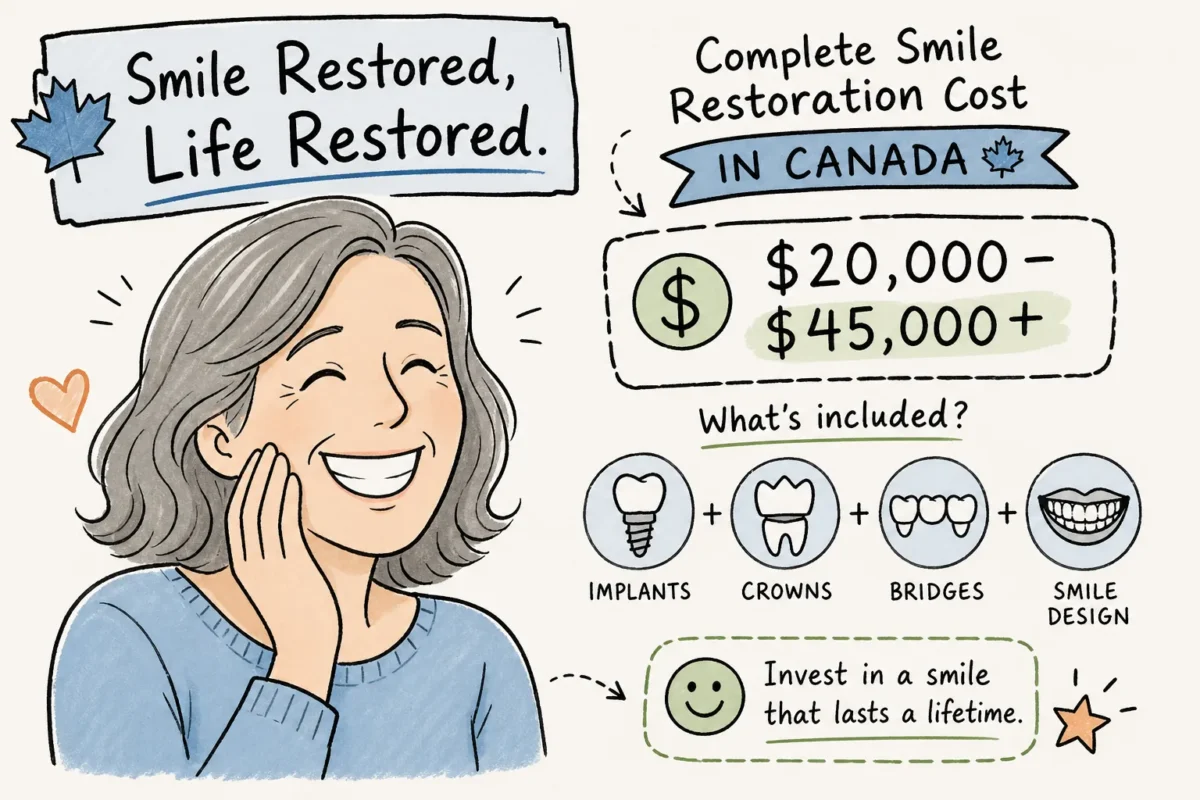
Depending on what your mouth actually needs, a complete restoration plan can include any combination of dental implants, crowns, bridges, porcelain veneers, composite bonding, teeth whitening, orthodontic alignment, periodontal therapy, bone grafting, and root canal treatment. Some of these are cosmetic finishing steps. Others are non-negotiable prerequisites that have to happen before anything else can be placed.
The clinical reality behind the price gap
A patient needing veneers on eight upper front teeth has a fundamentally different treatment load than someone missing most of their teeth who needs full-arch implant-supported bridges on both jaws. Both describe what they want as a “complete smile restoration.” That’s the range, and it’s why a specific clinical diagnosis is the only starting point that produces a useful number.
Complete smile restoration cost: real Canadian price ranges
Here’s where the numbers actually land in Canada in 2026. All figures below are in CAD, drawn from current provincial fee guides and major-market clinic pricing. These are realistic ranges, not entry-level figures designed to get you through the door.
Veneer-based cosmetic makeovers
Porcelain veneers run CAD $800 to $2,500 per tooth. Composite veneers are typically $250 to $1,500 per tooth. A moderate cosmetic makeover covering six to ten front teeth sits around $5,000 to $12,000. A full smile makeover with crowns, veneers, and whitening across more teeth typically runs $12,000 to $25,000 in Canada, with some comprehensive cases exceeding $30,000. For a Canadian perspective on typical veneer pricing, see this overview of veneers cost.
Single implants and multi-tooth crown-based restorations
A single dental implant with abutment and crown costs CAD $3,000 to $6,000 per tooth in most Canadian markets. Replacing three to five missing teeth with individual implants and crowns can push total costs into the $15,000 to $30,000 range before any preparatory work, like bone grafting or gum treatment, is factored in.
Full-arch implant solutions: All-on-4 compared to traditional implants
For patients missing most or all teeth in one or both arches, All-on-4 / All-on-X solutions typically cost $20,000 to $30,000 per arch in Canada, with full-mouth treatment running $40,000 to $50,000+. Traditional full-arch reconstruction using six to eight individual implants per arch runs higher: $30,000 to $45,000 per arch, or $50,000 to $70,000 for both. All-on-4 solutions generally cost less per arch while still delivering a fixed, non-removable result. For most patients missing a full arch, that cost advantage matters.
What drives your complete smile restoration cost up or down
The ranges above assume a relatively straightforward case. Most patients have at least one factor that moves them toward the higher end. Here are the three biggest cost drivers.
Procedure count and complexity
Every additional procedure in your plan adds cost. A patient who needs veneers on eight teeth plus whitening is looking at a very different total than someone who needs those same veneers plus bone grafting, two implants, and periodontal therapy first. The number of teeth involved and the clinical complexity of each step are the primary cost multipliers. Add-on procedures like bone grafting ($500 to $2,500 per site) and sinus lifts ($1,500 to $5,000) can add $2,000 to $7,500 or more before the main restoration even begins.
Province, city, and clinic type
Dental pricing in Canada is not standardized. Ontario and British Columbia, especially Toronto and Vancouver, consistently run at the higher end of national ranges. Smaller cities and rural areas trend lower. Boutique cosmetic clinics charge more than general practices. A specialist involved in your care, whether a periodontist, oral surgeon, or prosthodontist, adds to the total. That added cost often comes with necessary expertise, but it’s worth knowing it factors into the quote.
Preparatory work that has to happen first
Bone grafting, sinus lifts, extractions, and gum disease treatment all add surgical time, materials, and cost before the restorative phase even begins. A patient with significant bone loss who wants implants will spend considerably more than someone with healthy bone structure. These prep procedures aren’t optional. Skipping them compromises the restoration. They need to be factored into any realistic budget from day one, not discovered partway through treatment.
What insurance and public programs actually cover
Canada has several programs that can offset dental costs, but the gap between what patients expect and what these programs actually pay is significant. Going in with accurate expectations saves a lot of frustration later.
Private dental insurance: what it covers and what it doesn’t
Employer-sponsored and individual dental plans commonly cover preventive care, fillings, extractions, and some restorative work like crowns and bridges. What they almost universally exclude: veneers, whitening, and any procedure documented as cosmetic rather than restorative. If a crown is needed to repair a broken tooth, it may be covered. If the same crown is placed for appearance, it won’t be. That distinction matters, and it’s worth confirming with your insurer before treatment starts, not after you’ve already committed to a plan.
The Canadian Dental Care Plan: eligibility and scope
The federal Canadian Dental Care Plan (CDCP), updated in 2026, helps eligible Canadians without private dental insurance access medically necessary dental services, including some crown coverage for adults through preauthorization. It does not cover cosmetic procedures, implants, or implant-supported crowns. Eligibility is income-based, and the plan is designed for essential care rather than elective smile restoration work. It’s a meaningful program for qualifying patients, but it won’t offset most of the costs in a comprehensive smile makeover.
Financing options worth asking about
Most dental clinics offering major restorative work provide third-party financing through plans that allow patients to spread payments over 12 to 60 months, sometimes interest-free for shorter terms. Medical credit lines through financial institutions are another common route. Ask specifically about payment plan structures and any interest that applies. The total financed cost can be significantly higher than the original treatment quote, so the math is worth doing before you sign.
How to get an accurate estimate for your specific case
A phone quote or a price list tells you almost nothing useful. A realistic complete smile restoration cost estimate comes from one source: a detailed clinical assessment with full diagnostic records, including X-rays, CT scans, and intraoral scans. Everything else is a guess.
The questions worth asking before agreeing to a plan
Ask your dentist to break the treatment plan into phases and provide a per-procedure cost breakdown. Ask what preparatory work is required and whether it’s included in the quote. Ask what happens to the overall cost if a procedure takes longer than expected or if additional work is discovered during surgery. A clinician who answers those questions clearly is one worth working with. One who gets vague is telling you something too.
Why an estimate isn’t a quote, and why that matters for budgeting
Treatment plans can change once a dentist has full diagnostic records. Budget for a realistic upper range rather than the entry-level number. Contingency costs for bone grafting or additional implants are common findings, not rare surprises. Plan for the full scope of treatment, not just the procedures that are certain on day one. Patients who budget to the minimum estimate are the ones who feel blindsided mid-treatment.
When a second opinion or cross-border consultation makes sense
For major restorations, particularly full-arch implant work where Canadian costs can exceed $40,000 to $70,000, a second opinion is worth the time. Some patients go further and request consultations with internationally certified specialists abroad. Dt. Çağrı Altuntaş Dental Clinic in Istanbul offers smile analysis consultations and personalized treatment plans for international patients, including Canadians weighing the cost difference between treatment at home and a dental tourism approach. That kind of no-commitment assessment can clarify what’s actually needed and what it realistically costs, wherever you ultimately choose to proceed. For timeline expectations for major procedures, see this overview of how long a full mouth restoration takes in Istanbul. Many patients comparing options also consult international pricing and logistics resources such as this guide to dental implants in Turkey when evaluating potential savings.
Getting to the real number
Complete smile restoration cost in Canada can land anywhere from $5,000 for a conservative cosmetic makeover to $70,000+ for a full-mouth implant reconstruction. That range isn’t vague: it reflects the real difference between treatment plans that address completely different clinical situations. The number that matters is the one specific to your mouth, your procedure count, and your location.
The most useful thing you can do right now is get a proper clinical assessment with diagnostic records, not a ballpark estimate over the phone. Know the full procedure list, understand what preparatory work applies to your case, and factor in your province and clinic type before making comparisons between quotes.
If the Canadian quotes for major work feel out of reach, you have options. Financing can spread costs. Insurance may cover the restorative portions. And if you’re open to dental tourism, Dt. Çağrı Altuntaş Dental Clinic offers a smile analysis and a personalized treatment plan as a starting point, with no obligation, just a clear picture of what your restoration actually involves and what it would cost. To get an accurate complete smile restoration cost for your specific situation, start with a full diagnostic assessment. That’s the number worth making decisions from.