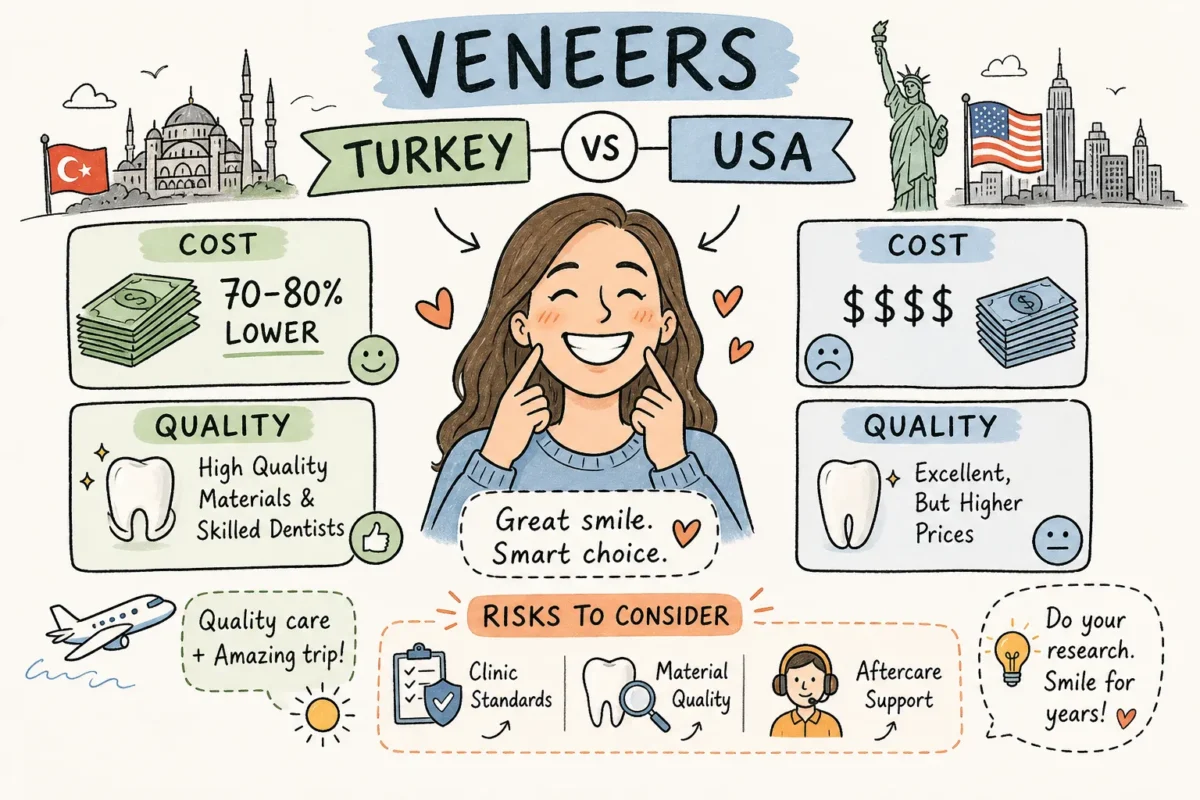
Porcelain veneers in the USA run $1,500 to $1,800 per tooth. In Turkey, the same material costs $200 to $350 per tooth. On a standard 10-veneer case, that’s a price difference of $12,000 or more before you’ve booked a single flight. When comparing veneers in the Turkey vs USA, the numbers are hard to ignore.
What’s less obvious is whether the quality, credentials, and post-treatment support hold up when you’re flying home the following week. That’s the actual question worth answering. Clinics like Dt. Çağrı Altuntaş Dental Clinic in Istanbul represent a specific category of provider: internationally trained cosmetic dentists with verifiable credentials operating at a genuinely different standard from high-volume dental tourism operations. That distinction matters, and this article will show you why.
Below, you’ll find a direct cost comparison for veneers in the USA vs Turkey, an honest look at quality, the credentials that actually carry weight, what warranties realistically cover, and a practical checklist to decide whether dental tourism makes sense for your situation, including specific considerations for Canadian patients.
Veneers in Turkey vs USA: What You’ll Actually Pay
The per-tooth numbers are straightforward. Porcelain veneers cost $200 to $350 per tooth in Turkey versus $1,500 to $1,800 in the USA. Zirconia veneers run approximately $250 to $400 in Turkey compared to roughly $1,500 to $2,500 in the USA, though US zirconia pricing is less consistently reported than porcelain, so treat that upper range as an estimate. Those are 2026 figures from credentialed clinics in Istanbul, not budget providers on the outskirts of town. For a dedicated breakdown of clinic pricing and what those figures mean in practice, see Porcelain Veneers in Turkey: The Real Cost in 2026.
US prices typically exclude consultation, adjustments, and follow-up care, which can add meaningfully to the total cost per visit. Turkish packages at reputable clinics, by contrast, often bundle consultation, temporary veneers, the final fitting, and aftercare instructions into a single quoted price, though you should always confirm exactly what’s included in writing before booking.
Now factor in the travel overhead that’s easy to underestimate. Round-trip flights from major North American hubs to Istanbul vary by season and departure city; Canadian travelers flying from Toronto or Vancouver should expect competitive transatlantic fares, though prices shift considerably depending on timing. Budget separately for 7 to 10 nights of accommodation, costs depend heavily on hotel class and season, so research current rates for Istanbul before finalizing your numbers. Factor in daily expenses and the trip overhead is a real addition to the treatment total.
Even so, the math tends to work decisively in Turkey’s favor for multi-veneer cases. A 10-veneer case at a quality Istanbul clinic, including estimated travel expenses, can come in well below the equivalent US cost, illustratively, clinic costs of $2,500 to $3,500 plus $2,500 to $4,000 in travel puts the all-in figure in a range that US domestic pricing rarely approaches, even before follow-up visits. These are estimates based on published per-tooth rates combined with realistic travel budgets; your actual numbers will depend on clinic, season, and package inclusions. The direction of the saving is consistent. The exact magnitude is yours to calculate.
Does Cheaper Mean Worse? The Honest Answer on Quality
The materials used at top Turkish clinics are largely identical to those used in the USA. Credentialed cosmetic dentists in Istanbul work with Ivoclar Vivadent IPS e.max lithium disilicate, zirconia ceramic systems, and comparable feldspathic porcelains, the same material families used in leading US cosmetic practices. The veneer itself is not the quality variable. For further reading on specific treatment approaches and materials used at a specialist practice, see Porcelain Veneers, Dt. Çağrı ALTUNTAŞ 2026.
The real quality variable is the person placing it, and the model the clinic operates under. A systematic review of porcelain laminate veneers reported a 10-year cumulative survival rate of 95.5% across 6,500 veneers. Those numbers reflect properly prepared and bonded veneers. They do not protect you from rushed preparation work, poor shade selection, or a dentist running an extremely high daily patient load.
The volume-first clinic model is the actual risk in dental tourism. Facilities processing large numbers of patients daily tend to cut corners on diagnostic time, tooth reduction precision, and shade customization. Before-and-after content from Turkish clinics skews heavily positive because satisfied patients post; complications rarely do. That’s not a Turkey problem specifically, it’s a high-volume business model problem that happens to be concentrated in dental tourism hubs.
The “Turkey teeth” look that’s become shorthand for obvious, unnatural dental work comes from two specific sources: patients requesting extreme whitening beyond what their facial coloring supports, and clinics using thicker, stock-shade veneers to save lab and chair time. A dentist prioritizing natural aesthetics spends significant time on shade mapping, tooth reduction depth, and gum line symmetry. That process cannot be rushed into a 90-minute appointment slot. When evaluating any clinic, ask to see cases completed by the actual treating dentist, not stock photos from the marketing team. A useful directory for verifying clinic listings and patient reviews is WhatClinic’s veneers directory for Turkey, which can help you find clinic-level details and patient feedback.
It’s also worth noting that no head-to-head clinical studies directly compare veneer outcomes between Turkish and US clinics. High-quality results are well-documented at credentialed Turkish practices, but the evidence base is practice-level rather than comparative. Do the credential verification work and the quality gap narrows considerably.
Credentials That Carry Real Weight When Vetting a Turkish Clinic
The Health Tourism Authorization Certificate from Turkey’s Ministry of Health is the baseline requirement. It’s a legal mandate for any clinic treating international patients, not a marketing badge. No current authorization means no booking, full stop. The Ministry inspects facilities before issuing this certificate, and clinics must meet documented competency criteria to receive it. For context on legal oversight and recent regulation changes affecting international patients, see the Turkish guidance on health tourism accreditation.
Beyond the authorization, JCI accreditation signals internationally benchmarked patient-safety standards, while ISO certification signals documented, consistent clinical processes. Turkish Dental Association (TDB) membership covers professional standing and ethical obligations. International affiliations with organizations like the ICOI or ITI signal active engagement with global clinical standards. Ask for copies of these documents rather than accepting website logos as evidence.
The red flags for a high-volume operation are consistent across the industry:
- Pricing quoted with no in-person or video consultation before treatment begins
- No named treating dentist listed publicly, or scheduling that makes individual accountability impossible
- Generic before/after photos with no patient demographic context
- Vague or missing written warranty terms
- No English-language aftercare documentation
What a properly credentialed boutique practice looks like in practice: Dt. Çağrı Altuntaş holds a Master’s degree in Oral Surgery and Implantology from Saint Camillus International University of Health Sciences in Italy, postgraduate training that goes beyond what most Turkish cosmetic practices require. Dt. Çağrı Altuntaş Dental Clinic operates under Health Turkey certification, uses digital smile design with intraoral scanning technology, and is based in Nişantaşı, Istanbul’s most established upscale district. That positioning reflects a focus on premium, patient-centered care rather than the volume model common to tourist-district dental strips. This is the standard to benchmark against when comparing veneers in the USA vs Turkey: an internationally credentialed treating dentist, verifiable certification, documented technology, and a named specialist accountable for your case from start to finish.
Warranties and Aftercare: What’s Realistic When You’re Flying Home
Reputable Turkish clinics typically offer 3 to 5-year warranties on veneers and crowns, covering remakes and repairs. Implant components often carry longer coverage, 5 to 10 years on the fixture is common. These are repair and remake guarantees in most cases, not refunds. The coverage is only as strong as the clinic’s written terms and their actual process for handling remote cases. For a useful reference on typical warranty language and enforcement in Turkish dental practices, see this guide to warranty terms for international patients.
Get all warranty terms in writing, in English, before treatment begins. Confirm explicitly what triggers a warranty claim, whether you need to return in person, and whether the clinic accepts photo and video documentation for remote assessment. Clinics that hedge on these specifics are signaling that enforcement will be equally vague, treat that as a red flag.
The practical gap between Istanbul and North America is follow-up care. If a veneer chips or debonds six months after you’re home, whether you’re in Toronto, Vancouver, or anywhere else in Canada, your Turkish clinic cannot see you the next morning. Well-run clinics manage this through remote consultation via video calls, post-op summaries that any competent local dentist can act on, and direct contact information for the treating dentist rather than a general inbox.
Canadian patients should also factor in that provincial dental coverage rarely applies to treatment received abroad, and that warranty claims requiring a return visit add to the total cost. Confirming the clinic’s remote assessment process before you book is not a minor detail, it’s central to whether the warranty has any practical value from a Canadian postal code.
Before you fly home from any treatment trip, collect four things: a full treatment summary with material specifications, the lab report for your veneers, warranty documentation, and direct contact details for the treating dentist. These are your safety net if anything needs attention after you land.
A Practical Checklist: Is Dental Tourism Right for You?
The financial case for traveling is strongest when you need multiple veneers. The break-even point depends on clinic prices, travel costs, and package inclusions, there’s no universal threshold, but as a working principle, the per-veneer saving needs to outrun total trip overhead. Run the actual numbers for your case rather than relying on a rule of thumb. You’re a reasonable candidate for dental tourism if you’re in good general dental health, don’t have complex pre-existing conditions requiring ongoing specialist oversight, and are comfortable managing follow-up care remotely or with a trusted local dentist at home. For additional cost perspective and patient-focused price comparisons, see this comprehensive veneers cost guide and clinic-level cost reporting like the analysis on how much veneers cost in Turkey.
Build roughly 5 to 7 days into your schedule for a straightforward veneer case, and up to 7 to 10 days for complex or full-mouth work. A typical veneer case in Istanbul involves consultation and scans on day one, tooth preparation and temporaries on days two and three, then lab fabrication, trial fitting, final bonding, and bite checks through approximately day five to seven. Plan conservatively, tighter schedules leave no room if any stage takes longer than expected. For more detail on timelines for larger cases, see Full Mouth Restoration in Istanbul: How Long It Takes.
Canadian travelers should also price out flights from their nearest major hub (Toronto, Vancouver, Calgary, or Montreal are common departure points for transatlantic routes) and factor in any applicable travel insurance requirements for medical procedures abroad. Some Canadian travel insurance policies exclude elective dental treatment, so read the fine print before you book.
Before committing to any clinic, ask these specific questions:
- Who is the named treating dentist, and what are their specific credentials, degree institution, postgraduate training, and years of cosmetic dentistry experience?
- Is the clinic currently Health Turkey authorized, and can you provide documentation?
- What material brand and type will be used for my veneers, and which laboratory fabricates them?
- What are the exact warranty terms in writing, and how are repairs handled if I’m back in Canada?
- What does the aftercare package include, and how do I contact the treating dentist directly after I return home?
The honest final filter is straightforward. Dental tourism works when you treat it like any high-value medical decision: verify credentials independently, read treatment contracts before signing, and choose a named specialist, not a clinic brand. The risk is not Turkey. The risk is choosing a clinic based on the lowest price rather than the strongest evidence of quality and accountability. The dentists worth traveling to are rarely the ones with the most aggressive promotional offers.
The Decision on Veneers USA vs Turkey Comes Down to One Thing
High-quality veneers in Turkey are possible at a fraction of US or Canadian domestic costs, not as a promotional claim, but as an accurate description of what’s achievable at the right clinic, with the right dentist, using the same materials a top North American cosmetic practice would use. The savings are real, the quality ceiling is high, and the risk is manageable when you do the verification work.
Dt. Çağrı Altuntaş Dental Clinic represents what separates a trustworthy dental tourism destination from the operations that give Turkey dentistry its mixed reputation: an internationally credentialed specialist, Health Turkey certification, and a practice model built around natural-looking, lasting results rather than volume throughput. The decision on veneers, USA, Turkey, or anywhere else, comes down to one thing: who is actually placing them, and whether you can verify it before you sit in the chair.