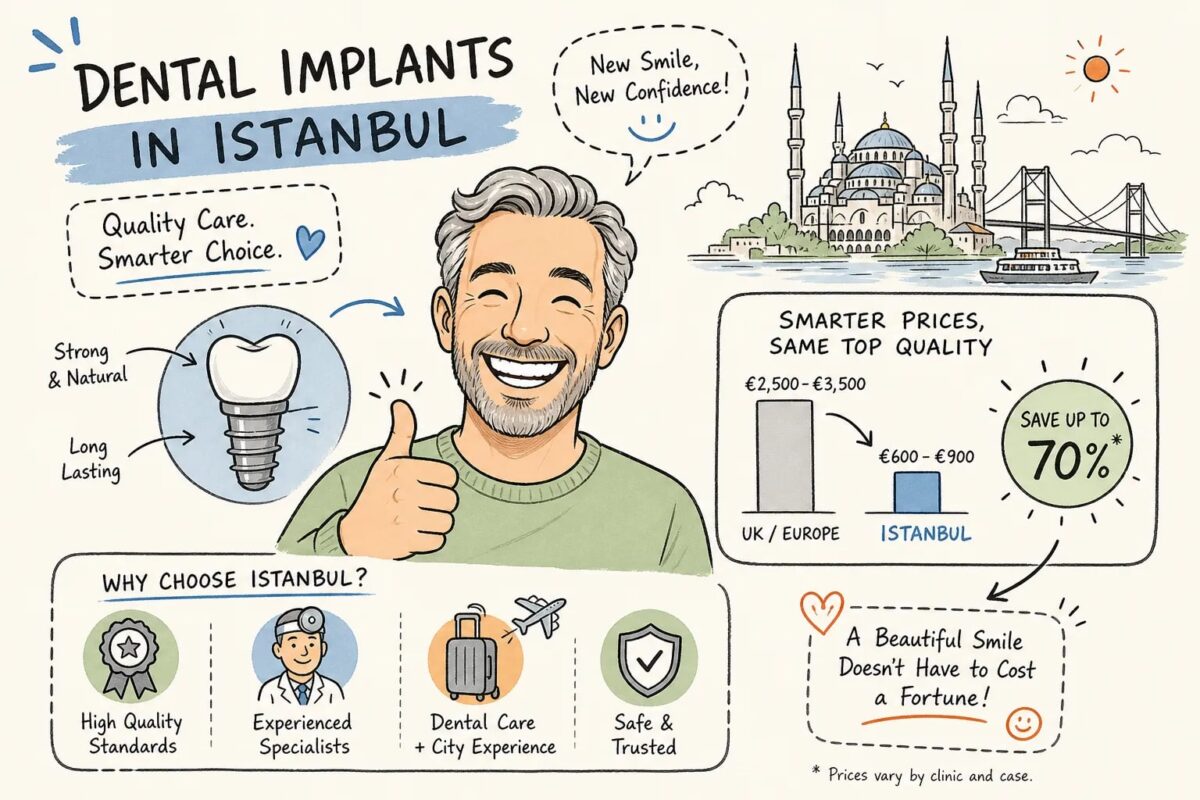
If you’re researching dental implants Istanbul cost, here’s the short answer: a single implant runs $400 to $800 per tooth in 2026, compared to $3,000 to $6,000 for the same procedure in the United States. That’s not a typo, and it’s not because Istanbul cuts corners. It’s because overhead, labor, and healthcare economics work differently in Turkey. Many Istanbul clinics serving foreign patients use internationally recognized implant brands, digital diagnostic technology, and specialists with postgraduate surgical training, the same baseline patients expect in the US and Western Europe.
Istanbul has become one of the most serious implant destinations in the world because of what it can actually deliver: internationally trained specialists, digital diagnostic technology, and government-backed accreditation for clinics serving foreign patients. Dt. Çağrı Altuntaş Dental Clinic, located in Istanbul’s Nişantaşı district, is one such clinic, serving international patients with transparent pricing and written cost breakdowns before any commitment is made. When you’re comparing dental tourism Istanbul packages, that level of upfront clarity is a meaningful differentiator.
This guide covers the actual 2026 price ranges, a comparison table by implant brand and material, a clear breakdown of what packages include versus what they don’t, and a checklist for choosing a clinic that won’t surprise you with hidden costs after you’ve already landed.
Dental implants Istanbul cost, per-tooth pricing in 2026
The per-tooth price range you can expect
A single dental implant with the abutment and crown included runs $400 to $800 in Istanbul for 2026. That’s the all-in number most patients pay, covering the surgical placement, the connecting piece between the fixture and crown, and the visible tooth itself. It is not just the titanium post. Compare that to the $3,000 to $6,000 range in the US, and you’re looking at savings of $2,200 to $5,600 per tooth. For someone replacing three or four teeth, that math changes everything.
The range reflects real choices the patient makes, specifically which implant brand goes in and what material the crown is made from. Both are negotiable. Both affect how your final bill lands within that $400 to $800 window.
Why the price varies even within Istanbul
Two clinics can quote $420 and $780 for what looks like the same single implant, and both quotes can be completely legitimate. The difference almost always comes down to three variables: the implant system used, the crown material, and whether the abutment is a standard off-the-shelf piece or a custom-milled one. A Straumann implant with a zirconia crown at a boutique clinic in Nişantaşı costs more than an Osstem fixture with a porcelain-fused-to-metal crown at a high-volume suburban facility. Neither is automatically wrong. They serve different priorities.
Clinic overhead factors in too. A practice with cone-beam CT scanning, intraoral cameras, and a specialist with postgraduate surgical training charges more than a general dentistry chain. That price difference reflects something real. It’s worth understanding what you’re paying for before choosing the lowest quote.
How Istanbul pricing compares to the rest of Turkey
Istanbul sits at the higher end of Turkey’s implant price per tooth range, particularly in neighborhoods like Nişantaşı. Clinics in Ankara or Antalya may quote somewhat lower for comparable procedures, though the exact difference varies by clinic and treatment type. For international patients flying in specifically for treatment, the convenience, infrastructure, and access to premium specialists in Istanbul usually makes the slight premium worth it. Istanbul’s dental tourism ecosystem is more developed than anywhere else in Turkey, multilingual coordinators, international transport links, and accredited clinics concentrated in one city.
Dental implants Istanbul cost: All-on-4 and All-on-6 full-arch pricing
All-on-4 costs per jaw in 2026
All-on-4 treatment in Istanbul runs $3,500 to $6,000 per jaw in 2026. A complete package typically covers four implants, a temporary prosthesis placed immediately after surgery, and the final zirconia bridge. Many patients need treatment on both arches, which puts the full-mouth total at $7,000 to $12,000 depending on what’s included and which materials are used. All-on-4 pricing in the US is commonly far higher, frequently quoted in the $20,000 to $40,000 range, though figures vary widely by provider and region.
“Per jaw” is almost always how Istanbul clinics quote first. Ask early on whether you need one arch or two, because the second arch is where costs stack up quickly.
All-on-6 and the case for more implants
All-on-6 places two additional implants per jaw for better load distribution and stability. Prices run somewhat higher than All-on-4, typically in the $4,500 to $7,500 per jaw range as an approximate market estimate, though your actual quote will depend on brand, materials, and clinic. The upgrade is most relevant for patients with lower bone density in the posterior jaw, where four implants may not provide adequate support for the bridge long-term. Your implantologist should recommend this based on your CBCT scan results, not as a default upsell. If you have healthy bone density and a normal bite pattern, All-on-4 is sufficient for the vast majority of patients.
Full-mouth restoration: what the three scenarios actually cost
Here’s how three realistic scenarios shake out for full-mouth treatment in Istanbul in 2026. A budget approach using a local or Korean implant system with a PFM prosthesis typically runs $6,000 to $8,000 total for both arches. A mid-range solution with a Korean or European brand implant and a zirconia bridge comes in at $8,000 to $10,000. A premium approach using Straumann or Nobel Biocare fixtures with custom zirconia on both arches lands at $10,000 to $14,000. The material difference between a PFM and a full-arch zirconia bridge alone accounts for $800 to $1,500 of that spread.
How implant brand and material choice drive the price
Brand tiers: premium, mid-range, and value systems
The implant fixture market breaks into three tiers, and Istanbul clinics carry all of them. Premium systems from Straumann and Nobel Biocare run roughly $600 to $1,200 per implant in Istanbul. These are Swiss and American brands with decades of clinical evidence, global support networks, and the most extensive long-term outcome data available. Mid-range systems, primarily Korean brands like Osstem and Dentium, run $390 to $600 per implant. They’re well-made, widely used, and supported by solid clinical evidence. Turkish and local systems sit at the lower end of the range and work fine for many cases, though the supporting research base is thinner.
Brand choice affects the fixture itself, not just the clinic’s margin. Premium implants generally use more advanced surface treatments associated with efficient osseointegration. For most patients, that distinction is subtle. For high-demand cases or patients with lower bone quality, that difference in osseointegration performance matters more.
Zirconia vs. porcelain-fused-to-metal crowns
Zirconia crowns are stronger, look more natural, and are fully biocompatible. In Istanbul, they typically cost $100 to $200 more per tooth than PFM crowns, though the exact premium varies by clinic. For a full-arch bridge, that adds up to $800 to $1,500 more overall. PFM crowns have a metal substructure with porcelain fused on top. They work fine in the back of the mouth where aesthetics matter less. For front teeth or anyone prioritizing a natural appearance, zirconia is the clear choice. For full-mouth restorations, most reputable clinics default to zirconia, and that’s the right call.
2026 Istanbul implant pricing table
| Treatment | Implant Brand Tier | Crown/Prosthesis | Est. Istanbul Price (USD) |
|---|---|---|---|
| Single implant + crown | Local / Turkish system | PFM | $400, $550 |
| Single implant + crown | Mid-range (Osstem / Dentium) | PFM or zirconia | $500, $700 |
| Single implant + crown | Premium (Straumann / Nobel) | Zirconia | $700, $1,200 |
| All-on-4 per jaw | Mid-range | Zirconia bridge | $3,500, $5,000 |
| All-on-4 per jaw | Premium | Custom zirconia bridge | $5,000, $6,500 |
| All-on-4 both arches | Mid-range | Zirconia bridge | $7,000, $10,000 |
| All-on-4 both arches | Premium | Custom zirconia bridge | $10,000, $14,000 |
These are market ranges based on 2026 Istanbul pricing data. They are not clinic-specific quotes. Your final cost depends on diagnostic findings, bone condition, and the specific package negotiated with your clinic.
What’s actually included in Istanbul implant packages
Standard inclusions across most reputable clinics
A well-structured Istanbul implant package covers the initial consultation and oral exam, CBCT and panoramic X-ray imaging, the implant placement surgery, a standard abutment, a temporary prosthesis, local anesthesia, lab fees, and, for full-arch cases, hotel accommodation for five to seven nights plus airport and clinic transfers. That’s the baseline. If a clinic’s quote doesn’t clearly state all of those as included, ask specifically about each one before comparing it against quotes that do include them.
What’s commonly listed as extra
Bone grafting, sinus lifts, additional extractions, general anesthesia or IV sedation, international flights, travel insurance, and, in some staged packages, the final crown are the most common add-ons. This is where “all-inclusive” packages diverge most sharply, and where patients get surprised. A package that includes the hotel but quotes the final zirconia bridge separately is a very different proposition than one that includes both. Always request an itemized quote in writing, not a headline number. A single document that lists exactly what’s in and what’s out protects both you and the clinic.
The “all-inclusive” myth and how to see through it
No two Istanbul clinics define “all-inclusive” the same way. Some include the hotel, the final bridge, diagnostics, and transfers. Others include accommodation but bill separately for the prosthesis, which can add thousands to a full-mouth case. The fix is straightforward: email every clinic on your shortlist and ask for a written itemized breakdown. Any clinic that responds with a clear, specific list is operating at a different standard of transparency than one that sends back a brochure and a phone number.
The factors that move your final bill up or down
Bone grafting and sinus lifts
These are the biggest unknowns in implant pricing, and no clinic can confirm whether you need them without a CBCT scan. A standard bone graft adds $400 to $900 per site. A sinus lift, needed when the upper jaw lacks sufficient bone height near the sinuses, can add $800 to $1,500. Responsible clinics won’t quote you a final price until they’ve reviewed your imaging. If a clinic gives you a firm all-in number before seeing your scan, that’s a red flag: they’re quoting blind, and the real number will come later.
Patients with a history of prolonged tooth loss, gum disease, or long-term denture wear are statistically more likely to need grafting. Factor in a buffer of $500 to $1,500 if any of those apply to your situation.
Complexity, implant count, and anesthesia choice
A patient replacing two back teeth under local anesthesia has a fundamentally different cost structure than someone getting six implants across two arches with bone grafting and IV sedation. General anesthesia and IV sedation are almost never included in standard implant quotes and typically add $300 to $600 per session when required. Each additional implant, each additional graft site, and each additional surgical hour adds to the total. The base quote is a starting point, not a ceiling, until your diagnostic imaging confirms the plan.
Clinic tier, location, and specialist credentials
A boutique clinic in Nişantaşı with on-site CBCT imaging, an intraoral scanner, and a postgraduate-trained implantologist charges more than a high-volume chain running six dental chairs simultaneously. That’s not an accident. The premium reflects technology, accountability, and a specialist’s training level. It also reflects something harder to quantify: a clinic that charges more for quality has more reputational skin in the game. Premium clinics are more likely to manage complications with real follow-up care rather than telling you to see someone local when you get home.
Travel, accommodation, and aftercare costs to budget for
Flight and hotel costs for a single implant trip
Round-trip flights from major US cities to Istanbul run approximately $600 to $1,200 depending on departure city, airline, and booking window, based on typical economy airfare trends for transatlantic routes. Hotel costs in Istanbul average $70 to $150 per night for a solid mid-range option, though many full-arch packages bundle five to seven nights. A single-implant trip for the placement stage typically requires four to five days in Istanbul. On top of procedure costs, budget $1,000 to $2,000 for travel and accommodation on a single-implant trip.
The second-trip reality for staged implants
Most single implants require two visits: the placement surgery on the first trip, then crown attachment after osseointegration three to six months later. That second trip means another round of flights and hotel. Full-arch All-on-4 cases can sometimes be completed in one extended stay with a temporary prosthesis already in place, but the final zirconia bridge typically requires a return visit for fitting and adjustment. Build a second trip into your total cost estimate from the beginning. Ignoring it produces a misleadingly low number.
Medications, aftercare, and travel insurance
Post-surgical antibiotics and pain management typically cost $30 to $80 in Istanbul pharmacies. Travel insurance with medical coverage is strongly recommended and runs $50 to $120 for a week. Set aside a contingency buffer of $300 to $500 for unexpected complications, particularly if bone grafting becomes necessary after the CBCT scan reveals something the initial consultation didn’t flag. The total travel overhead for a well-planned Istanbul implant trip, flights, hotel, medications, insurance, and transfers, lands in the $1,500 to $2,500 range for most American patients.
What a reputable Istanbul implant specialist actually looks like
The credentials that separate specialists from generalists
Dental implants are a surgical procedure. The dentist placing them should have documented postgraduate training in oral surgery or implantology, not a general dentistry degree supplemented by a weekend workshop. The standard to look for is a Master’s degree or doctoral-level training in implantology or oral and maxillofacial surgery from a recognized institution, combined with verifiable clinical experience and a documented case portfolio. Dr. Çağrı Altuntaş holds advanced postgraduate training in oral surgery and implantology, which represents the same level of surgical specialization patients expect from implant providers in the US and Western Europe. In a market where many clinics assign implant cases to general dentists, that distinction matters.
Why Health Turkey certification matters for international patients
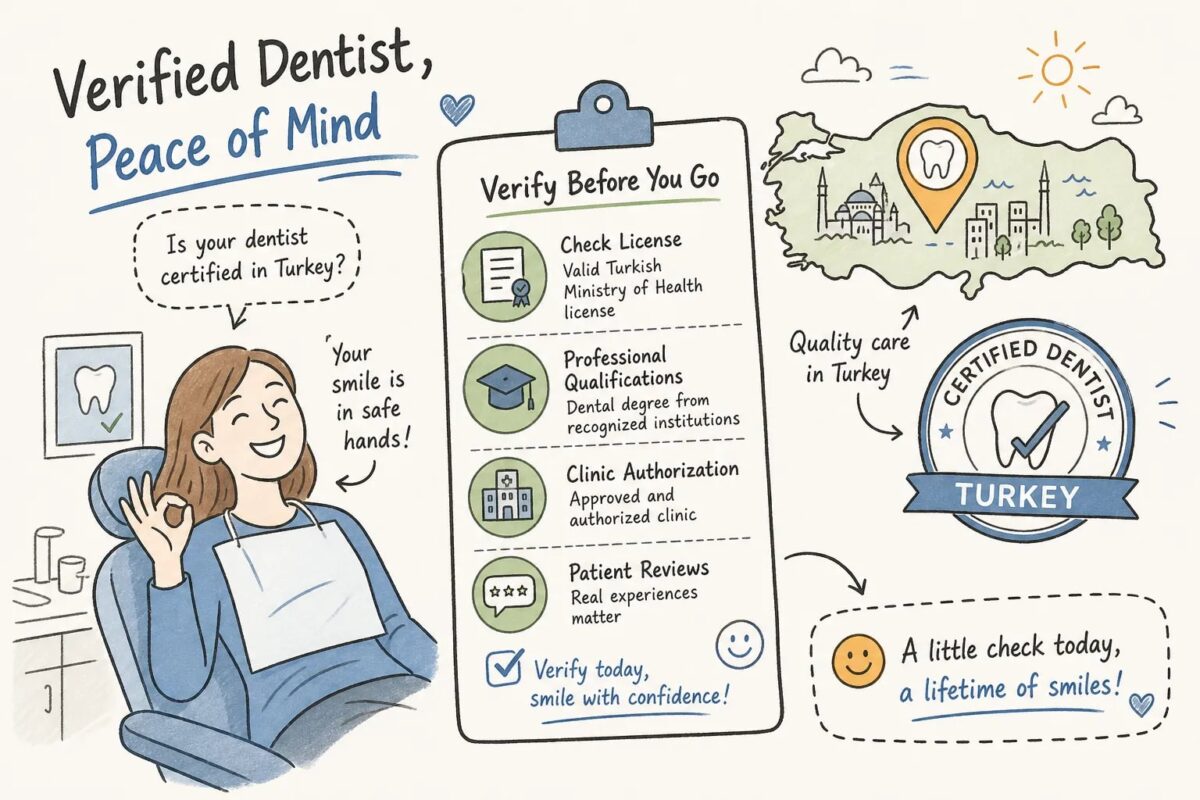
Health Turkey is Turkey’s government-backed certification program for clinics serving international patients. Certified clinics meet documented standards for equipment, safety protocols, patient communication, and complaint handling. For an American patient with no baseline familiarity with Turkish healthcare, it functions as an independent quality signal comparable to JCI accreditation for hospital systems. Any clinic actively competing for international dental tourism patients should hold this or an equivalent third-party accreditation. Its absence isn’t automatically disqualifying, but its presence removes a significant layer of uncertainty.
The practical checklist before you book
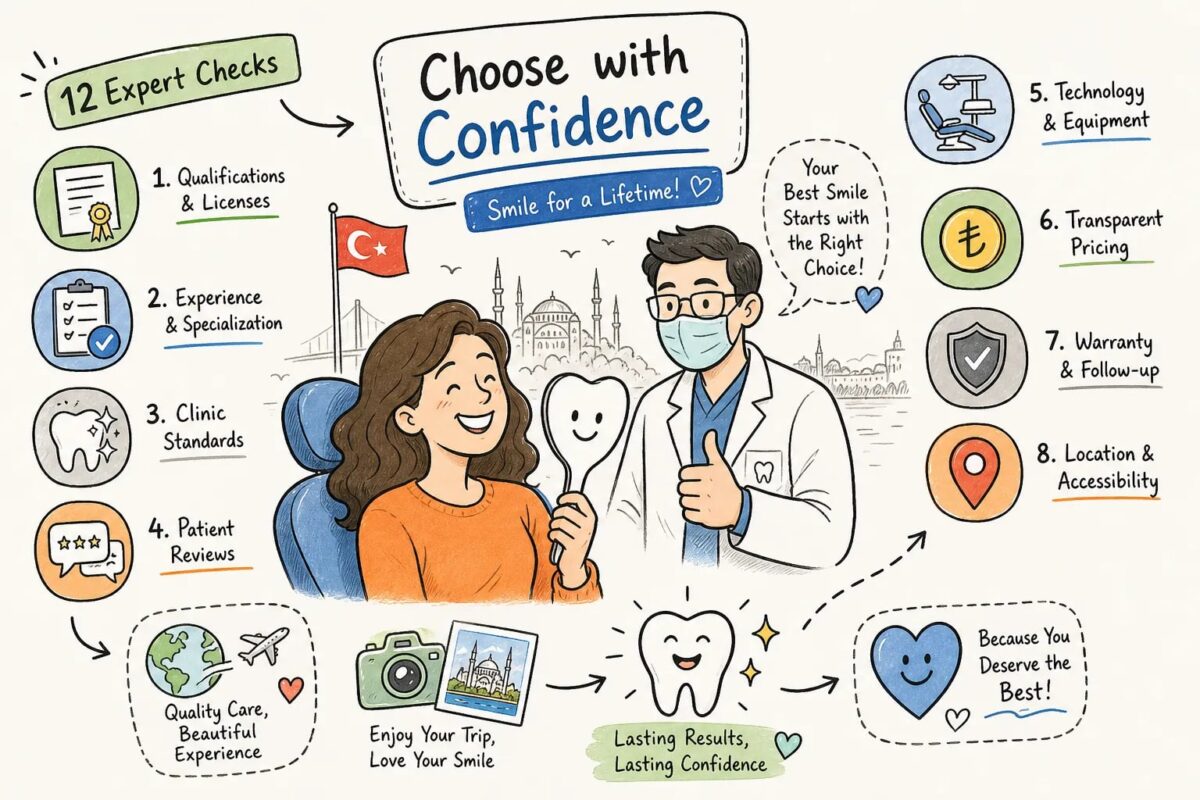
Apply this to every clinic on your shortlist before committing to anything:
- Verifiable postgraduate training in implantology or oral surgery, not just general dentistry
- Health Turkey certification or equivalent accreditation (JCI, ISO 9001)
- Published pricing or willingness to provide a written, itemized quote
- On-site CBCT scanning capability
- Documented before/after case portfolio
- Independent patient reviews on third-party platforms
Clinics that satisfy all six are operating at a meaningfully higher standard than those that satisfy two or three. Run through this list before you email anyone a deposit.
How to compare quotes and get a real number
The five questions to ask every clinic before committing
Send these to every clinic you’re considering, and ask for written responses:
- Which implant brand is included in the quote?
- What crown material is used, zirconia or PFM?
- Is bone grafting included in the price, and if not, what does it add?
- How many visits are required to complete the full treatment?
- What is the clinic’s policy if there’s a complication after you return home?
A clinic that answers all five clearly and in writing is operating from a position of transparency. One that deflects, rushes you toward a deposit, or keeps answers vague is not.
Red flags that signal pricing you shouldn’t trust
No itemized quote available is the most common one. Others include pressure to book before reviewing your CBCT results, a headline price that’s deliberately vague about materials, no verifiable specialist credentials on the clinic’s website, and no stated policy for implant failure or post-treatment complications. Price is never sufficient on its own to evaluate an implant clinic. The real filters are transparency, credentials, and accountability. A clinic that is cheap and evasive is not a bargain. It’s a liability.
Your next step: request a written quote from a verified specialist
An accurate implant quote requires diagnostic imaging. Any number you receive before a CBCT scan is an estimate, not a commitment. Dt. Çağrı Altuntaş Dental Clinic works specifically with international patients and provides written cost breakdowns before any commitment is made, reviewing your case, identifying what treatment you actually need, and presenting a clear itemized figure upfront. That’s the right starting point for researching dental implants Istanbul cost: not a comparison table from a dental tourism aggregator, and not a quote from a clinic that hasn’t looked at your jaw.
The bottom line on dental implants Istanbul cost
Single implants run $400 to $800 in Istanbul in 2026. Full-mouth All-on-4 solutions for both arches fall in the $7,000 to $12,000 range. The implant brand and crown material you choose are the biggest levers on where your cost lands within those ranges. The savings versus US pricing are real and substantial, the dental implants Istanbul cost advantage is well-documented across treatments.
The work is finding a clinic where those savings don’t come at the expense of clinical quality. That means a specialist with documented surgical training, a clinic with Health Turkey certification or equivalent accreditation, and a written itemized quote that leaves nothing ambiguous before you book. Dt. Çağrı Altuntaş Dental Clinic in Nişantaşı focuses specifically on international patients and is built around the transparency and specialist credentials that make a dental tourism decision a sound one.
Get a written, itemized quote from a Health Turkey-certified specialist with verifiable surgical training. Compare it against two or three others. Then book based on credentials and transparency, not on whoever sent the lowest number first.
Frequently Asked Questions
What should a complete Istanbul implant quote include?
It should identify the implant fixture, abutment, final crown, diagnostics, surgery, temporary restoration if needed, follow-up, guarantee terms and likely additional procedures.
Why do advertised implant prices vary so much?
Some prices cover only the implant fixture, while others include the restored tooth. Brand, grafting, sedation, crown material and case complexity also affect the total.
Will I need two trips to Istanbul?
Many staged implant cases require surgery first and the final restoration after healing. Immediate-loading treatment follows a different schedule and is not suitable for everyone.
Are bone grafts included in implant packages?
Often they are not. Ask whether extractions, grafts, sinus lifts, temporary teeth and additional imaging are separate.
What implant records should I take home?
Request imaging, the surgical report, implant and component details, product labels where available, maintenance instructions and emergency contact information.