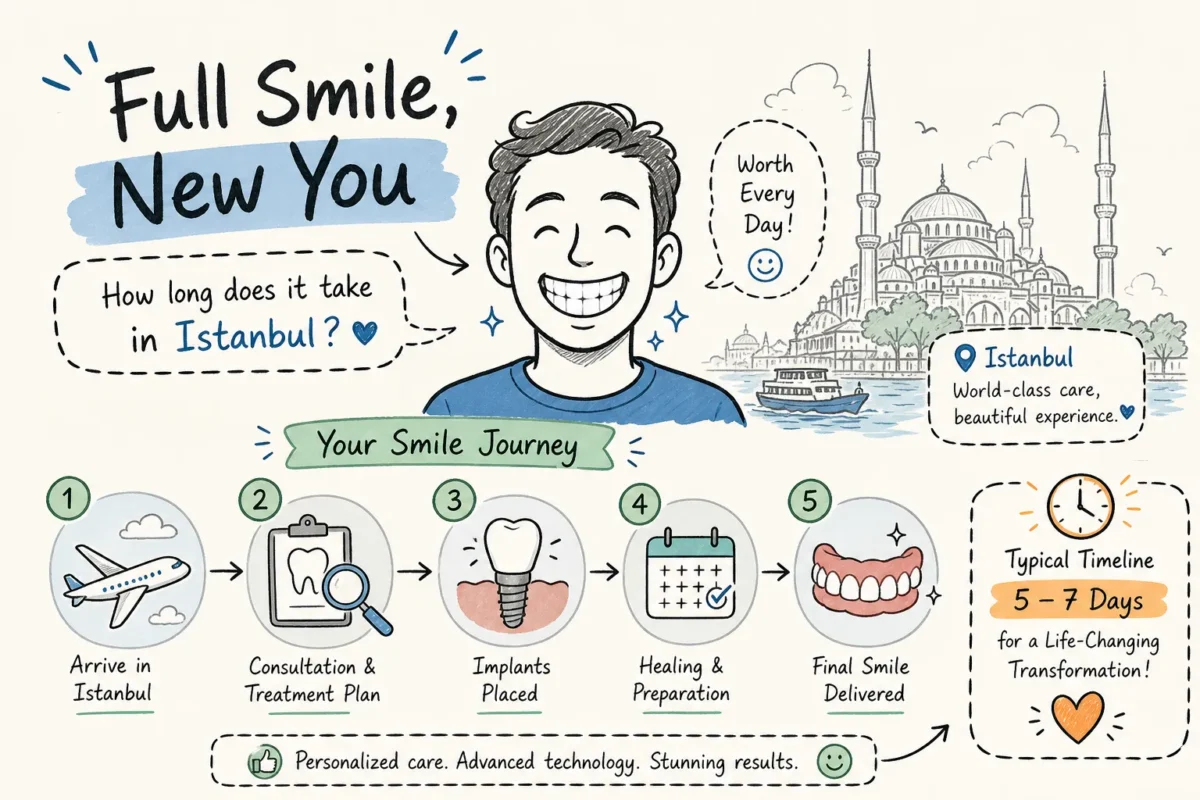
Five days or nine months. That’s the honest range for a full mouth restoration in Istanbul, and neither number is wrong. The difference comes down to what your mouth actually needs, not what any clinic’s marketing page suggests.
Americans planning dental tourism to Istanbul are right to ask about timing before they book flights. Getting this wrong doesn’t just waste money on plane tickets, it means arriving for a second visit before your body is ready, or rushing through a process that requires patience. So how long does a full mouth dental restoration take in Istanbul? The realistic answer depends entirely on your case category, and this guide breaks down every one of them.
At Dt. Çağrı Altuntaş Dental Clinic in Nişantaşı, Istanbul, every treatment plan starts with a complete diagnostic workup: 3D CBCT imaging, intraoral scanning, and digital smile design. That front-loaded process produces a phase-by-phase timeline before treatment begins, so patients traveling from the United States know how many trips they need and what each visit covers. The clinic reports that this approach consistently reduces mid-treatment surprises and last-minute schedule changes for international patients.
This guide walks through every phase of the process so you can build a realistic picture of your own case.
What the full restoration process looks like phase by phase
The consultation and diagnostic phase
Every restoration starts with a clinical evaluation: medical history, intraoral exam, X-rays, and a 3D CBCT scan that maps bone density, volume, and sinus anatomy. This is not optional paperwork. Those three factors are the most likely to change your timeline significantly. Clinics using digital planning technology can often complete diagnostics and finalize a full treatment plan during the initial visit or within a few clinic days, depending on case complexity.
Implant placement and the surgical phase
For patients needing implants, this is the most time-intensive phase. A full-arch case, whether All-on-4 or All-on-6, typically takes 2 to 4 hours per arch; see a typical dental implant surgery duration overview for context. Implant placement and temporary teeth happen in the same appointment for qualifying patients. Patients who also need extractions add some soft tissue healing time to the equation, either before or alongside the implant surgery. If you want more procedural detail from the clinic’s perspective, review their dental implant treatment information.
Crowns, veneers, and the restorative phase
Patients pursuing porcelain veneers, zirconia crowns, or a mix of both follow a different sequence: tooth preparation, shade selection, temporary veneers, lab fabrication, and final bonding. In Istanbul, many clinics work with on-site or closely partnered labs that turn crowns and veneers around in roughly 3 to 7 days, depending on the lab and case volume. That turnaround means the entire restorative phase fits cleanly inside a single trip for most patients.
How long does a full mouth dental restoration take in Istanbul? Same-day vs. staged routes
The same-day (immediate loading) route
Immediate loading means implants are placed and temporary fixed teeth are attached during the same surgical appointment. For qualifying patients, the first trip covers surgery and temporaries in one visit of 5 to 7 days. The second trip, 3 to 6 months later, is for the permanent prosthesis and typically takes 3 to 5 days. Total across both visits: roughly 8 to 12 clinic days. Not every patient qualifies for this route. Eligibility depends on bone density and whether the implant achieves sufficient primary stability. CBCT imaging helps predict eligibility before scheduling, but final confirmation of primary stability is made intraoperatively, so pre-surgical imaging narrows the field, it doesn’t guarantee candidacy.
The staged reconstruction route
Staged reconstruction follows a more conservative sequence. The process runs from extractions through staged healing windows to implant placement and, finally, the permanent prosthesis. This approach is standard for patients with significant bone loss, multiple complication sites, or cases that didn’t meet the clinical criteria for immediate loading. It typically requires more than two trips and can push the total full-mouth reconstruction timeline past 12 months. The tradeoff is a more methodical process that carries lower complication risk in genuinely complex cases.
Healing windows that control your schedule
Osseointegration: the phase that sets the clock
After implant surgery, the implant fuses with the jawbone in a process called osseointegration. The standard osseointegration window across implant protocols is 3 to 6 months, though selected cases in ideal bone conditions have been documented at 9 to 12 weeks; a useful dental implant healing timeline explains typical milestones during this period. During this window, patients are back home. No clinic visits are required unless a complication arises. The final prosthesis appointment is scheduled only after imaging confirms stable integration, so rushing this phase simply isn’t an option.
What bone grafts and sinus lifts add to your timeline
When bone volume is insufficient for implant placement, grafting or a sinus lift is performed first. These procedures add a preparatory healing phase ranging from a few weeks for minor augmentation to 4 to 9 months for more extensive work. For complex full-mouth cases involving significant bone grafting, the total implant healing time from first procedure to final placement commonly reaches 8 to 12 months. That single factor accounts for most cases that extend well beyond the standard 3 to 6 month range. If you need a practical summary of expected recovery after a sinus lift, consult a sinus lift recovery timeline.
How many trips to Istanbul most patients actually need
One-trip cases: veneers, crowns, and cosmetic restorations
Patients pursuing porcelain veneers, zirconia crowns, or a complete cosmetic smile makeover without implants typically finish everything in 5 to 7 days. A full-mouth veneer case involving 16 to 20 porcelain veneers follows a consistent schedule: diagnostics on day one, tooth preparation and temporaries on day two, lab fabrication over two to three days, then final bonding and adjustments before departure. One trip. No waiting at home.
Full-mouth restoration timeline in Istanbul: two-trip implant cases
For most patients traveling to Istanbul for All-on-4 or similar full-arch implant work, two trips is the standard structure. The first trip runs 5 to 7 days and covers diagnostics, surgery, and temporary teeth. The second trip, 3 to 6 months later, runs 3 to 5 days for permanent prosthesis fitting. For single implants, the same two-trip structure applies but with shorter stays: roughly 2 days for surgery and a few days for final crown fitting. This two-trip framework is the clearest way for most implant patients in Istanbul to plan their schedule. If you’re specifically researching options like All-on-4 in Turkey, use the two-trip model as your baseline planning assumption.
When a third trip becomes necessary
Third visits are uncommon but do happen. Adjustments after permanent placement, complications during healing, or procedures staged across multiple surgical phases can all produce a third visit. Patients who arrive with thorough pre-visit diagnostics already reviewed by the clinic tend to report fewer unexpected additional visits. The planning upfront is what keeps the trip count predictable.
Procedures that push your timeline by months
Extractions, grafts, and sinus lifts: what each adds to your schedule
Tooth extractions add 7 to 10 days of initial soft tissue healing, and potentially a few months of bone recovery if an implant is planned at the same site. Bone grafts extend the total restoration to 8 to 12 months in cases requiring significant volume, with minor augmentation adding at least several weeks. Sinus lifts fall in a similar category: most patients wait 4 to 6 months after a sinus lift before implant placement proceeds, and some surgeons recommend 6 to 9 months depending on the extent of augmentation. All three issues are detectable before your first trip if you get the right imaging done.
How to find out early whether you need any of these
A CBCT scan taken during the initial consultation reveals bone volume, density, and sinus anatomy in detail. Clinics that offer pre-visit digital records review can flag these issues before you book flights. That prevents the scenario where a patient arrives expecting a straightforward implant case and discovers on day one that grafting is required. The question to ask directly: “Does my case require any pre-implant procedures based on my existing records?” Getting a clear answer before confirming travel dates changes everything.
How to get a realistic personal timeline before you book
The questions that reveal how long your specific case will take
Before committing to any clinic, ask these four questions. How many trips does my case require based on my records? Are any pre-implant procedures anticipated? What is the lab turnaround time for my restorations? What is the earliest available surgery date? Clinics that answer with specific numbers rather than vague ranges have done the diagnostic work required to plan properly. Vague answers at this stage are a warning sign, not a negotiating position.
Why digital planning compresses the full-mouth restoration timeline for international patients
Practices like Dt. Çağrı Altuntaş Dental Clinic in Nişantaşı use intraoral scanning, 3D digital smile design, and CBCT analysis to build a detailed treatment roadmap before the patient lands in Turkey. Same-day appointments and tight coordination with the lab reduce the number of clinic days to the clinical minimum. For Americans traveling across multiple time zones, that front-loaded planning is the difference between a clean two-trip schedule and an open-ended treatment calendar. The clinic offers a free smile analysis consultation designed to walk prospective international patients through exactly this kind of phase-by-phase planning, reach out before you book to get a personalized timeline. For an overview of the clinic’s treatments and services, check their services page before your consultation.
The bottom line on timing
Veneers and crowns: one trip, 5 to 7 days. Implant-based restorations: two trips separated by 3 to 6 months of healing at home. Complex cases involving bone grafting or sinus lifts: 8 to 12 months total from first procedure to final placement. Most patients asking how long a full mouth dental restoration takes in Istanbul fall into one of those three categories.
The most important step before booking isn’t getting a price quote. It’s getting a diagnostic review that tells you which category your case actually falls into. A price quote without a treatment plan isn’t worth much. A treatment plan based on your imaging gives you a number you can actually plan around.
The full-mouth restoration timeline in Istanbul is ultimately determined by bone health, treatment scope, and how thoroughly the clinic plans before surgery day. Ask for a specific, phase-by-phase timeline based on your records, not a general range. If a clinic can give you one, that’s a clinic worth considering. Contact Dt. Çağrı Altuntaş Dental Clinic to request your free diagnostic review and get a realistic timeline for your specific case. If you still have questions after that, consult the clinic’s FAQ for common pre-visit and travel queries.
Timelines range from about five days (for qualifying immediate‐loading cases) up to nine months for staged reconstructions. The exact duration depends entirely on your clinical needs, whether you need implants, extractions, bone grafting, or only crowns/veneers, and the chosen treatment route.
The biggest drivers are bone density, bone volume, sinus anatomy and whether you need extractions or grafting, all assessed with 3D CBCT imaging. Clinic workflow and lab turnaround (for crowns/veneers), plus whether you qualify for immediate loading or require staged healing, also change the schedule.
Many restorative phases (crowns and veneers) can fit inside a single trip because local labs often turn work around in 3 to 7 days. Implant cases usually require at least two visits unless you qualify for immediate loading, since permanent prostheses are typically delivered after a 3, 6 month healing period.
Immediate loading means implants are placed and temporary fixed teeth attached in the same surgical appointment, allowing the first trip to cover surgery and temporaries in about 5 to 7 clinic days. Eligibility depends on sufficient bone quality and achieving primary implant stability; 3D CBCT helps predict candidacy but final confirmation is made during surgery.
A full‐arch implant surgery for All‐on‐4 or All‐on‐6 typically takes around 2 to 4 hours per arch. Patients who need extractions will add soft‐tissue healing time before or alongside implant placement, which can extend the overall timeline.
Many Istanbul clinics work with on‐site or closely partnered labs that fabricate porcelain veneers and zirconia crowns in roughly 3 to 7 days. That lab turnaround means the entire restorative phase (preparation, temporaries, and final bonding) often fits within a single trip for most patients.
The clinic starts with a complete diagnostic workup, 3D CBCT imaging, intraoral scanning, and digital smile design, to produce a phase‐by‐phase timeline before treatment begins. That front‐loaded planning tells patients how many trips they will need and what each visit will cover, reducing mid‐treatment surprises and schedule changes.