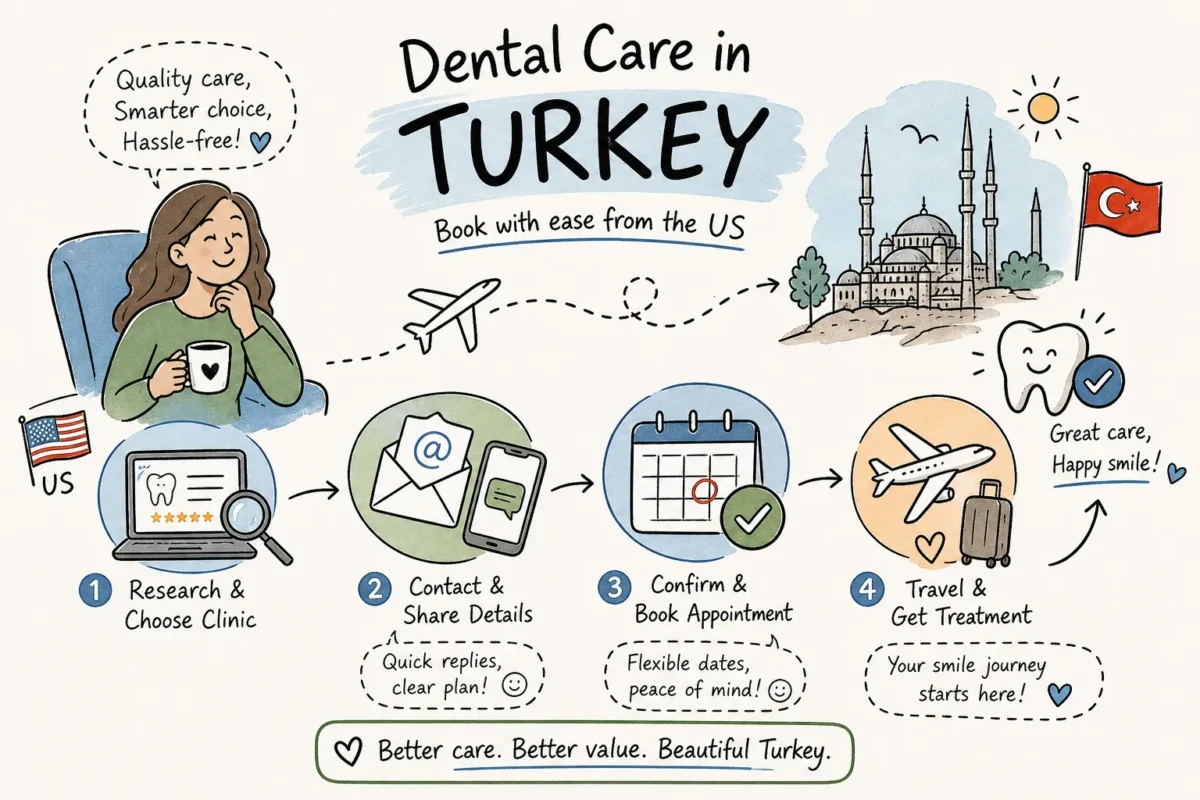
Booking dental treatment in Turkey from the US should follow a documented sequence: verify the clinic and treating dentist, share appropriate records securely, receive a preliminary itemised plan, confirm what may change after examination, and agree on travel, payment and aftercare terms before paying a deposit. Online photographs alone should not be treated as a final diagnosis.
Dental costs in the U.S. are high; a single crown often costs significantly more than what patients pay in Turkey for comparable quality. Those who need treatment for multiple teeth quickly find themselves facing total costs that put a significant strain on their monthly budget. Istanbul is increasingly seen as a serious alternative, and yet many U.S. patients hesitate—not because of a lack of trust in Turkish dentists, but because the booking process seems opaque when handled remotely.
The process is actually more clearly structured than it first appears. If you’d like to know how to book a dental appointment in Turkey from the U.S., this article provides a step-by-step guide, from your initial contact with the clinic to the completion of your follow-up care. Dr. Çağrı Altuntaş’s clinic in Nişantaşı offers, among other things, free online smile analyses and communicates with international patients in English. You can start the entire process from the comfort of your own home, long before you even pack your suitcase.
1. Finding the Right Clinic: Criteria That Really Matter
Simply searching for “dentist Turkey” and hoping for the first result: That’s not a strategy. If you compare options systematically, you’ll avoid disappointment and find a clinic that truly meets your needs much faster.
An Overview of Certifications and Quality Labels
The most important quality certifications for international patients are the Health Turkey certification, JCI (Joint Commission International) accreditation, and comparable international seals of approval. Health Turkey is particularly significant because the seal is awarded by the Turkish health authority, requires regular inspections, and demonstrates internationally recognized standards for U.S. patients. Dr. Çağrı Altuntaş’s clinic adheres to these quality standards and caters to international patients from English-speaking countries. Additional information on recognized clinics and comparison lists with recommendations for the best dental clinics in Turkey can be helpful in the decision-making process.
How to Read and Interpret Reviews Correctly
Google reviews, Trustpilot profiles, and testimonials on platforms like Reddit or PatientBeyondBorders provide valuable firsthand insights. However, they should always be considered a supplement to hard quality data, not the sole criterion for making a decision. A clinic with many positive reviews is a good sign; even more convincing is one that can also demonstrate recognized certifications, transparent treatment plans, and verifiable results. For example, read the testimonial from Gökçe S. or the report from Gera B. for concrete examples of the treatment process and follow-up care.
Free initial consultation as a reliable way to get started
Many reputable clinics offer a free initial consultation—with no upfront payment and no obligation to proceed with treatment. If you receive competent and patient advice right from the first contact, you’ll quickly recognize how patient-centered a clinic is. The free smile analysis at Dr. Altuntaş’s office is exactly this first, no-obligation step: a good way to see if the clinic and its treatment philosophy align with your own preferences.
2. Make initial contact and start the online consultation
Making initial contact with a clinic in Istanbul sounds like more work than it actually is. If you choose the right channel and make good use of the time difference, you’ll get an initial response quickly.
Which communication channels work best
Turkish clinics can generally be reached by email, WhatsApp, or through a web contact form. WhatsApp is well-suited for quick follow-ups and initial questions, while email is the better choice for written confirmations and treatment plans. For your initial inquiry in English, a short, clear message is sufficient: your name, the desired treatment, a note that X-rays are attached, and a request for a free cost estimate.
Bridging the time zone difference between the U.S. and Turkey
Depending on the U.S. state, Istanbul is 7 to 10 hours ahead of local time—a 7-hour difference from New York and a 10-hour difference from Los Angeles. Sending messages early in the morning U.S. time is therefore practical: this ensures that the request reaches the clinic on the same business day. Dr. Altuntaş’s team intentionally plans for asynchronous communication; responses are typically provided within one business day, though exact response times may vary depending on the volume of inquiries.
3. How to Send X-rays and Photos Digitally, Step by Step
This step causes unexpected anxiety for many patients, even though it is technically straightforward. Anyone who knows what the clinic needs and how to transfer the files can complete the process in less than an hour.
What Documents Turkish Clinics Need for Remote Diagnosis
Hospitals typically request the following documents for an initial online assessment; ideally, they should be complete and of good quality:
- A recent panoramic X-ray
- Intraoral photos from multiple angles (frontal, lateral, occlusal)
- Existing medical findings or previous treatment records
- A brief description of your own wishes and concerns
For more complex cases, such as implants or a complete oral rehabilitation, the clinic may also request a 3D CT scan or a digital panoramic X-ray. For most cosmetic treatments, recent photos and a panoramic X-ray are entirely sufficient as a first step.
Here’s how to transfer digital photos safely and easily
The first step: Request a digital copy of the X-rays from your U.S. dentist, preferably in DICOM format or as JPG files. Then send the files via WeTransfer, Google Drive, or directly through the clinic’s patient portal. Good clinics will actively assist you with this and explain which format and method of transfer they prefer. Important: Do not send screenshots or heavily compressed image formats, as these can result in the loss of clinically relevant image information.
4. Confirm the treatment plan and realistically estimate the costs
A three-line cost estimate sent via WhatsApp is not a treatment plan. If you know exactly what a reputable quote must include and what prices to expect in 2026, you can critically evaluate quotes and make an informed decision.
What a professional written treatment plan must include
Never book based on a verbal quote: That is the most important rule in dental tourism. A reliable written plan specifies the exact treatment steps, the materials and brands used, the number of sessions required, the total cost with no hidden additional charges, and the warranty terms. Good to know: Implants usually require two separate trips—one for the implantation and one for the final crown. Veneers, on the other hand, are often completed during a single visit.
Realistic 2026 Budget for Common Treatments
In 2026, prices at leading clinics in Istanbul will generally fall within the following ranges:
- Implants: approximately 500 to 1,500 euros per tooth (including abutment and crown)
- Veneers: approximately 200 to 500 euros per tooth, depending on the material (E-max or zirconia)
- Crowns: approximately 150 to 400 euros per tooth
The most important factors affecting the price are the implant brand, the crown material, any necessary bone grafting, and diagnostic costs. Many clinics also offer all-inclusive packages that include hotel accommodations, airport transfers, and follow-up care, which significantly simplifies the overall planning process and makes it even easier to compare prices with treatment costs in the U.S. A detailed overview of dental treatment in Turkey provides deeper insight into why patients are increasingly traveling there and what advantages medical treatments offer in that country.
This detailed cost analysis is very useful for obtaining a complete breakdown of the actual costs, particularly for dental implants. In addition, an overview of dental implant practices in Istanbul provides practical information on procedures and prices at leading clinics.
5. Plan the trip, arrive at the destination, and ensure follow-up care
Once the treatment plan has been confirmed, the practical part begins: sorting out entry requirements, organizing the trip, and understanding what to expect once you’re there. If you plan all of this in advance, you’ll arrive in Istanbul feeling relaxed and will know what to do upon your return.
Entry and Travel Documents for U.S. Citizens
U.S. citizens are exempt from visa requirements for short-term tourist stays of up to 90 days in Turkey and need only a valid U.S. passport with at least six months remaining validity from the date of entry, as well as at least one blank page for stamps. Travel insurance should also be on your checklist. It’s also important to note that most U.S. dental insurance plans do not cover treatment abroad. Medical bills from abroad may have tax implications; if in doubt, it’s worth checking with a tax advisor.
Flights, Hotels, and Transfers: What Clinics Can Arrange
Do not book flights until the exact dates have been confirmed with the clinic, as treatment plans are occasionally adjusted. Dr. Altuntaş’s clinic in Nişantaşı will coordinate airport transfers upon request and provide recommendations for nearby hotels. Istanbul is accessible via direct flights from several U.S. hubs, and Nişantaşı is a centrally located neighborhood with good transportation links.
What Happens on the First Day of Treatment and How Follow-Up Care Works
On the first day, a clinical examination, a digital intraoral scan, and final confirmation of the treatment plan take place before the actual treatment begins. Leading clinics, such as Dr. Altuntaş’s, use digital 3D planning technology, allowing patients to visualize the planned outcome even before the first procedure. Follow-up care is provided after the patient returns home via WhatsApp or video call: clear instructions on how to manage any potential discomfort and direct access to the treatment team. Long-term results depend on the treatment itself, individual oral hygiene, and consistent follow-up care.
Ready to take the first step?
If you want to understand how to book a dental appointment in Turkey from the U.S., you can approach the process in five clear steps: choose a certified clinic, submit your documents digitally, have the treatment plan confirmed in writing, organize your trip once the appointment is confirmed, and clarify follow-up care in advance. With proper preparation, the process is significantly less time-consuming than many initially assume. In addition, the patient guide offers practical checklists and tips for planning the entire trip.
If you’d like to take the first step now, you can request a free smile analysis from Dr. Çağrı Altuntaş in Istanbul—with no obligation and no time pressure. Simply send in recent photos or X-rays to receive an initial assessment. The clinic’s team communicates with international patients in English and supports them from the first contact through to the completion of follow-up care.
Frequently Asked Questions
What records should I send for an online dental assessment?
Clinics may request clear photographs, recent X-rays or scans, medical history, medication details and a description of your goals.
Can a final treatment plan be confirmed before I travel?
A preliminary plan is possible, but the final plan normally follows clinical examination, bite assessment and any required imaging in person.
What should an itemised quote include?
It should list procedures, tooth numbers, materials, diagnostics, temporary work, likely extras, visit schedule, guarantee and aftercare terms.
When should I book flights?
Book after the clinic confirms provisional dates and explains what could extend treatment. Flexible arrangements reduce risk when clinical findings change.
How should I pay a deposit safely?
Use the clinic’s verified business payment channel and obtain written cancellation, rescheduling and refund terms before payment.
What aftercare documents should I take home?
Request treatment records, imaging, material or implant details, maintenance instructions, medication information and emergency contact arrangements.