How do I find a trustworthy dentist in Turkey as an American? It’s the right question to ask before you book anything. Dental tourism in Turkey is real, the savings are real, and the risk is also real, not because Turkish dentistry is inherently unsafe, but because the market is uneven. A veneer that runs $180 to $250 per tooth in Istanbul can cost significantly more back home. That gap is real and documented. So is the fact that some Turkish clinics are world-class, while others run high-volume operations built for throughput, not care.
The problem isn’t Turkey. The problem is that many Americans have no system for telling the difference. They rely on Instagram before-and-afters and a Google rating. That’s not enough.
This guide gives you a real vetting system: eight specific steps to filter out the wrong clinics and identify the ones worth flying to. By the end, you’ll know what credentials to check, which review platforms to trust, what to demand before you book, and what good warranty terms actually look like.
Why the most popular Turkish dental clinics aren’t always the safest bet
The volume-factory problem in dental tourism
High marketing visibility in dental tourism often correlates with high patient volume, not high quality. Clinics that invest heavily in Google ads, social media influencers, and broker partnerships are optimized for bookings, not outcomes. High-volume operations serving international patients on tight schedules leave little room for individualized care or thorough planning. This is the volume-factory model, and it’s the most common trap Americans fall into when finding a trustworthy dentist in Turkey.
What “popular” actually signals in an unregulated market
Turkey’s cosmetic dentistry sector lacks a single overarching enforcement body that prevents unqualified clinics from marketing aggressively online. Popularity is a function of marketing budget, not clinical excellence. A boutique clinic with 200 thoughtful reviews and an internationally trained dentist will often rank below a high-volume operation with 2,000 generic five-star ratings. The vetting steps below exist precisely because the surface signals, reviews, rankings, social proof, are not reliable on their own.
Health Turkey certification: the baseline filter every American should apply first
What Health Turkey certification actually means in practice
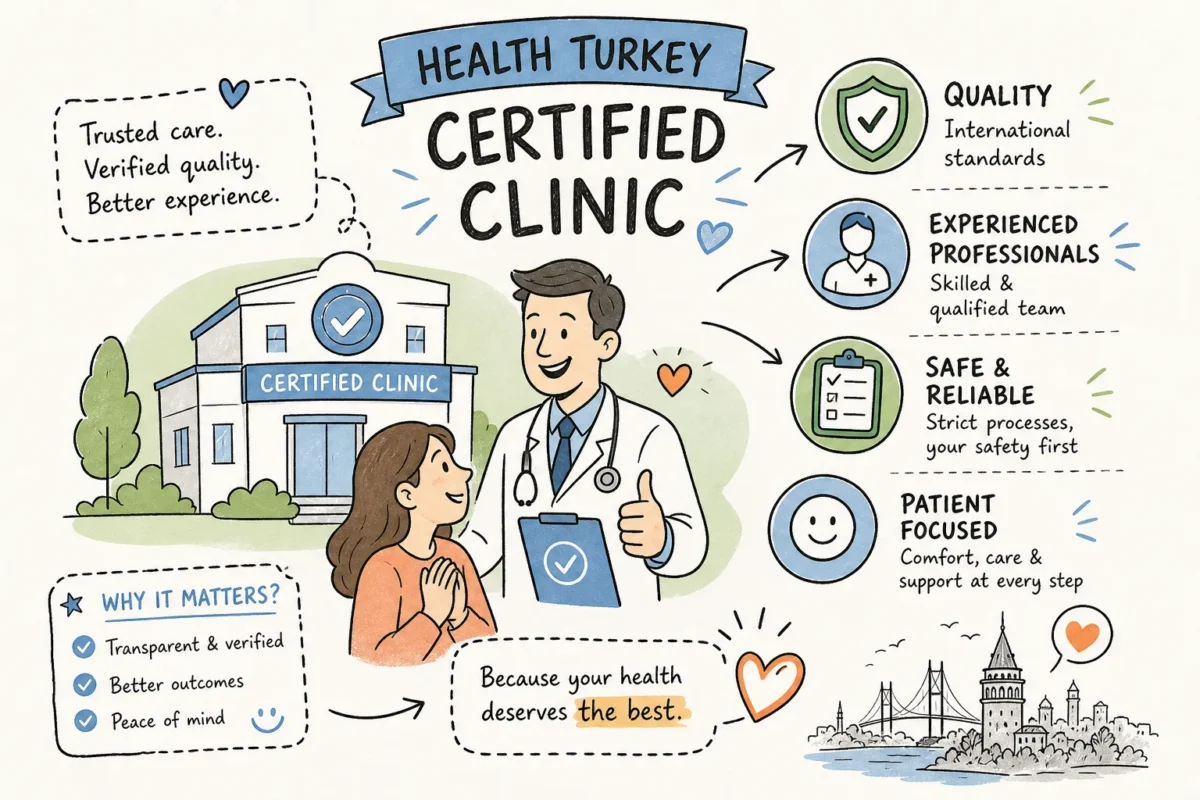
Health Turkey is Turkey’s Ministry of Health authorization program for clinics serving international patients. It’s not a marketing badge, it’s a formal authorization that requires a clinic to meet facility standards, maintain qualified staff, and operate within defined protocols for treating foreign nationals. This is separate from JCI accreditation (Joint Commission International), which is a distinct international standard. A handful of Turkish dental clinics hold JCI accreditation, Esnan Dental Clinics-Skyland has been identified as the first standalone dental clinic to achieve it, according to JCI’s public registry. Health Turkey certification is far more common and is the minimum bar worth checking for any clinic targeting American patients.
How to confirm a clinic’s certification status before contacting them
Don’t just accept the badge on their website. Ask the clinic for their Health Turkey authorization certificate number, then request a copy of the certificate with a visible expiration date. Cross-reference it against official Ministry of Health records where possible. Legitimate clinics should produce this documentation promptly. Persistent refusal to provide it is a strong red flag and a good reason to move on before you ever get on a call with them.
Why certification matters more for international patients than domestic ones
International patients face additional cross-border enforcement and logistical barriers if something goes wrong, barriers that domestic patients simply don’t face. Health Turkey certification creates formal accountability for international patient care, including documentation protocols and treatment standards. It’s not a guarantee of quality, but it establishes a baseline that unregistered clinics don’t have to meet. That distinction matters when you’re thousands of miles from home.
How to find a trustworthy dentist in Turkey as an American: verifying credentials step by step
The Turkish Dental Association register and what to look for
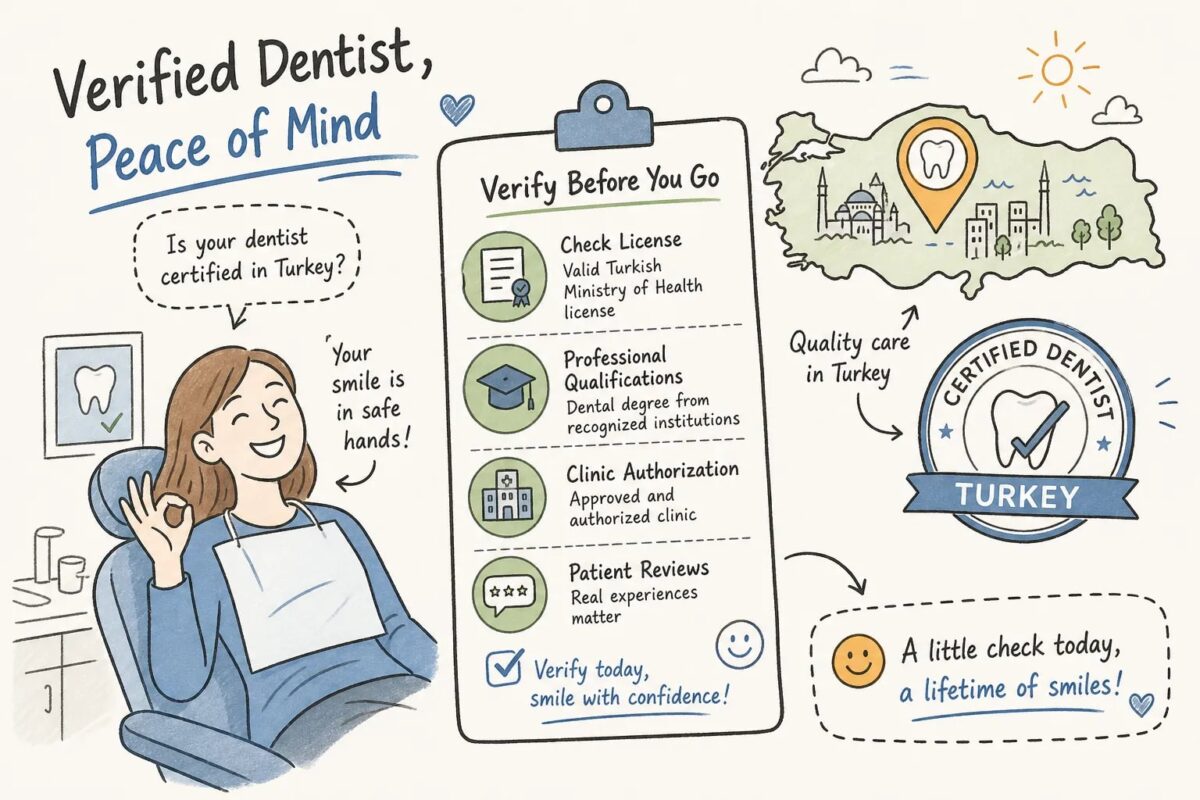
Every licensed dentist in Turkey holds a registration number with the Turkish Dental Association (TDB). Ask the clinic for the treating dentist’s full legal name and TDB registration number, then request confirmation that the registration is active. Cross-check the name, title, and listed specialty against what the clinic claims on their website. Discrepancies between the TDB record and marketing materials are an immediate red flag. You can contact TDB directly at [email protected] if the clinic is evasive about providing this information.
Why postgraduate specializations need to be verified separately
In Turkey, as in most countries, a general dentistry license doesn’t automatically confer specialist status in prosthodontics, oral surgery, or implantology. A dentist who performs full-mouth restorations or complex implant placements should hold a postgraduate certificate or master’s degree in the relevant specialty. Ask for the diploma directly. A dentist with a master’s degree in Oral Surgery and Implantology from a recognized international institution gives you a verifiable paper trail that most high-volume clinic dentists cannot produce. That level of academic specificity matters when you’re evaluating someone who will restructure your smile. When reviewing Dr. Çağrı Altuntaş’s credentials, for example, ask specifically for the diploma from Saint Camillus University in Italy and verify it directly with the issuing institution, that’s exactly the due diligence process every American should apply.
What questions to send in writing before your first call
Send an initial email requesting these four things before you schedule any call: the treating dentist’s full legal name as registered with TDB, their registration number, their specialty certificate or postgraduate diploma if they’re claiming a specialty, and the clinic’s Ministry of Health authorization number. Any clinic that returns complete answers promptly is demonstrating transparency. Any clinic that answers vaguely, redirects, or skips the credentials while pushing you toward pricing is showing you a red flag worth taking seriously.
Where to find real international patient reviews (and how to spot the fake ones)
The three review platforms worth checking for Turkish dental clinics
Not all review platforms are equal. For Turkish dental clinics serving international patients, three platforms offer the most credible review infrastructure: WhatClinic labels reviews as “verified” and ties them to specific clinics; Trustpilot performs checks on reviews and prohibits clinics from paying to remove negative feedback; and Bookimed restricts reviews to patients who booked through the platform. Cross-reference the same clinic across all three. If a clinic appears on only one platform with a pristine score, that’s worth noting.
Patterns that signal review manipulation
Generic five-star reviews with no treatment details are the most common signal. Real dental patients mention procedure type, recovery specifics, appointment count, communication quality, and often the journey itself. If the majority of reviews sound like “amazing clinic, highly recommend” without any of that texture, they likely aren’t genuine. Also check the timeline: a sudden cluster of five-star reviews within a short window often indicates a solicited campaign. Read the worst reviews first. How the clinic responds to criticism tells you more about how they operate than any five-star comment does.
Why before-and-after photos need context to be useful
Many clinics post striking before-and-after imagery on Instagram and their websites. On their own, these photos prove very little. They don’t tell you the patient’s name, the treatment timeline, the materials used, or whether the outcome held up over time. Look for video testimonials from international patients with verifiable social profiles. Better yet, ask whether the clinic can connect you with a past patient willing to share their experience directly. A clinic confident in its outcomes won’t hesitate at that request.
Red flags that should stop you before you book anything
Pricing anomalies and suspiciously low all-inclusive packages
In Turkey in 2026, reputable clinics typically charge $350 to $900 for a single implant and $180 or more per veneer, with all-on-four full-arch implant packages starting around $2,500 to $7,000 per arch. A clinic quoting dramatically below these ranges may be using inferior materials, cutting procedural corners, or building in hidden costs that only surface after you’ve traveled. Treat dramatically low pricing as a caution signal worth investigating. Itemized quotes are a baseline expectation, any clinic that only provides a package number without a procedure-by-procedure breakdown is not being transparent with you.
Communication and pressure tactics that signal the wrong kind of operation
Legitimate clinics take time to gather clinical information before they quote anything. If a clinic sends you a treatment plan and price within hours of your first inquiry, without X-rays, photos, or any clinical data, they didn’t customize that plan for you. It’s a template. Similarly, any clinic that uses urgency tactics like “this price is only valid this week,” pushes you to wire a large deposit immediately, or discourages questions about credentials is showing you exactly how they operate with patients. Walk away. The right clinic will make you feel informed, not rushed.
Request a digital treatment plan before you commit to traveling
What a legitimate pre-travel treatment plan actually includes
Before you book flights, a reputable clinic should provide a digital treatment plan based on submitted clinical records: photos, X-rays or CBCT scans, and ideally a digital scan. This plan should include the proposed procedures in sequence, the materials specified by brand and grade, the estimated number of appointments and timeline, the itemized cost breakdown, and a clear explanation of what happens if the outcome differs from expectations. This isn’t extra work for a competent clinic. It’s the standard.
How 3D digital smile design protects you as an international patient
Advanced clinics use digital smile design software and intraoral scanning to create a visual simulation of your outcome before any preparation work begins. This simulation is a communication tool: it aligns expectations between you and the dentist before you get in the chair. At Dt. Çağrı Altuntaş Dental Clinic, 3D smile planning with intraoral scanning is part of the pre-treatment consultation process, not a marketing feature, but a clinical protection for you. You see what you’re agreeing to, and changes can be made digitally before they’re made permanently to your teeth.
What to do if a clinic won’t provide a pre-travel plan
If a clinic refuses to engage in pre-treatment planning until you’ve paid a deposit and arrived in Istanbul, that’s a meaningful signal. Some clinics frame this as “we need to see you in person first,” which is partly legitimate for complex cases. But a full refusal to share a provisional treatment approach or preliminary scope tells you the clinic is not set up to serve international patients properly. A clinic built for American patients will have a clear process for remote assessment before you ever buy a plane ticket.
The virtual consultation you should schedule before you board a plane
What to ask during a virtual consultation and why the answers matter
A virtual consultation isn’t just a meet-and-greet. It’s a clinical assessment and a communication test in one call. Come prepared with specific questions: What is your postgraduate training in this procedure? How many of this specific treatment have you performed on international patients? What happens if I need a revision after I return home? What does your written guarantee cover, and what does it exclude? The answers matter less for content and more for behavior. A dentist who answers precisely and without defensiveness is demonstrating clinical confidence. A dentist who pivots to pricing or testimonials instead of answering directly is telling you something important.
What good answers sound like versus what rushed answers signal
A credible English-speaking dentist in Turkey will walk you through their rationale for the proposed treatment, not just the cost. They’ll ask about your dental history, your expectations, your timeline, and your tolerance for the procedure. They’ll tell you what they won’t do, not just what they will. Clinics with an actual patient-centered philosophy use the virtual consultation to disqualify themselves from patients they can’t serve well. That kind of honesty is one of the clearest signals that the clinic is worth visiting.
Warranties, aftercare, and what happens when something needs fixing back home
What a real written guarantee covers at a legitimate Turkish clinic
Reputable Turkish clinics provide written warranties, not verbal assurances. For implant fixtures, lifetime guarantees are common, though many clinics use “lifetime” to mean fracture coverage on the implant screw itself, not a guarantee against biological failure. For crowns, veneers, and other prosthetic work, warranty periods typically range from one to five years, sometimes longer depending on the material and clinic policy.
What matters is specificity. The guarantee should name the implant brand and specifications, define what is covered, fracture, cement failure, workmanship defects, and spell out what is excluded, including accidental damage, poor hygiene, missed follow-up appointments, and smoking-related failure.
The records pack every international patient should leave with
Before you fly home, a responsible clinic should hand you a complete records package: the written treatment plan and final invoice, CBCT scans and clinical photos, an implant passport with brand and lot numbers, the written warranty with named exclusions and expiration terms, and a maintenance schedule for follow-up care. This documentation is what makes a warranty claim enforceable from thousands of miles away. Without it, “lifetime guarantee” is a marketing phrase with no mechanism behind it.
Finding a trustworthy dentist in Turkey as an American: what a fully vetted clinic looks like
Use the eight steps in this guide as a filter, and apply them consistently to every clinic you evaluate. A clinic that passes each checkpoint, Health Turkey certification, a dentist with verifiable postgraduate credentials, documented 3D digital planning, a clear process for virtual consultations, and written treatment guarantees, isn’t a coincidence. It’s a clinic built for international patients rather than merely adapted for them. Dt. Çağrı Altuntaş Dental Clinic in Nişantaşı, Istanbul is one clinic that invites this level of scrutiny, and that willingness to be vetted is itself a useful signal. Use it as a benchmark when you’re evaluating others.
Start with the right questions, not the right price
The point of this guide isn’t that Turkey is risky or that it’s foolproof. The vetting steps exist to make the decision clear. Clinics that welcome credential checks, provide detailed pre-travel plans, offer virtual consultations, and back their work in writing are not rare, but they’re not the majority either. The ones that do are easy to identify when you know what to look for.
Start with Health Turkey certification. Verify credentials directly with the TDB. Cross-reference reviews across WhatClinic, Trustpilot, and Bookimed. Request a digital treatment plan before you buy a flight. Schedule a virtual consultation before you commit to anything. Americans can find trustworthy dentists in Turkey, but only when the right filters are applied from the start.
If you’re ready to take the next step, Dt. Çağrı Altuntaş Dental Clinic offers a free smile analysis and personalized consultation for international patients. Submit your photos and X-rays and get a specific treatment assessment before you buy a flight.
Frequently Asked Questions
How can an American verify a Turkish dentist?
Check professional registration, education and experience relevant to the planned procedure, and verify the clinic’s international-patient authorisation.
What should I request before paying a deposit?
Ask for a diagnosis-based preliminary plan, itemised quote, materials, visit schedule, cancellation terms, guarantee and aftercare process.
Can I trust before-and-after photos?
Use them as supporting evidence only. Look for similar cases, consistent photography and clear information about the treatment performed.
What are common warning signs?
Pressure to pay, vague provider identity, refusal to share documents, fixture-only implant prices and promises made without diagnostics are warning signs.
How should I plan follow-up care in the US?
Take records, imaging and material details home, and discuss local follow-up and responsibility for corrective care before travel.