Growing numbers of Canadians are flying abroad for dental work, and vetting a dentist abroad carefully is what separates a successful trip from an expensive problem. The economics make the appeal obvious. A single implant that runs $3,000 to $6,000 in Canada can cost $600 to $1,500 in Istanbul. A porcelain veneer priced at $1,200 to $2,800 per tooth at home is available in Turkey for $200 to $400. The savings aren’t theoretical. For a patient needing six to ten veneers, the difference easily covers the entire trip and then some.
The risks are real too, but they’re manageable with the right approach. The problem is that many patients do their homework backwards. They browse a clinic’s website, admire the before/after gallery, read a few Google reviews, and book. That process feels thorough. It isn’t. This checklist flips the order. Before a flight is booked or a deposit is paid, these are the things worth verifying systematically. The goal isn’t to scare you out of dental tourism. It’s to make sure you come home with the smile you paid for.
Vetting a Dentist Abroad Starts with Credentials, Not Branding
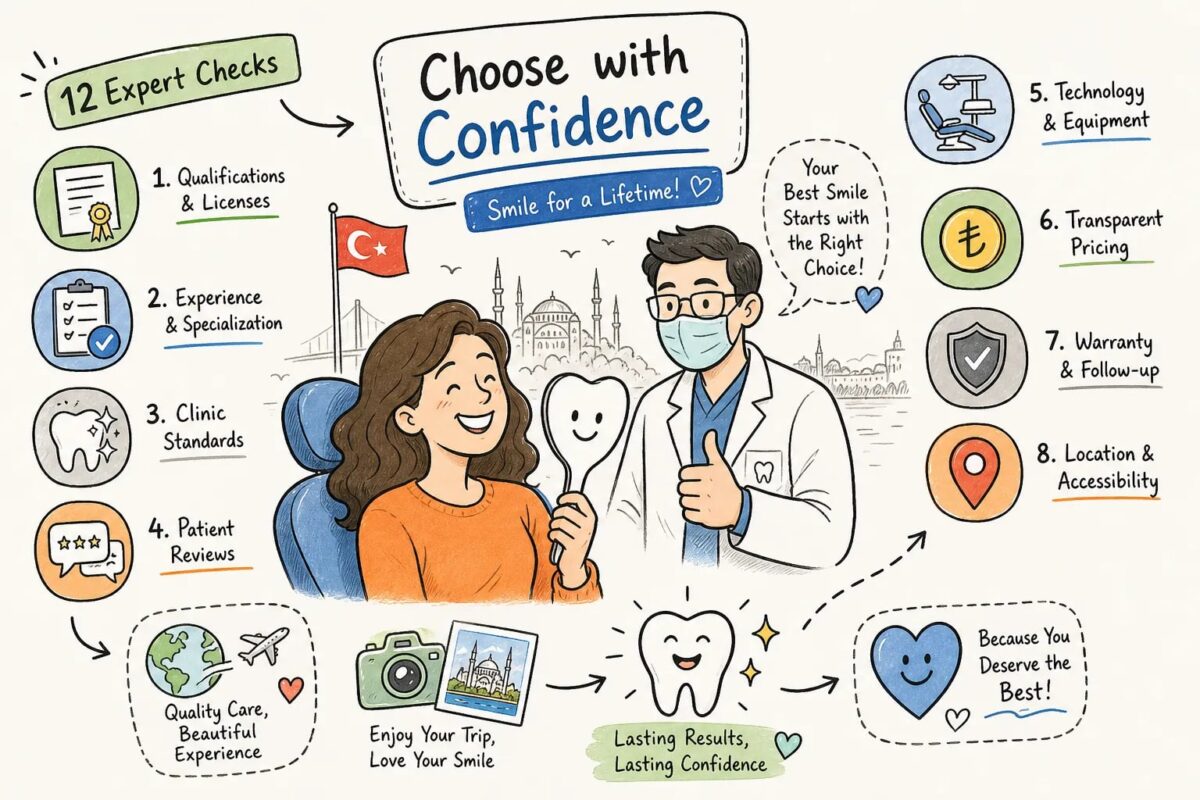
A clinic can look exceptional online and still employ a dentist whose training doesn’t match the complexity of what they’re offering. When choosing a dentist abroad, ask specifically: where did the treating dentist complete their undergraduate dental degree, and what postgraduate training have they completed? A basic dental degree permits general practice, but high-level cosmetic work requires more than that. Digital smile design, full-arch veneer cases, and implant placement each draw on advanced training that goes beyond dental school.
Postgraduate specialty training from an internationally recognized institution carries meaningful weight when you’re evaluating overseas dental clinics. Dr. Çağrı Altuntaş at Dt. Çağrı Altuntaş Dental Clinic in Istanbul states postgraduate training in Oral Surgery and Implantology from Saint Camillus International University of Health Sciences in Italy, combined with over 15 years of focused cosmetic dentistry practice. That kind of European postgraduate training, paired with extensive clinical experience, is the profile worth looking for in any dentist you’re considering. If a clinic can’t tell you where the treating dentist trained, in what program, and for how long, that’s a gap that should stop you there.
What Clinic Accreditation Actually Signals
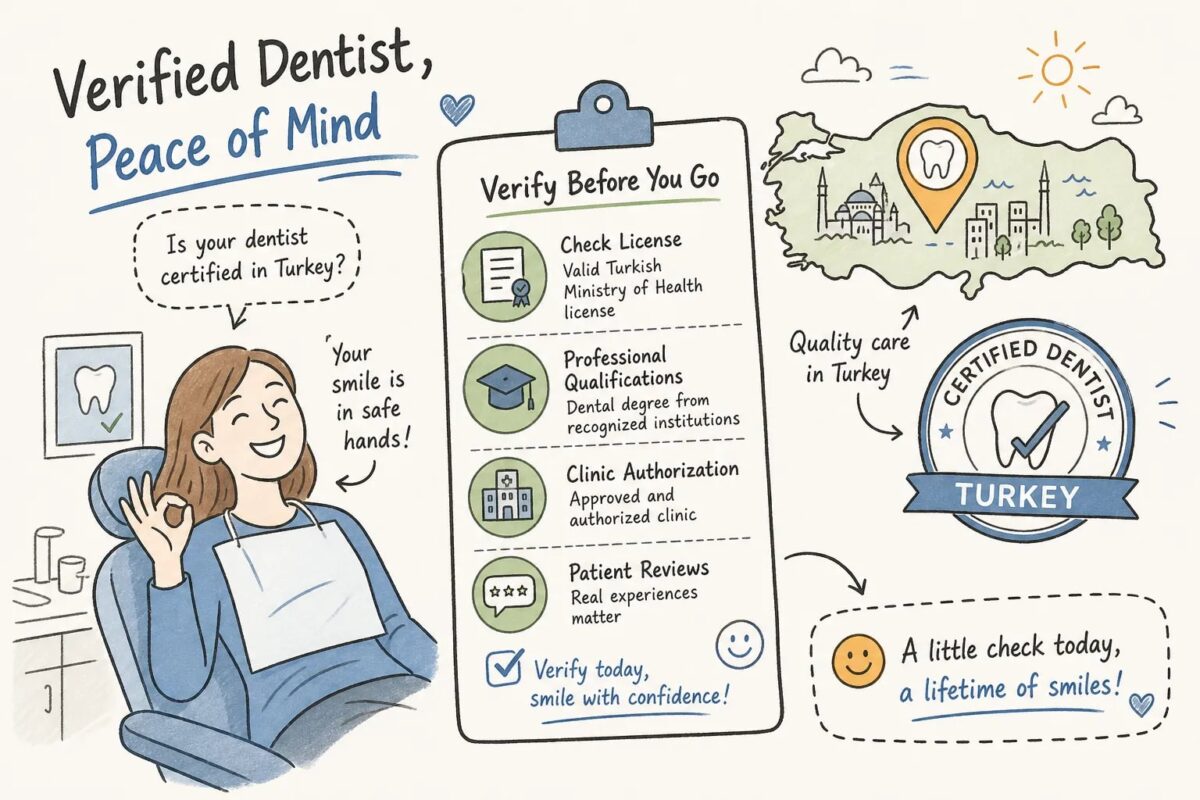
There’s a real difference between a “hygiene certificate” on a waiting room wall and legitimate accreditation. The first is a marketing artifact. The second comes from a recognized body with defined standards, regular inspections, and a public record. For facility accreditation, look for recognition from a credible healthcare accreditor such as AACI’s international dental accreditation standard. For individual dentists, the relevant check is active registration with the country’s dental regulator.
For Turkey specifically, Health Turkey certification is a government-issued authorization from the Turkish Ministry of Health that permits a clinic to treat international patients. It’s not a cosmetic badge. Clinics holding it have met standards covering hygiene protocols, approved equipment, patient safety requirements, and international patient services including language support and written treatment documentation. It’s verifiable through the official Health Turkey registry, any clinic not listed there is not legally permitted to treat foreign patients. Dt. Çağrı Altuntaş Dental Clinic lists Health Turkey certification, which gives Canadian patients a verifiable entry to check against the official registry rather than relying on a brochure claim.
You can also verify individual dentists through the Turkish Dental Association (TDB), which registers all licensed dentists in Turkey. Ask for the treating dentist’s full legal name and registration number, then confirm it directly. One thing to check: make sure the specialist named on the website is the person who will actually be treating you, not a junior associate assigned on the day.
How to Evaluate a Before/After Portfolio with Real Skepticism
A portfolio that shows consistent lighting between before and after shots, multiple angles rather than a single curated view, and a range of starting points is a meaningful signal. What you want to see is variety: patients who came in with staining, crowding, gaps, and worn edges, not just ideal candidates who needed minor refinement. A gallery made up entirely of Hollywood-uniform results should prompt questions. Real clinical experience produces a wide range of outcomes across a wide range of starting points.
Red flags to watch for include different camera angles between the before and after shots (which exaggerate improvement), obvious editing around the gum line, and suspiciously uniform tooth shapes that suggest stock imagery rather than real cases. A reverse image search on portfolio photos is a legitimate check and takes about thirty seconds. Beyond the photos themselves, ask the clinic to provide five to ten before/after cases that match your specific situation. If you need three implants and six veneers, you want to see cases of similar scope, not isolated single-tooth transformations. A clinic with genuine breadth of experience in cross-border dentistry can produce those examples. One that deflects that request is telling you something.
Communication Quality Is a Safety Mechanism, Not a Convenience Feature
When you’re abroad for a clinical procedure, clear communication isn’t optional. You need to understand your treatment plan, consent to each step, and feel safe raising concerns if something feels off. A clinic with genuine multilingual support means English-speaking coordinators, written treatment plans in your language, and real pre-treatment consultation calls before you board the plane. Ask directly: who will you be communicating with before, during, and after your visit? Get a name. If the answer is vague, that’s a signal.
Clinics using digital smile design and intraoral scanning technology take this further. With 3D treatment planning, you can see a visual simulation of your expected outcome before any tooth is prepared. That’s not technology for its own sake. It’s a communication standard that forces alignment between what you expect and what the dentist is planning, upfront, before any irreversible work begins.
If a clinic offers this, ask to see an example of how they present it to patients. Dt. Çağrı Altuntaş Dental Clinic incorporates intraoral scanning and 3D smile planning as a standard part of the consultation process. For a full-arch case, that level of pre-treatment transparency is something every patient should expect from any vetted dental clinic they’re considering.
The Real Cost Math: What Canadians Actually Save Abroad
The numbers are compelling. In Canada in 2026, a single dental implant runs $3,000 to $6,000. In Istanbul, the same procedure is typically $600 to $1,500. A crown costs $1,000 to $3,000 in Canada versus $250 to $500 in Turkey. Porcelain veneers in Turkey, priced at $1,200 to $2,800 per tooth at home, are available for $200 to $400 in Istanbul. For a patient needing six to ten veneers, the savings exceed $10,000 even after accounting for flights and accommodation.
Most cost comparisons leave out the full picture. Round-trip flights from major Canadian hubs to Istanbul run approximately $900 to $1,400, based on typical fares from cities like Toronto, Vancouver, and Calgary, though prices vary by season and booking window. Budget for accommodation, meals, and a buffer stay in case minor adjustments are needed. Factor in travel insurance and the cost of any follow-up care back in Canada. When the honest math is done, dental tourism to Turkey still represents substantial savings for most Canadians, but the realistic total trip cost lands closer to $2,500 to $3,500 once logistics are included. That’s still a fraction of what the same work would cost at home, but the calculation is worth doing before you commit.
Vetting a Dentist Abroad: Sterilization Standards and Insurance
A legitimate clinic answers sterilization questions without hesitation. Ask whether all reusable instruments are autoclaved, how often the clinic performs biological spore testing on sterilizers (weekly testing is the established benchmark), whether single-use items are discarded after each patient, and how surfaces are disinfected between appointments. If you get vague answers like “hospital-grade cleanliness” rather than specific process descriptions, treat that as a hard stop. Ask for written infection-control protocols. A clinic operating to international patient standards will have them and will share them without reluctance; for more on typical office practices see this guide on infection control in dental offices.
On the insurance side, the category matters. Standard Canadian travel insurance typically covers unexpected dental emergencies that occur during travel, a broken tooth or an infection, but not complications from planned dental treatment. For dental tourism, the relevant product is a specialist medical tourism insurance policy.
Medical Travel Shield is one example that explicitly covers complications from planned procedures abroad, including repatriation costs. Before you leave, confirm what documentation your policy requires for claims: treatment records, itemized billing, and a diagnosis document from the treating clinic. Get those documents from the clinic at the end of your visit, regardless of how smoothly everything goes.
A Checklist Worth Actually Using
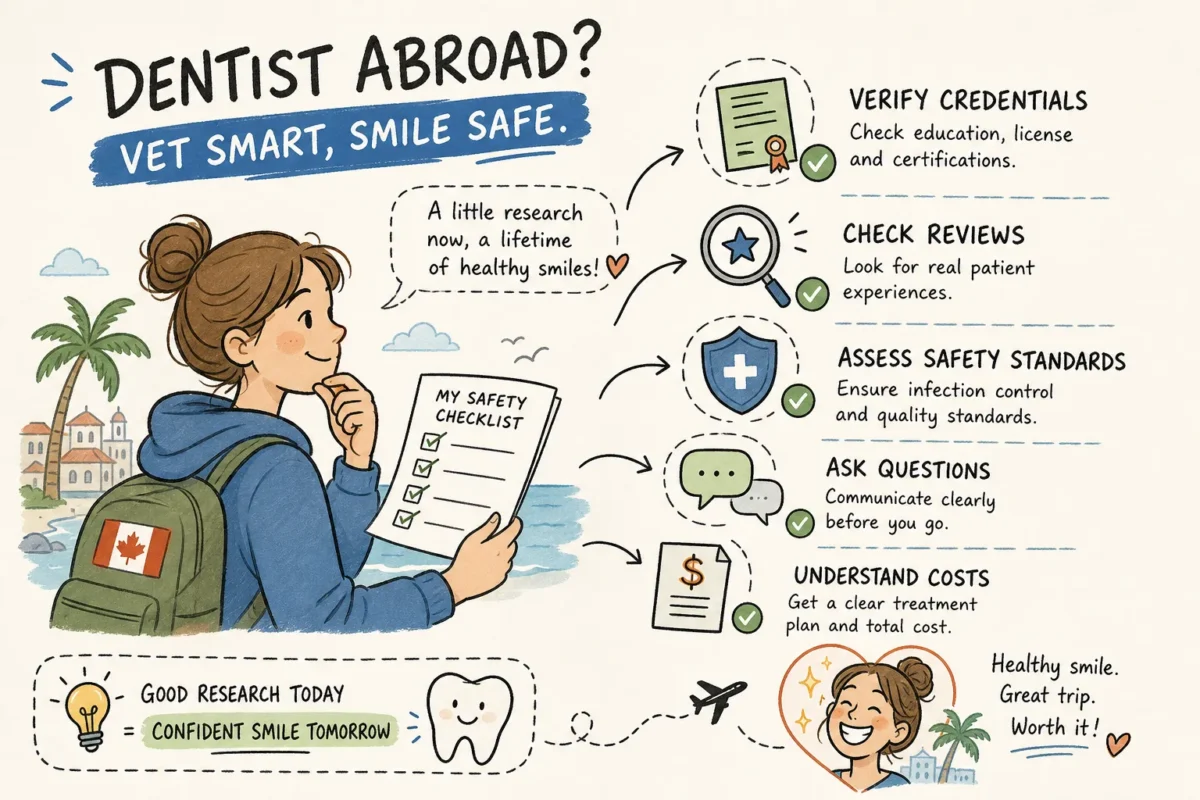
Vetting a dentist abroad doesn’t require specialized knowledge. It requires doing it in the right order. Start with credentials, not photos. Confirm accreditation through official registries. Ask hard questions about sterilization and get written treatment plans before committing. Evaluate the portfolio critically and request cases that match your own situation. Run the full cost math including travel. Know your insurance position before you board the plane.
Dt. Çağrı Altuntaş Dental Clinic in Istanbul is one example of a clinic built around the kind of transparency this checklist demands, stated postgraduate training, Health Turkey certification to verify, digital treatment planning, and dedicated multilingual support. Use this checklist on every clinic you shortlist. The right clinic will pass it. In short, vetting a dentist abroad methodically is what protects both your health and your savings, and it’s a reasonable standard to hold any clinic to before you commit.