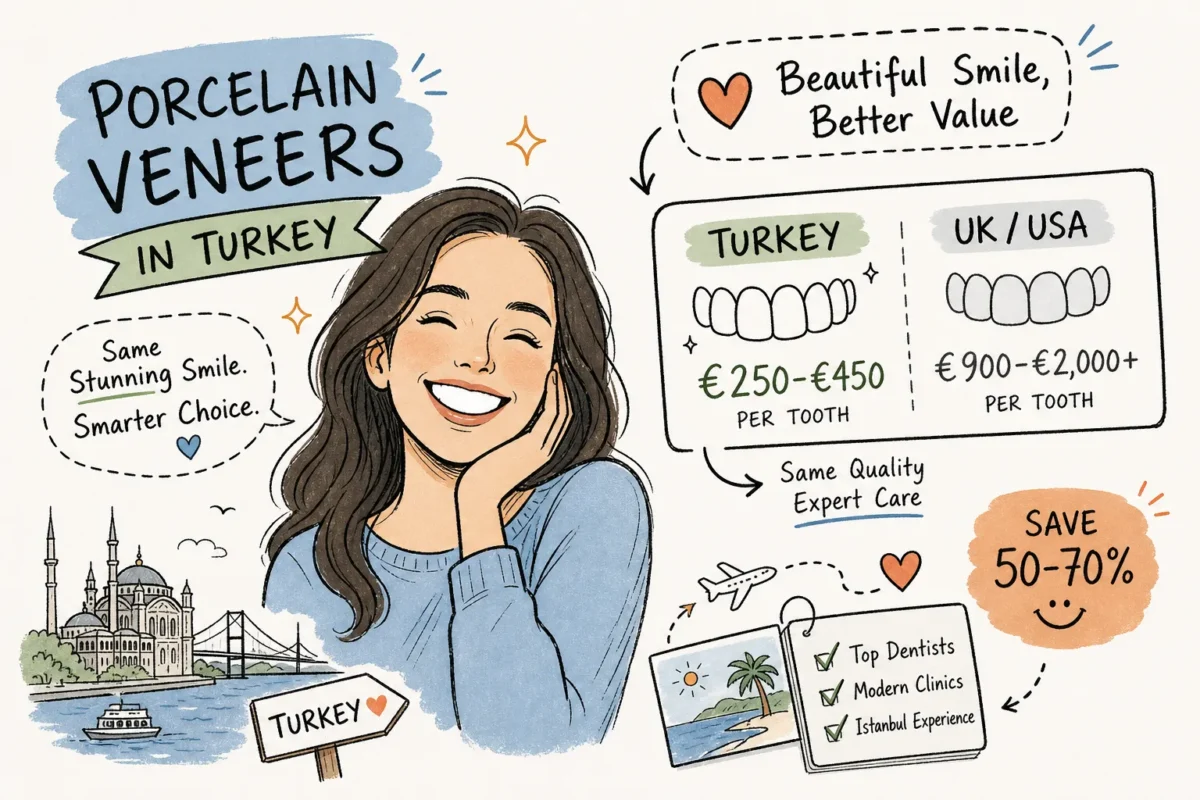
American patients are routinely quoted $1,500 to $2,500 per tooth for porcelain veneers at home. In Istanbul, the same caliber of work runs $200 to $400 per tooth. That gap is real, and it’s why a growing number of Americans fly to Turkey for smile makeovers every year. The math isn’t complicated. Even after flights and a hotel, many patients, particularly those pursuing full-set treatments, save $8,000 to $30,000 compared to what they’d pay at home.
This article breaks down exactly what porcelain veneers cost in Turkey in 2026, what that price does and doesn’t include, and what separates a clinic worth trusting from one to avoid. Boutique, Health Turkey-certified practices in Istanbul, like Porcelain Veneers, Dt. Çağrı ALTUNTAŞ 2026 in Nişantaşı, are the kind of options American patients are actively researching. Understanding what those clinics offer, and how to evaluate them honestly, is what this article is for.
What porcelain veneers actually cost per tooth in Turkey right now
The 2026 per-tooth price range for porcelain veneers at reputable Turkish clinics is $200 to $400. That’s the real number, not a teaser. Where you land within that range depends on the material you choose, the clinic’s reputation, and the lab doing the fabrication.
Standard porcelain, E-max, and zirconia price ranges
The three main materials you’ll encounter are standard porcelain, E-max (lithium disilicate), and zirconia. Each sits at a slightly different price point in Turkey:
- Standard porcelain veneers: $200, $350 per tooth
- E-max (lithium disilicate) veneers: $225, $350 per tooth
- Zirconia veneers: $200, $400 per tooth
- Composite veneers (for comparison): $150, $180 per tooth
E-max is commonly preferred for anterior aesthetic veneers because it transmits light more naturally than standard porcelain, giving veneers a translucency that mimics real enamel. That’s why it costs slightly more. Zirconia is exceptionally durable, which makes it the better call for back teeth or patients with a grinding habit. Standard porcelain is a solid middle ground for most smile makeover cases. For more on the specific benefits of the E-max option, see E-max veneers.
How full-set pricing works
Most patients aren’t replacing one tooth. A full smile makeover typically involves 8 to 20 veneers across the upper and sometimes lower arch. An 8-veneer upper set in Turkey runs roughly $1,600 to $2,800 total. A full 16- to 20-veneer upper and lower treatment runs roughly $3,200 to $8,000, depending on material choice and clinic tier.
Those are realistic ranges, not starting-from figures designed to get you on the phone. A boutique clinic using premium E-max and a European-sourced lab will price toward the top of that range. A higher-volume clinic using domestic materials will price toward the bottom. The difference matters, and the next sections explain why.
Turkey vs. the US: what the price difference actually looks like
The US average for porcelain veneers runs $1,500 to $2,500 per tooth. Turkey runs $200 to $400 per tooth. An 8-veneer set in the US costs $10,000 to $20,000. In Turkey, the same set costs $1,600 to $2,800. A full 16-tooth treatment in the US can reach $20,000 to $40,000. In Turkey, it’s $3,200 to $8,000. These aren’t edge cases or cherry-picked quotes. They’re the standard market rates on both sides.
What travel actually adds to the total
Round-trip economy flights from major US hubs to Istanbul run approximately $900 to $1,500 in 2026, depending on departure city and how far ahead you book. A hotel for 7 to 10 nights in Istanbul, which is what most veneer patients need, runs roughly $700 to $1,500 depending on the tier you choose. That puts total travel overhead at approximately $1,600 to $3,000. For concrete flight routing and pricing examples, see flights such as flights from New York to Istanbul.
Even adding the full cost of travel, many patients save $8,000 to $30,000 on a full-set veneer treatment compared to what they’d pay at home. The math holds up. And unlike flying to another US city for a cheaper dentist, Istanbul gives you a genuinely premium cosmetic dental market, not a compromise.
What a veneer package in Turkey actually includes
Turkish veneer packages are generally all-inclusive for the treatment itself. Extras vary, and the details matter. At a reputable clinic, the quoted price typically bundles:
- Consultation and smile design planning
- X-rays and diagnostics
- Tooth preparation
- Temporary veneers for the waiting period
- Final veneer fitting and bonding
- Lab fabrication
That last item is important. At Turkish clinics, lab work is almost always included in the quoted price rather than billed separately, a sharp contrast to how many US dental offices handle it.
At premium practices, digital smile planning with intraoral scans and 3D preview software is part of the process, not an upsell. That matters because it lets you approve the exact shape and shade of your veneers before the lab fabricates them. It’s how you avoid getting work that looks wrong when it arrives. See how clinics implement this approach in their smile planning workflows: Smile Design, Dt. Çağrı ALTUNTAŞ 2026.
What’s often not included
Flights and hotel are usually excluded from the treatment price. Some clinics advertise dental holiday packages that bundle accommodation and airport transfers, but most quote treatment-only. Airport and clinic transfers are included by many clinics, confirm it in writing. Aftercare warranties vary widely. Most reputable clinics include a follow-up appointment and a post-treatment guarantee, but ask for a written guarantee specifying exactly which failure scenarios are covered and for how long before you book.
Any clinic that won’t provide an itemized written quote is a yellow flag. Itemization isn’t a negotiating tactic; it’s how you know what you’re actually buying. Clinics that resist it are usually hiding something, excluded lab costs, lower-grade materials, or both.
The factors that push veneer prices up or down
Price differences between Turkish clinics aren’t random. Material and lab quality, the dentist’s credentials, and the clinic’s overhead structure each play a distinct role. Understanding all three helps you evaluate quotes more accurately than just comparing numbers.
Material quality and where the veneers are made
Not all dental labs are equal. Turkish clinics that use European-sourced ceramic materials from manufacturers like Ivoclar or VITA charge more than those using budget domestic labs. E-max and high-grade zirconia cost more in raw materials, and that cost passes through to the patient. When requesting a quote, ask specifically which lab fabricates the veneers and where the materials are sourced. A clinic that can answer that question clearly is operating transparently. One that can’t, or won’t, is not.
Dentist credentials and specialist training
A cosmetic dentist with postgraduate specialist training commands higher fees than a general dentist offering veneers as a side service. That premium is worth paying. The margin between a $250 and $350 veneer is trivial compared to the financial and physical cost of redoing failed work. When credentials are verifiable and internationally obtained, they’re one of the strongest signals of quality available to you as a foreign patient.
Clinic location and overhead
Clinics in upscale Istanbul neighborhoods like Nişantaşı operate with higher overhead than high-volume dental tourism operations in less expensive areas. That’s reflected in pricing, and that’s appropriate. A higher price at a legitimate boutique clinic signals quality positioning, not gouging. The risk zone is the middle: clinics charging $300 or more per tooth but operating at factory volume with compromised personalization and lab quality. That’s the combination that produces the most disappointing outcomes.
How to verify a Turkish clinic’s quality before you book
Credentials and certifications are the fastest way to separate legitimate clinics from marketing-heavy ones. They’re not infallible, but they narrow the field quickly.
Certifications that carry real weight
Health Turkey certification is the Turkish government’s international patient accreditation for clinics treating foreign patients. It’s not a marketing badge. It requires documented quality standards, sterilization protocols, licensed staff, approved materials, and patient safety systems, and it’s verifiable through official channels. A clinic holding Health Turkey certification has cleared a real bar. JCI (Joint Commission International) accreditation is the gold standard for hospital-level facilities and is an even stronger signal. ISO certifications are supportive but weaker than outcome-based accreditation on its own.
For independent, procedure-focused listings and clinic comparisons that can help you narrow options, check reputable clinic directories and procedure pages such as those listing porcelain veneer clinics in Turkey on Bookimed. Peer-reviewed safety and outcome data can also inform your decision; see a relevant peer-reviewed study for broader context on dental treatment outcomes.
Reading patient reviews without getting fooled
Look for reviews that name the specific procedure, the treating dentist, and mention post-treatment follow-up. Volume and recency matter more than an average star rating. Be skeptical of clinics whose reviews all read like they were written by the same person: polished, short on specifics, and heavy on enthusiasm. The most credible reviews include details about complications, how the clinic responded, and what the teeth looked like six months later.
Ask the clinic directly for procedure-specific complication and revision rates. A reputable clinic will have this data and share it. One that responds to the question with testimonials instead of numbers is telling you something about how it operates.
Using a benchmark to evaluate other clinics
Dr. Çağrı Altuntaş’s practice in Nişantaşı represents the upper end of what Istanbul’s cosmetic dental market offers: Health Turkey certification, Italian postgraduate surgical training, 15-plus years of clinical experience, and digital smile design technology including 3D intraoral scanning. That combination of credentials, technology, and boutique patient volume is a useful benchmark when evaluating other clinics. If another clinic can’t match that credential profile at a comparable or lower price, it’s worth asking exactly why. For German-language details, see Porzellan-Veneers, Dt. Çağrı ALTUNTAŞ 2026.
Getting your quote and the practical next steps
The quality of a clinic’s quoting process tells you a lot about how it operates. Clinics that send a flat price sheet without asking to see your teeth are not doing the work required to give you a real estimate. Clinics that ask for photos and records before quoting are operating properly.
What to send for an accurate estimate
To get a meaningful quote, send:
- Recent dental X-rays or a panoramic scan if you have one
- Clear photos of your teeth from the front and sides, both smiling and relaxed
- A brief description of what you want to change
That’s enough for a qualified clinic to provide a specific, itemized estimate rather than a starting-from number.
Red flags in quote responses
Walk away from any quote response that shows these signs:
- No itemization of what’s included in the price
- Pressure to book immediately or claim a “limited-time” price
- No mention of which dentist specifically will treat you
- No information about the lab used or material sourcing
These aren’t minor details. Each one signals that the clinic isn’t operating with the transparency a serious cosmetic procedure requires.
Starting with a free smile analysis
Many reputable Turkish clinics, including Dr. Çağrı Altuntaş’s practice, offer a free initial smile analysis where you submit photos and receive a personalized assessment before committing to anything. That’s the right first step. Get the analysis, compare responses from two or three clinics, evaluate the quality of how they respond as much as the price they quote, and then decide. If you want comparative pricing articles to understand the market before you reach out, there are practical cost breakdowns available such as guides on pricing and what to expect in Turkey.
The bottom line on porcelain veneers turkey cost
At reputable Turkish clinics, porcelain veneers cost $200 to $400 per tooth in 2026. Travel overhead typically runs $1,600 to $3,000 total. Even after accounting for flights and a hotel, many patients, especially for larger full-set cases, save $8,000 to $30,000 compared to having the same work done at home. That’s a meaningful number, and it’s why Istanbul has become a serious destination for cosmetic dentistry, not just a budget option.
The clinic choice is everything. Credentials, Health Turkey certification, lab quality, and transparent pricing separate good outcomes from expensive mistakes. The veneer procedure itself is straightforward when performed by a qualified cosmetic specialist. The risk isn’t the procedure; it’s choosing the wrong person to perform it.
If you’re seriously considering veneers in Turkey, start by requesting a free smile analysis from a Health Turkey-certified clinic. Submit your photos, ask the questions outlined above, and compare how clinics respond. The first step costs nothing. What you learn from it is worth a lot.