
Orthodontics is a specialty of dentistry that examines, diagnoses, and treats the alignment of teeth and jaws, as well as misalignments and bite problems (malocclusion). It does more than just create an aesthetically pleasing smile; it also preserves long-term oral health by improving chewing function and making oral hygiene easier. Dr. Çağrı Altuntaş, who sees patients at his clinic in Nişantaşı, Istanbul, combines modern orthodontic approaches with a vision for aesthetic dentistry to offer tailored solutions for patients of all ages.
Why Is Orthodontic Treatment Necessary?
Crooked teeth or malocclusion do not only affect appearance; they can also lead to the following health problems:
Tooth Decay and Gum Disease: It is difficult to clean between crooked teeth, which leads to plaque buildup.
Joint Problems: Improper bite alignment (when the upper and lower teeth do not align properly) can lead to pain and locking of the jaw joint.
Chewing and Speech Disorders: Due to the position of the teeth, it may be difficult to chew food thoroughly or to produce certain sounds.
Tooth Wear: Improper force applied between teeth leads to premature wear of the enamel.
Orthodontic Treatment Methods
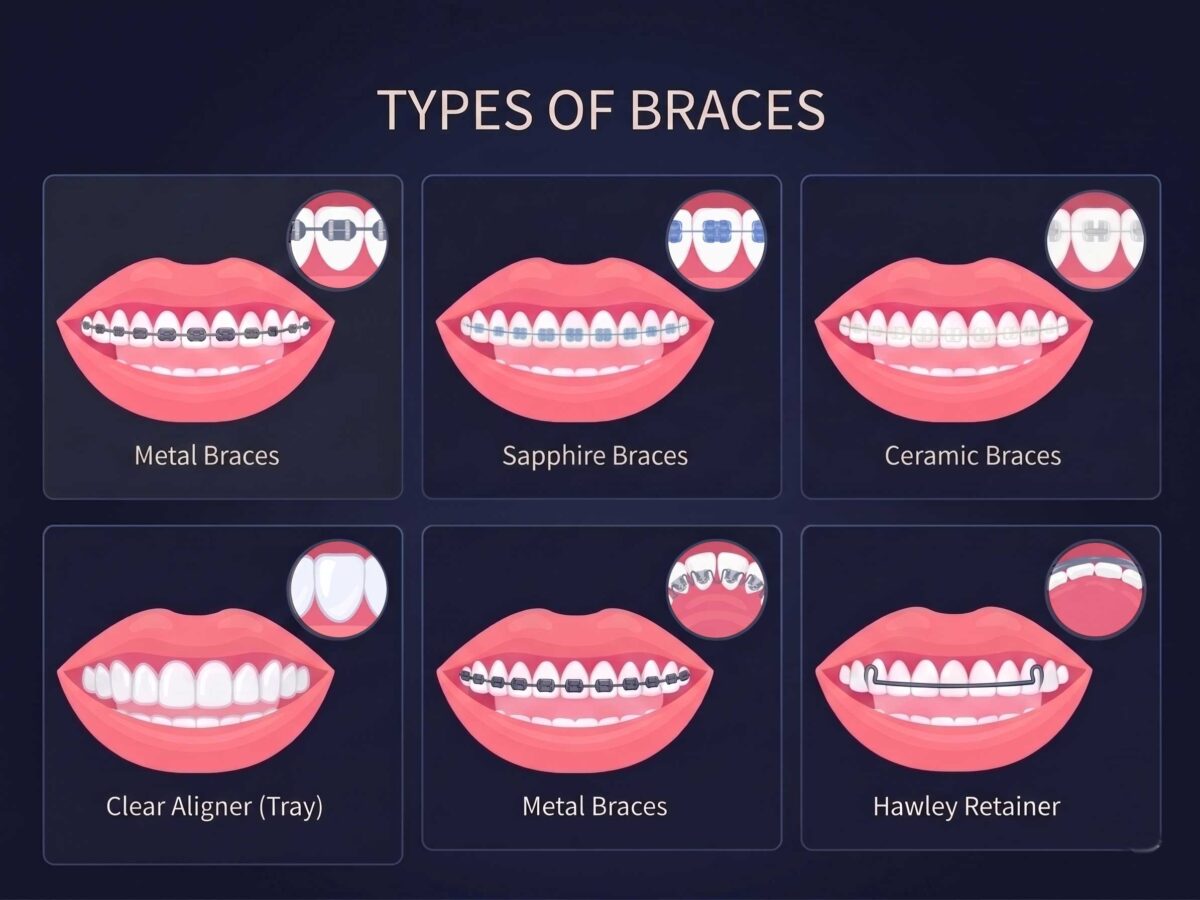
Thanks to modern technological advancements, orthodontics is no longer limited to just “metal braces.” The main methods used at our Nişantaşı clinic are as follows:
1. Clear Aligners (Invisalign, etc.)
In this method, also known as “invisible orthodontics,” custom-made clear aligners are used to gradually move the teeth. They are virtually invisible to others, and the fact that they can be removed while eating offers great convenience.
2. Metal and Porcelain Braces (Traditional Braces)
This is the most common and effective method. For patients concerned about aesthetics, tooth-colored (transparent) brackets are used to minimize visibility.
3. Lingual Orthodontics (Invisible Braces)
This is a method in which braces are bonded to the inner (tongue-side) surface of the teeth rather than the front surface. The treatment process is completely invisible from the outside.
4. Orthodontics
Especially in children who are still growing and developing, it corrects issues such as a narrow jaw or an upper or lower jaw that is too far forward or too far back at the bone level using orthodontic appliances.
At What Age Should Orthodontic Treatment Be Undertaken?
Children: It is recommended that the first orthodontic examination be conducted at age 7. Although the teeth may not be fully aligned at this age, monitoring jaw development can help prevent the need for major surgical procedures in the future.
Adults: There is no age limit for orthodontic treatment. People of all ages with healthy gums and bone structure can have their teeth straightened using clear aligners or aesthetic braces.
Treatment Process and Planning
The orthodontic process with Dr. Çağrı Altuntaş proceeds as follows:
Digital Analysis: A 3D model of the teeth is created using intraoral scanners (such as iTero).
Simulation: A computer simulation is used to show the patient what their teeth will look like after treatment.
Procedure: Depending on the chosen method, braces are fitted or the first set of clear aligners is provided.
Follow-up: Progress is typically monitored every 4 to 6 weeks.
Frequently Asked Questions About Orthodontics
How long does orthodontic treatment take?
Although the duration of treatment varies depending on the severity of the case, it generally ranges from 12 to 24 months. Mild misalignments can be corrected with clear aligners in 6 to 8 months.
Does getting braces hurt?
Having braces fitted is a painless procedure. However, it is normal to feel some pressure and mild soreness in your teeth for the first few days after they are fitted; this is a sign that your teeth are beginning to move.
Are clear aligners or braces more effective?
Both methods produce excellent results when properly planned. While clear aligners offer advantages in terms of aesthetics and hygiene, traditional braces may provide faster results in cases of highly complex malocclusions.
Is tooth extraction necessary during orthodontic treatment?
This is not necessary in every case. If there is not enough space in the jaw for the teeth to fit, or if there is severe overjet, tooth extraction may be planned to achieve the ideal alignment.
Can you get braces as an adult?
Absolutely. Orthodontic treatment is possible at any age as long as the bone structure supporting the teeth is healthy. Today, adults make up a large portion of our patient base.
Will my teeth become crooked again after I have my braces removed?
Once treatment is complete, the retention phase begins. If retainers—such as fixed retainers or night guards—are not used, there is a risk that the teeth will shift back to their original positions.
Is it hard to eat while wearing braces?
While wearing metal braces, you should avoid biting into hard foods like apples and carrots and steer clear of sticky foods. With clear aligner treatment, however, there are no such restrictions.
How much will orthodontic treatment cost in 2026?
Prices are determined based on the selected method, whether the procedure involves the upper or lower jaw, and the estimated duration of treatment. After a detailed analysis, the most suitable payment plan is developed.
Will braces affect my speech?
Braces placed on the outside of the teeth do not affect speech. Although clear aligners or lingual braces may cause a slight slurring of speech for the first few days, the tongue adapts very quickly.
Can impacted teeth be removed with orthodontic treatment?
Yes, impacted canine teeth, in particular, can be moved into their proper positions through a minor surgical procedure and the application of orthodontic force.