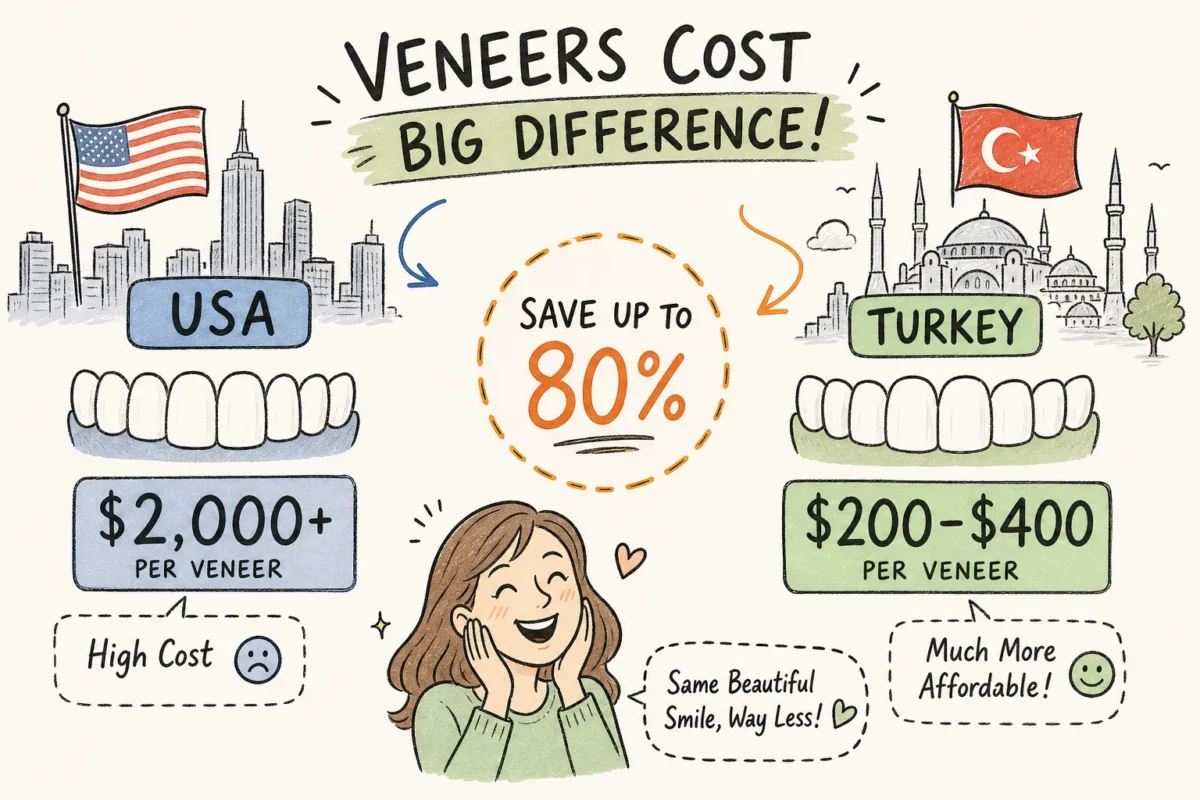
How much cheaper are veneers in Turkey compared to the US? Porcelain veneers in Turkey run roughly $220 to $500 per tooth. In the US, the same procedure costs $900 to $2,500. That gap, anywhere from 4x to 10x depending on the clinic and material, draws a steady stream of North American patients to Istanbul each year for smile makeovers.
The real question isn’t what the clinic charges. It’s what you actually keep after flights, accommodation, and the costs most people forget to add up. This article breaks down the full math by material and case size so you can make a clear-eyed call before you book anything.
How much cheaper are veneers in Turkey compared to the US, per-tooth prices by material
Porcelain and zirconia: where the gap is biggest
Porcelain veneers in Turkey average $220 to $500 per tooth in 2026. Zirconia follows a similar pattern, running $280 to $650 per tooth versus $1,200 to $2,500 in the US. The gap is roughly 4x to 10x depending on clinic tier, the specific ceramic used, and whether you’re working with a boutique practice or a high-volume operation.
Lower overhead, a favorable exchange rate for international patients, and an intensely competitive cosmetic dental market in Istanbul all push Turkish prices down without touching lab quality. Turkish labs that supply top clinics also export work internationally, including to European and North American dental practices. Top Turkish labs supply these international markets and many meet high manufacturing standards, though quality does vary by provider, which is exactly why vetting matters.
Composite veneers: real savings, but a different product
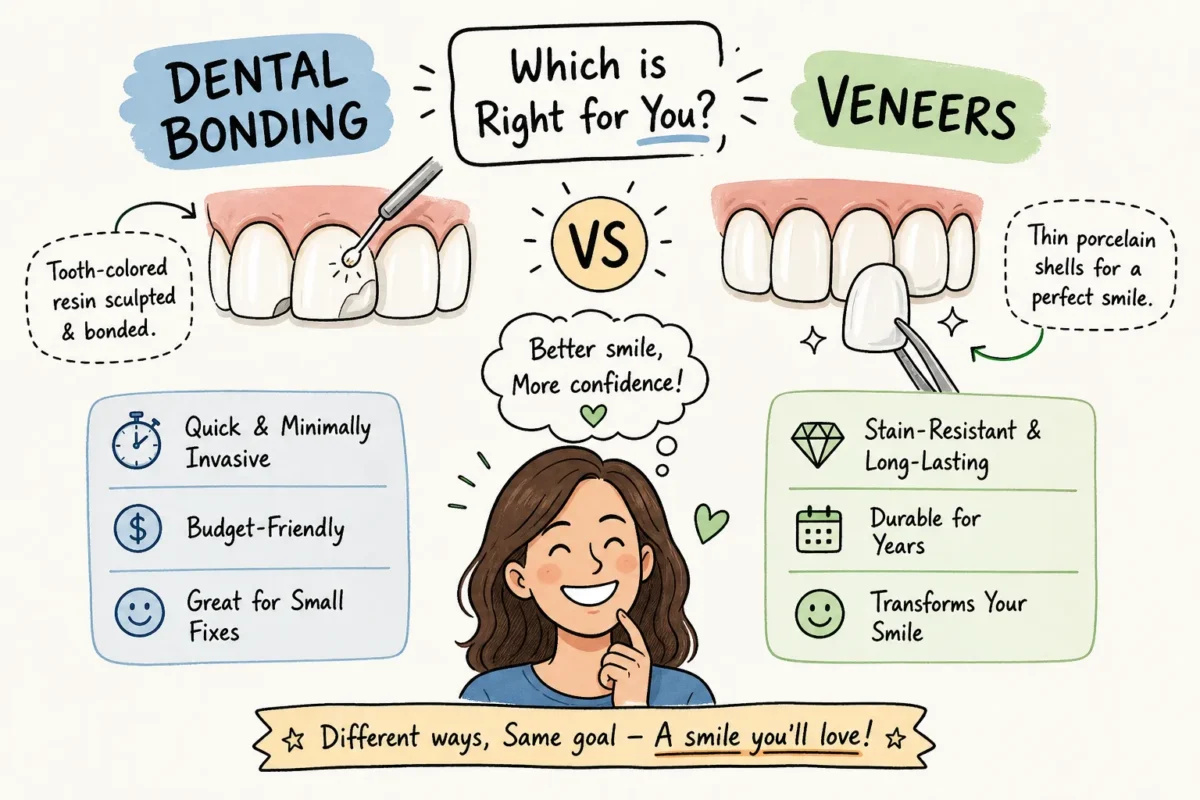
Composite veneers cost roughly $150 to $250 per tooth in Turkey versus $250 to $1,500 in the US. The savings are real, but composite and porcelain are fundamentally different materials. Composite is more affordable and reversible; porcelain resists staining better, lasts longer, and delivers a more natural translucency. The per-tooth price comparison matters less than choosing the right material for your case.
How much cheaper are veneers in Turkey compared to the US, full smile package costs
Per-tooth math adds up fast when you’re pricing out a full smile makeover. Here’s how package pricing compares across the most common case sizes:
| Treatment scope | Turkey package range | US package range |
|---|---|---|
| 8 veneers | $2,500, $3,500 | $10,000, $18,000 |
| 10 veneers | $3,000, $4,200 | $12,000, $22,000 |
| 16 veneers | $3,200, $6,800 | $14,800, $40,000 |
| 20 veneers | $4,500, $7,500 | $25,000, $45,000 |
Reputable Turkish clinics typically bundle consultation, 3D digital imaging, temporaries, lab fabrication, and airport transfers into those dental veneer package prices. Some include accommodation. US dental quotes often list these as separate line items, which makes the initial estimate look lower until you add everything back in.
Dt. Çağrı Altuntaş Dental Clinic in Nişantaşı, Istanbul, operates on this fully transparent model. Dr. Çağrı Altuntaş holds a Master’s degree in Oral Surgery and Implantology from Saint Camillus University in Italy and has focused on cosmetic dentistry for over 15 years. The clinic provides all-inclusive pricing on porcelain veneers, Health Turkey certification, and a digital workflow using intraoral scanning and 3D smile design, the practical checkboxes that separate a properly credentialed boutique clinic from a high-volume shop.
What your trip actually costs
The travel math most people underestimate
A roundtrip flight from a major US hub to Istanbul averages $900 to $1,300 in economy. Canadian patients flying from Toronto, Vancouver, or Montreal can expect similar ranges, typically $950 to $1,400 depending on routing and season, with most connections running through European hubs. Budget accommodation for a 7 to 10-day treatment trip adds another $500 to $1,000. Factor in local transport, meals, and incidentals and your total travel overhead runs roughly $1,800 to $3,000 per person. For specific route planning, see example flights from New York to Istanbul.
Even with that added, a 10-veneer case in Turkey typically saves $8,000 to $15,000 compared to the US equivalent, calculated against the package price ranges above. The net savings formula is straightforward: US clinic quote minus (Turkey clinic cost plus full travel overhead) equals what you actually keep. On most full-smile cases, that number is hard to ignore. If you’re from North America and want a focused discussion on patient experiences and expectations, see this practical overview for veneers in Turkey for American patients.
For Canadian patients, it’s worth noting that Turkey does not require a visa for Canadian citizens for stays under 90 days. Most Canadian provincial health plans do not cover cosmetic dental work at home or abroad, so coverage considerations are roughly the same whether you stay local or travel. Travel medical insurance that covers dental complications is worth adding to your budget.
Hidden costs worth building into your budget
A few items catch people off guard. Travel insurance for medical tourism adds to the upfront spend. Pre-departure diagnostics and dental record translations can add fees. If something needs adjusting after you return home, a revision visit means another flight and more accommodation. Build a 10 to 20% contingency on top of your projected Turkey treatment cost. That buffer isn’t pessimism. It’s just accurate planning that protects the savings you came for.
Quality and longevity: what the evidence actually shows
How long veneers last regardless of where you get them
Research on porcelain laminate veneers shows a cumulative survival rate of approximately 89% over a median 9-year follow-up, and around 93.5% at 10 years in long-term study sets (Layton & Walshaw, 2012, among comparable studies). These numbers reflect the procedure and material, not the country of treatment. Country of treatment is not a variable controlled in any major peer-reviewed veneer longevity study. For detailed clinical evidence, see this long-term study on porcelain laminate veneers.
Longevity depends on material quality, bonding technique, bite management, bruxism treatment where needed, and patient aftercare. A skilled cosmetic dentist using certified ceramic in Istanbul produces the same clinical durability as one in New York or Toronto. The country of treatment is not a meaningful variable.
Accreditations that signal a legitimate clinic
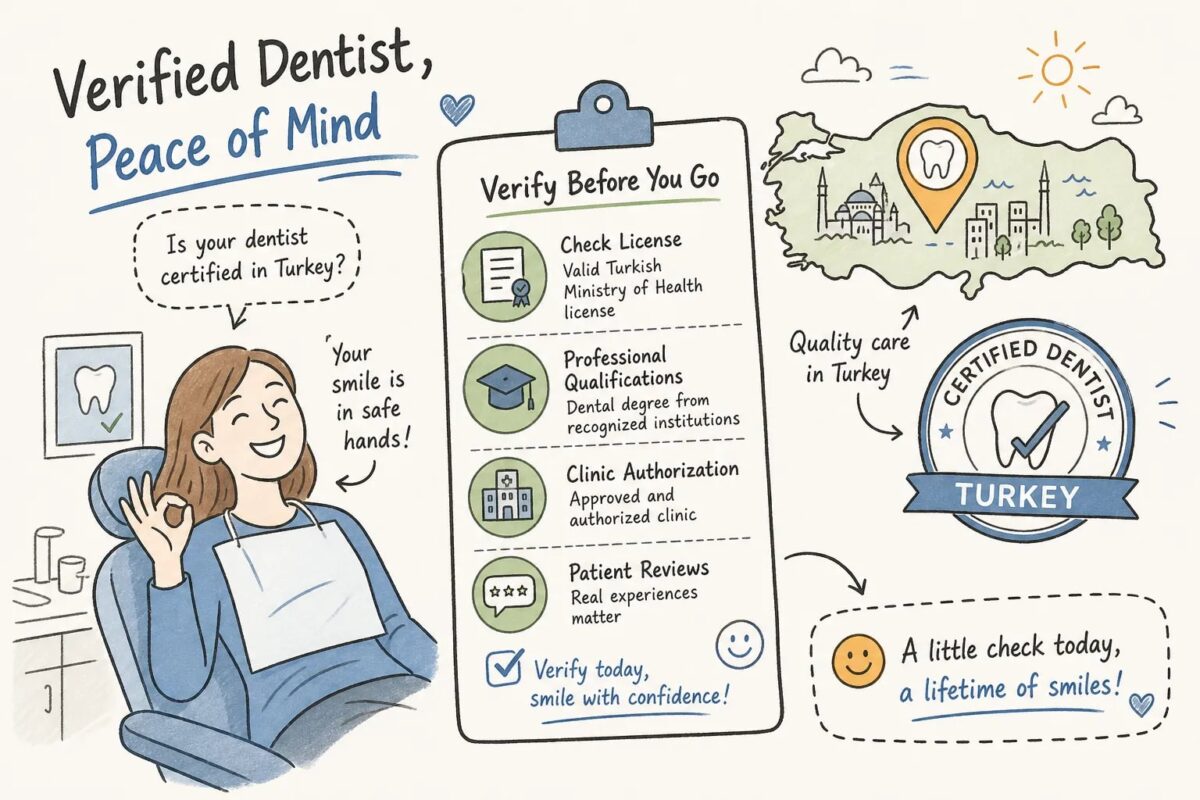
Health Turkey certification is the Turkish Ministry of Health’s legal authorization for a clinic to serve international patients. It requires verified clinical standards, approved materials, infection-control protocols, and regular audits. It’s not a marketing badge; it’s a legal requirement for facilities offering health tourism services, and it’s verifiable through official directories. JCI, ISO, and TEMOS certifications go further, applying international quality frameworks to patient safety systems. Check all of them before booking.
How to vet a Turkish clinic before you commit
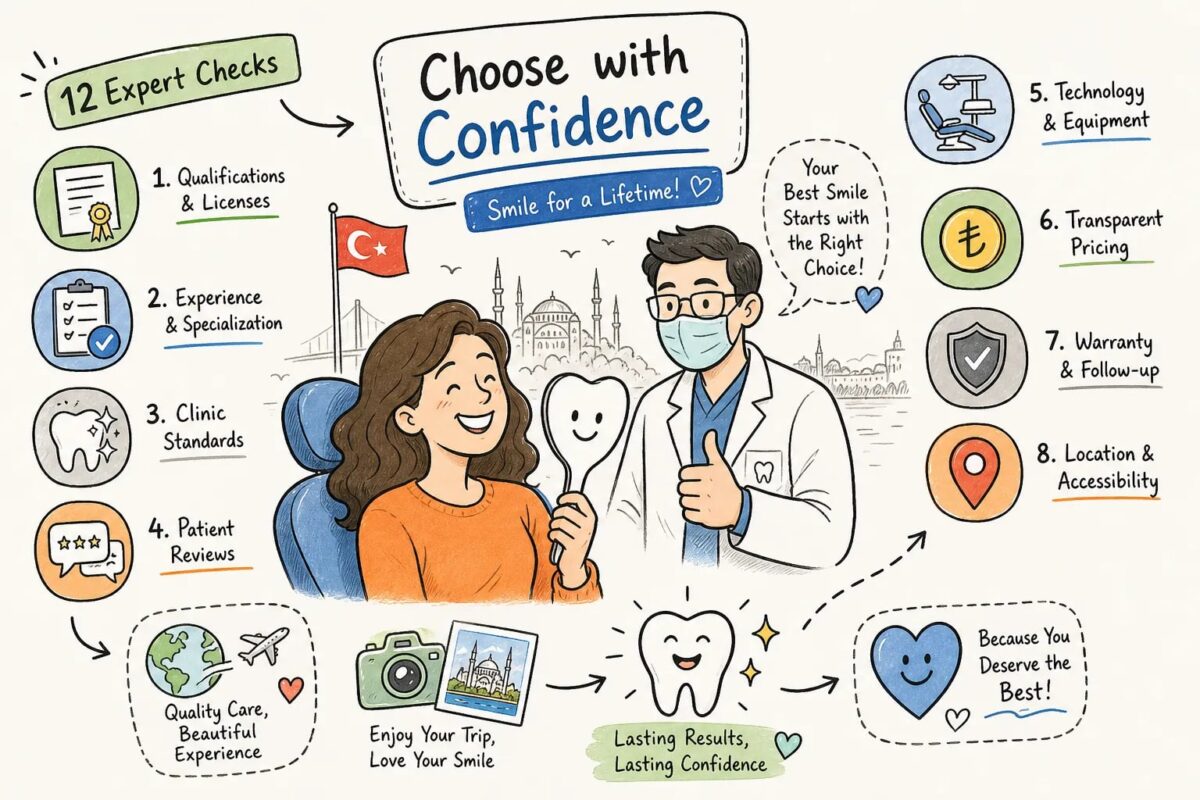
The difference between a good outcome and a bad one almost always comes down to due diligence before you fly. The failure modes for veneers placed abroad are well documented: poor fit, shade mismatch, debonding from inadequate bonding technique, and marginal gaps that allow bacterial leakage. These happen at poorly run clinics, not at properly credentialed ones. Clinic vetting is where the actual risk sits.
Green flags worth trusting:
- A written, itemized treatment plan listing specific materials and lab sources
- Verified before/after cases with patient reviews across multiple independent platforms
- Health Turkey, JCI, or ISO accreditation confirmed through official directories
- English-speaking staff with a clear communication protocol for international patients
- A digital workflow using CAD/CAM technology and intraoral scanning
Red flags that should stop you from booking:
- No clear accreditation or licensing information on the clinic website
- Prices significantly below the Turkish market average, which usually signals cheaper lab materials or rushed work
- Reluctance to provide a transparent, itemized quote before you commit
- No clear aftercare or follow-up pathway for patients returning home
- Urgency-based discounts or any pressure to book immediately
Who gets the best value and who should stay local
The patient profile that comes out ahead
If you need 8 to 20 veneers, have a flexible travel schedule, and don’t have complex underlying conditions requiring extended close follow-up, dental tourism in Istanbul works well in your favor. The savings on a full smile makeover comfortably outrun the trip costs, and Istanbul’s treatment timelines, typically 5 to 7 days from consultation to final placement, fit within a vacation-length stay. Istanbul is consistently ranked among Europe’s top travel destinations, so combining treatment with a city stay is a practical option many patients choose.
When staying local makes the smarter call
A patient needing only one or two veneers likely won’t generate enough savings to justify the trip. Anyone with active gum disease, significant bite issues, or conditions requiring months of close monitoring is better served at a local practice. Dental tourism isn’t the right answer for every case, acknowledging that keeps the math honest for the situations where it genuinely works.
The bottom line
So how much cheaper are veneers in Turkey compared to the US? On cases of 8 teeth or more, most patients save 60 to 80% on treatment costs in 2026, commonly more on full-mouth packages, even after a full trip is factored in. The quality gap, when you choose a properly credentialed clinic with an internationally trained dentist, is largely a myth unsupported by clinical data. Peer-reviewed survival rates for porcelain veneers say the same regardless of where the procedure takes place.
The decision rests on case complexity, travel flexibility, and how hard you’ve worked to vet the clinic. If all three check out, the math is straightforward. Patients can request a complimentary smile analysis and itemized treatment quote directly through Porcelain Veneers in Turkey: The Real Cost in 2026 at Dr. Çağrı Altuntaş’s boutique clinic in Nişantaşı. The clinic is backed by European surgical training, Health Turkey certification, and a digital workflow built for international cosmetic dental patients.